Africa Bee Farming: AI-Powered Apiculture For Africa's Future. research poster
All Research

The Hidden AI Operating System Audit Series™

Where AI creates new profit pools—not just productivity.

40AI Opportunity Audit™ 18 min readAugust 2026
Coverage · Africa · Continental · Institutional CoverageSector · Apiculture · Agri-Food & Natural ProductsFormat · Six-page audit

Africa Bee FarmingSmall Bee, Big Impact — Yields, Traceability And Premium Market Access.

An AI Opportunity Audit™ across Africa's apiculture value chain — hive monitoring, honey flow prediction, disease control, quality assurance, market linkage, training and finance — identifying £120M – £200M+ of annual AI-driven value by 2030 across 11M+ beekeepers and 1.1M MT of honey production potential.

Beekeepers In Africa

11M+

Honey Production Potential

1.1M MT

Market Opportunity By 2030

$2B+

Smallholder-Led Share

80%+

Export Revenue Potential

£600M+

Market CAGR (2024–2030)

7–9%

Annual AI Value By 2030

£120M – £200M+

Priority Markets

EU · ME · Asia · USA

The Thesis

Africa's bee farming sector is one of the most naturally advantaged yet underdeveloped agri-business opportunities on the continent. The biological endowment is world-class: indigenous bee populations, year-round forage, and honey chemistry that commands premium prices in Europe and the Gulf. What is missing is not bees — it is data. Hives are inspected on foot, colony losses are discovered after they happen, harvest timing is guessed, and quality is asserted rather than proven. Buyers pay for proof. Our analysis identifies £120M – £200M+ in annual AI-driven value by 2030 through seven multipliers, without adding a single hectare of forage.

Exhibit · Report Cover

40 · AI Opportunity Audit™

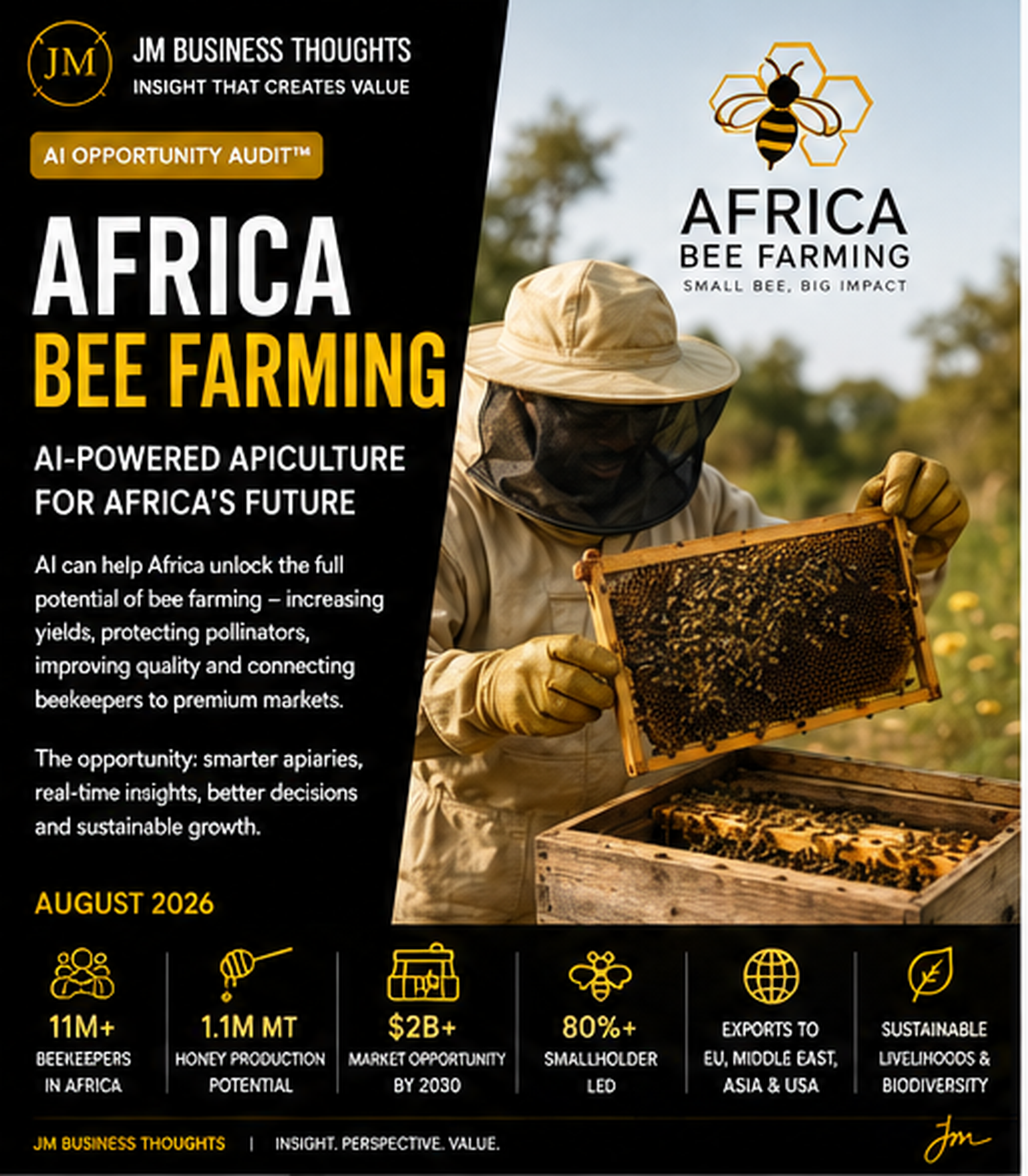
Africa Bee Farming: AI-Powered Apiculture For Africa's Future. report cover
Africa Bee Farming: AI-Powered Apiculture For Africa's Future.August 2026 · Africa · Continental · Institutional Coverage
01

Executive summary: a premium product sold as a commodity

Africa hosts 11M+ beekeepers and a realistic honey production potential of 1.1M MT, yet captures a fraction of the $2B+ market opportunity that will exist by 2030. The gap is not productivity in the field; it is verification, timing and market access.

By embedding AI across hive monitoring, yield prediction, disease detection, quality assurance, market linkage and traceability, Africa can unlock £120M – £200M+ in annual value by 2030. Roughly £600M+ of export revenue potential sits behind compliance evidence that AI can generate as a by-product of normal operations.

This report identifies seven AI value multipliers and estimates the financial and strategic impact across a smallholder-led base where 80%+ of output originates from farms too small to fund their own instrumentation — which is precisely why shared, platform-level intelligence is the correct unit of investment.

£120M – £200M+ per year by 2030 — on a 1.1M MT production base and $2B+ of addressable market.
  • AI-powered hive monitoring: £20M – £40M / year
  • Yield & honey flow prediction: £15M – £30M / year
  • Disease & pest detection: £15M – £25M / year
  • Quality & traceability: £20M – £35M / year
  • Market access & pricing intelligence: £20M – £35M / year
  • Training & knowledge access: £10M – £15M / year
  • Finance & insurance enablement: £20M – £20M / year
02

Market overview: biodiversity, food security and export demand

Bee farming plays a critical role in food security, biodiversity and rural incomes across Africa. Pollination services underwrite a far larger crop economy than the honey trade itself, which means the sector's true economic weight is systematically understated in national accounts.

Rising global demand for natural honey, beeswax, propolis and pollination services is opening high-value niches at 7–9% CAGR through 2030. Adulteration scandals in global honey supply chains have shifted buyer behaviour from price-first to provenance-first — an opening for any origin able to prove authenticity at scale.

AI adoption will drive productivity, quality and market access simultaneously, positioning Africa as a global leader in ethical, sustainable apiculture rather than a bulk supplier of undifferentiated drums.

  • 1.1M MT honey production potential against fragmented current output
  • $2B+ market opportunity by 2030; £600M+ export revenue potential
  • Export corridors: EU, Middle East, Asia and USA
  • Premium categories: single-origin honey, beeswax, propolis, royal jelly
03

Competitive landscape: who sets the price

The buy side is concentrated. Breitsamer, Comvita, Döhler, Beekeeper's Naturals and technical bodies such as Bee Informed set the specification standards and, by extension, the price. African producers currently meet those standards episodically and prove them manually.

Concentration is not a threat here — it is a targeting advantage. A small number of buyers means a small number of data interfaces. Machine-readable quality evidence delivered in the buyer's own format converts a five-month qualification cycle into a five-week one.

The competitor is not another origin. It is adulterated honey with a cheaper story and no proof.
04

AI maturity snapshot: early adoption, high upside

Data and analytics: data exists but integration is absent — hive records, cooperative ledgers and buyer specs live in incompatible systems.

AI capabilities: real pilots exist in hive monitoring and disease detection, but they are project-shaped rather than platform-shaped.

Technology platforms: fragmented tools with weak connectivity across rural sites. Customer experience for beekeepers themselves is limited — they are treated as suppliers, not users.

Operations remain manual and skills gaps persist. Overall: early adoption, high upside — the classic profile where the first mover to build shared infrastructure captures disproportionate value.

05

Financial impact model: five-year transformation

Scenario: full AI transformation over five years. Honey production rises from 600,000 MT to 1,100,000 MT. Average yield per hive rises from 8kg to 13.5kg. Farm gate price improves from $2.1/kg to $2.8/kg as verified provenance moves product out of the commodity band.

Revenue expands from $1.26B to $3.08B across the modelled base. AI investment runs at $10M – $15M per year from Year 1, against AI-driven value created of $35M in Year 1 rising to $200M+ by Year 5.

Cumulative five-year value creation: cost savings of £40M – £60M (15–25%), revenue uplift of £50M – £80M (10–20%), margin uplift of £20M – £40M (2–4%), and an annual run-rate of £120M – £200M+ by 2030.

Payback is not the question. The question is who owns the data layer when the buyers standardise on it.
  • Yield per hive: 8kg → 13.5kg
  • Farm gate price: $2.1/kg → $2.8/kg
  • Revenue: $1.26B → $3.08B
  • AI-driven value created: $35M (Y1) → $200M+ (Y5)
06

Transformation roadmap: five phases

Phase 1 (0–6 months) — Foundation: map the beekeeping ecosystem, audit data and baseline KPIs, run pilot hive monitoring and identify three priority use cases.

Phase 2 (6–12 months) — Pilots & capability: deploy IoT hive monitoring pilots, launch disease detection pilots, train beekeepers and field officers, and develop the AI analytics platform.

Phase 3 (12–24 months) — Scale & integrate: scale successful pilots, integrate weather, market and supply-chain data, launch quality and traceability tooling, and improve market linkages.

Phase 4 (24–36 months) — Optimise & expand: optimise operations and productivity, expand to new regions, introduce insurance and credit scoring, and strengthen export market access.

Phase 5 (36+ months) — Lead & innovate: an AI-powered ecosystem with predictive insights at scale, Africa positioned as global honey leader, and a sustainable, climate-smart growth model.
07

Enablers and risks

Key enablers: digital infrastructure, data sharing and collaboration, quality data and standards, IoT and AI platforms, skills and capacity building, finance and insurance, and coherent policy.

Success factors: strong leadership and coordination, beekeeper-centric design, sustainability and biodiversity outcomes treated as measurable assets rather than reporting overhead.

The dominant risk is fragmentation — fifty parallel pilots that never become one dataset. The second is extraction: if the intelligence layer is owned offshore, the margin follows it offshore. Both are governance choices, not technology constraints.

The Multiplier Framework

7 compounding levers

Seven multipliers convert biological advantage into verified, financeable, premium-priced output.

01

AI-Powered Hive Monitoring

Real-time hive health, temperature, humidity and weight — continuously, not on inspection day.

  • IoT sensors and computer vision across representative hive clusters
  • Anomaly detection on weight, acoustics and brood temperature
  • Automated alerts routed to field officers before colony collapse

Outcome · £20M – £40M / year — hive health, productivity and mortality reduction.

02

Yield & Honey Flow Prediction

Predict honey flow and optimise harvesting and planning against forage and weather.

  • Weather, bloom tracking and ML models on historic flow curves
  • Harvest-window optimisation per apiary rather than per region
  • Capacity and logistics planning aligned to predicted volumes

Outcome · £15M – £30M / year — better harvest planning and higher output.

03

Disease & Pest Detection

Early detection reduces losses and treatment costs across the colony base.

  • Image recognition and AI diagnostics on frame photography
  • Risk alerts by region, season and colony history
  • Targeted intervention protocols replacing blanket treatment

Outcome · £15M – £25M / year — reduced losses, healthier colonies.

04

Quality & Traceability

Ensure purity and trace origin — and unlock the premium markets that demand both.

  • Blockchain-anchored batch records from hive to drum
  • AI quality scoring against buyer specification thresholds
  • Export compliance packs generated automatically

Outcome · £20M – £35M / year — premium pricing, export readiness, compliance.

05

Market Access & Pricing Intelligence

Real-time market prices, demand forecasts and buyer matching for cooperatives.

  • Market analytics and demand prediction across export corridors
  • Buyer-matching engine on verified quality profiles
  • Contract timing guidance instead of spot-market exposure

Outcome · £20M – £35M / year — better prices, stronger market access.

06

Training & Knowledge Access

Upskill beekeepers and distribute best practice at population scale.

  • AI tutors and mobile learning in local languages
  • Field-officer copilots for diagnosis and advice
  • Practice benchmarking across cooperatives

Outcome · £10M – £15M / year — upskilling and best-practice adoption.

07

Finance & Insurance Enablement

Turn hive data into credit history — the missing collateral for smallholder apiculture.

  • Risk scoring on verified yield and colony data
  • Insurtech models priced on observed rather than assumed risk
  • Digital records as the basis for working-capital facilities

Outcome · £20M / year — credit access, risk cover, financial inclusion.

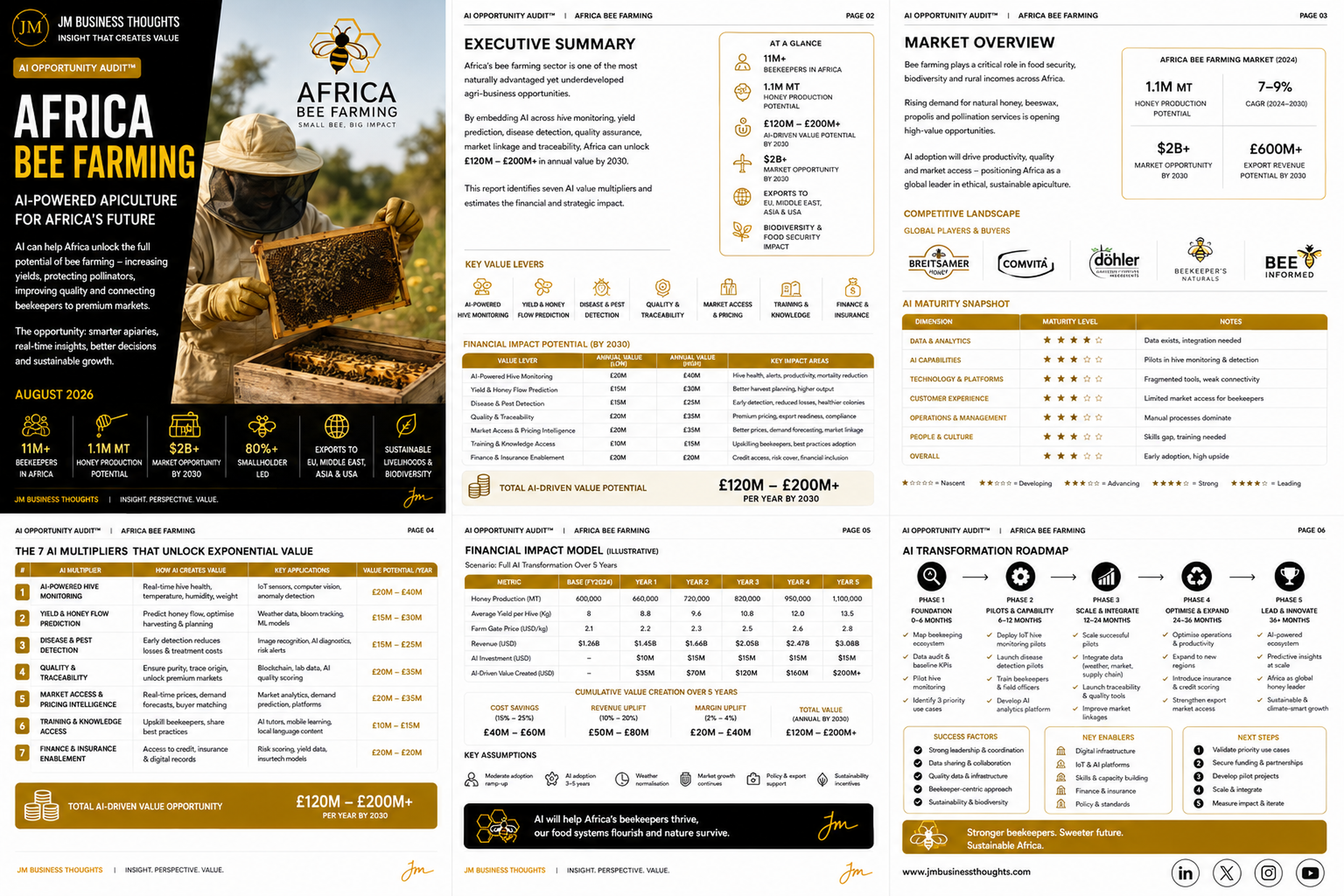
Africa Bee Farming: AI-Powered Apiculture For Africa's Future. full strategic breakdown
Africa Bee Farming — AI Opportunity Audit™, six-panel institutional sheet: executive summary, market overview, seven multipliers, financial impact model and transformation roadmap.

The Verdict

Africa does not have a honey production problem. It has a proof problem. The origin that can evidence purity, provenance and consistency at batch level will set the continental price — and the intelligence layer that produces that evidence is buildable today for a fraction of the value it unlocks. Stronger beekeepers. Sweeter future. Sustainable Africa.

JM founder signature
68 · PureGym — Fitness At Scale. More Personal. More Inclusive.67 · SIXT — Smarter Mobility. Greater Availability. A More Connected Tomorrow.66 · Sendwave — Money That Moves With Intelligence.65 · McDonald’s — Serving The Future With AI.64 · Compare the Market — Smarter Comparison. Better Matches. Brighter Tomorrows.63 · WeBuyAnyCar — Smarter Pricing. Faster Offers. Better Conversion.62 · Primark — Affordable Fashion. Greater Possibilities With AI.61 · Starbucks — Smarter Stores. Stronger Loyalty. Better Margins.60 · IKEA — AI-Powered Home Retail at Global Scale59 · H&M — Smarter Fashion. Brighter Tomorrow.58 · WeWork — The Value Wasn't Lost. It Was Mispriced.57 · Yahoo — The Value Wasn't Lost. It Was Mispriced.56 · Nando's UK — Smarter Restaurants. Stronger Loyalty. Better Margins.55 · The Amplifier54 · The Body Shop53 · Arcadia Group52 · Cazoo51 · Blockbuster50 · Carpetright49 · Wilko48 · Mothercare47 · Phones 4u46 · Farfetch45 · Jumia44 · Toys ‘R’ Us43 · The Collateral Gap — Part One41 · The Amplifier38 · Africa Greenhouse Farming37 · Uganda Tourism Board36 · Boots UK35 · Biffa (UK)34 · NatWest33 · Skip Hire Companies UK33 · The Audit32 · The Lean Company31 · Africa Mushroom Farming29 · The Rider Economy Nobody Verified28 · The Layer Underneath the Layer27 · Independent Timber Yards & Jewson Timber26 · Link Up TV & GRM Daily25 · East African Portland Cement42 · International Student Credential & Financial Verification — Part One24 · The Supply Chain Inside the Supply Chain23 · The White Space, Mapped22 · The Real Opportunity21 · Greencore20 · West Ham United19 · Roofings Group Uganda18 · Mombasa Port17 · Auto Trader UK16 · Uganda Coffee Development Authority15 · Brookside Dairy14 · GraceKennedy13 · Rightmove12 · Manchester United11 · Greggs30 · Twiga Foods10 · Uchumi09 · Konga08 · Edcon09 · GAME07 · Debenhams06 · Claire's05 · Boohoo04 · Argos