01
Predictive Maintenance
KSh 1.4B – 1.8B
- Predict equipment failures before they occur using sensor and historical data
- Less downtime and lower maintenance cost
- Longer asset life
Outcome · 25–35% reduction in unplanned downtime — fast impact
The Hidden AI Operating System Audit Series™
Where AI creates new profit pools—not just productivity.
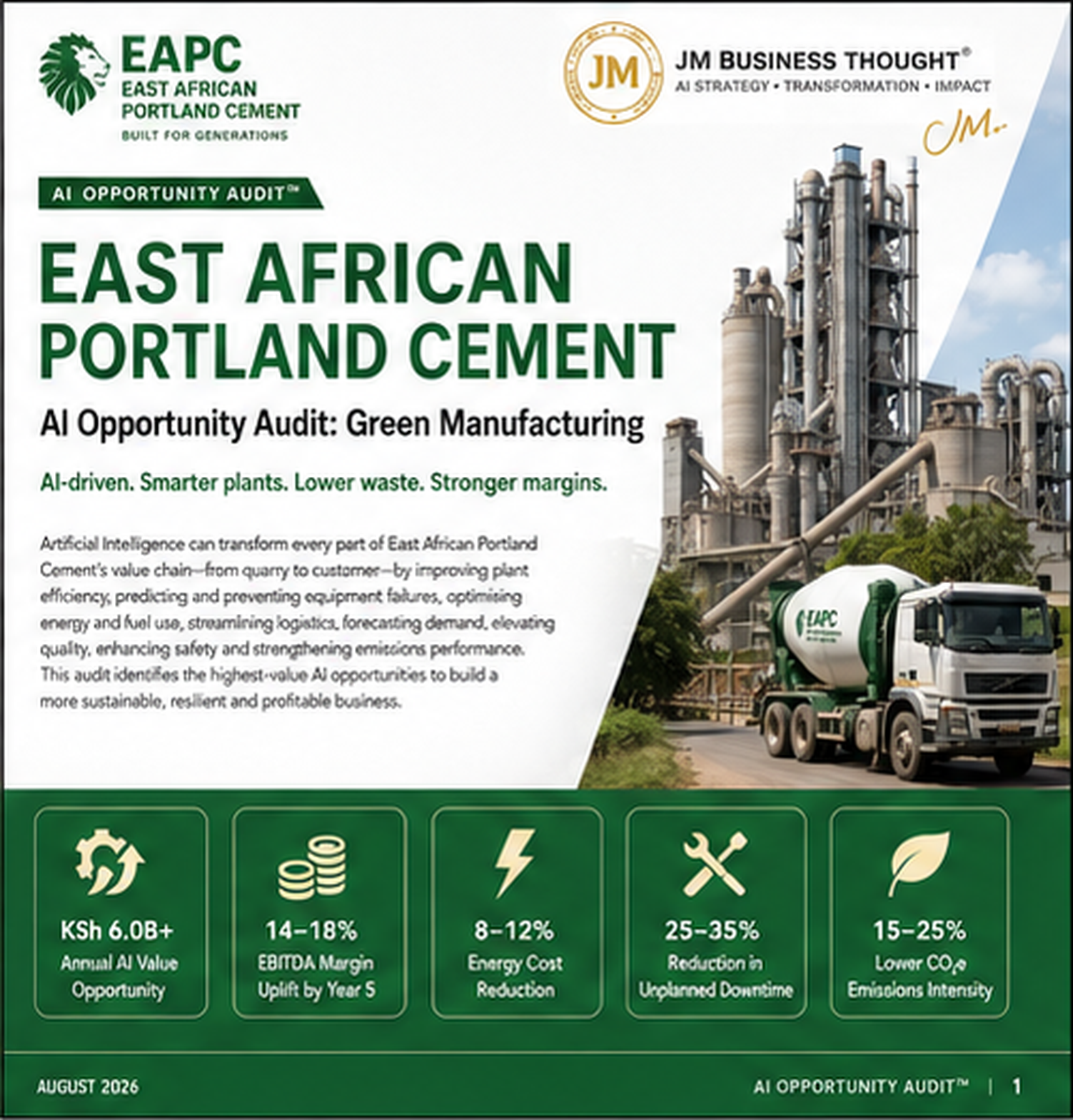
An AI Opportunity Audit™ across EAPC's full value chain — from quarry to customer — identifying a KSh 6.0B+ annual value pool through plant efficiency, predictive maintenance, energy optimisation, demand forecasting, quality and emissions performance.
Annual AI Value Opportunity
KSh 6.0B+
EBITDA Margin Uplift By Year 5
14–18%
Energy Cost Reduction
8–12%
Unplanned Downtime Reduction
25–35%
Lower CO₂e Emissions Intensity
15–25%
Installed Capacity
~4.2 Mtpa
Kenya Market Share (Est.)
~20%
Cumulative 5-Year AI Value
KSh 14.7B
The Thesis
Artificial intelligence can transform every part of East African Portland Cement's value chain — from quarry to customer — by improving plant efficiency, predicting and preventing equipment failures, optimising energy and fuel use, streamlining logistics, forecasting demand, elevating quality, enhancing safety and strengthening emissions performance. The audit identifies a multi-billion shilling value pool and the highest-value AI opportunities to build a more sustainable, resilient and profitable business.
Exhibit · Report Cover
25 · AI Opportunity Audit™
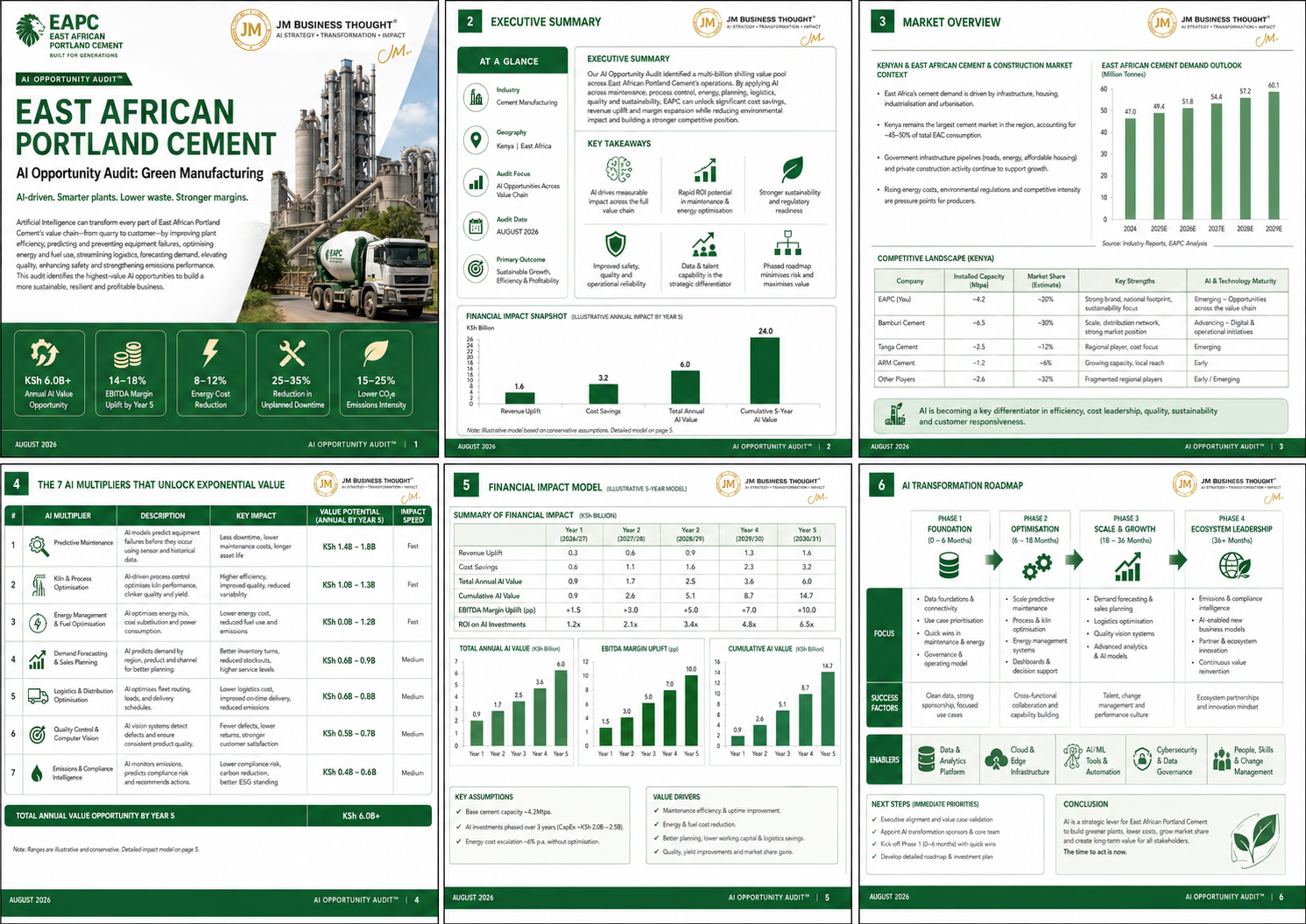
The audit identified a multi-billion shilling value pool across EAPC's operations. Applying AI across maintenance, process control, energy, planning, logistics, quality and sustainability can unlock significant cost savings, revenue uplift and margin expansion while reducing environmental impact.
The primary outcome sought is sustainable growth, efficiency and profitability — not cost-cutting alone. AI drives measurable impact across the full value chain, with rapid ROI concentrated in maintenance and energy optimisation.
Sustainability and regulatory readiness are treated as commercial assets: lower emissions intensity strengthens competitive position with infrastructure buyers and lenders, not just with regulators.
Illustrative annual AI value by Year 5 is KSh 6.0B, made up of KSh 1.6B revenue uplift and KSh 3.2B cost savings, compounding to KSh 14.7B cumulative five-year value.
AI-driven. Smarter plants. Lower waste. Stronger margins.
East Africa's cement demand is driven by infrastructure, housing, industrialisation and urbanisation. Kenya remains the largest cement market in the region, accounting for roughly 45–50% of total EAC consumption.
Regional demand is forecast to grow from 47.0 million tonnes in 2024 to 60.1 million tonnes by 2029 — a steady climb through 49.4Mt (2025E), 51.8Mt (2026E), 54.4Mt (2027E) and 57.2Mt (2028E).
Government infrastructure pipelines — roads, energy, affordable housing — and private construction activity continue to support growth. Rising energy costs, environmental regulation and competitive intensity are the pressure points for producers.
EAPC operates roughly 4.2 Mtpa of installed capacity with an estimated ~20% Kenyan market share, a strong national footprint and a sustainability focus. Its AI maturity is emerging — opportunities exist across the value chain.
Bamburi Cement leads on scale at ~6.5 Mtpa and ~30% share, with a strong distribution network and advancing digital and operational initiatives. Tanga Cement (~2.5 Mtpa, ~12%) is a regional player with local focus and emerging AI maturity.
ARM Cement (~1.2 Mtpa, ~6%) is growing capacity with local reach at an early stage of adoption, while other fragmented regional players account for ~2.6 Mtpa and ~32% collectively at early or emerging maturity.
AI is becoming the key differentiator in efficiency, cost leadership, quality, sustainability and customer responsiveness — in a commodity market, that is the whole of the competitive advantage.
In a commodity market, the operating system is the differentiation.
Cement economics are dominated by energy, thermal efficiency and asset uptime. A single unplanned kiln stoppage destroys days of margin; a percentage point of thermal substitution recurs every day of the year.
Process control is the largest single lever: kiln and mill optimisation improves clinker quality and variability simultaneously, which reduces both cost and customer complaints.
Demand and logistics volatility is absorbed today by holding inventory and paying for expedited transport. Forecasting converts that buffer into working capital.
Emissions are a cost line, a licence-to-operate condition and increasingly a commercial requirement in tendered infrastructure work — three reasons to instrument them properly.
The illustrative five-year model builds from KSh 0.9B of total annual AI value in Year 1 to KSh 6.0B by Year 5, with revenue uplift growing from KSh 0.3B to KSh 1.6B and cost savings from KSh 0.6B to KSh 3.2B.
Cumulative AI value reaches KSh 14.7B by Year 5 (0.9 → 2.6 → 5.1 → 8.7 → 14.7), with EBITDA margin uplift building from +1.5pp to +10.0pp.
ROI on AI investment moves from 1.2x in Year 1 to 6.5x by Year 5 (1.2x, 2.1x, 3.4x, 4.8x, 6.5x).
Key assumptions: a base cement capacity of ~4.2 Mtpa, AI investment phased over three years at roughly KSh 2.0B – 2.5B capex, and energy cost escalation of around 6% per annum without optimisation.
KSh 6.0B+ of annual AI value by Year 5. KSh 14.7B cumulative. 6.5x ROI.
Phase 1 (0–6 months) — Foundation: data foundations and connectivity, use case prioritisation, quick wins in maintenance and energy, and the governance and operating model.
Phase 2 (6–18 months) — Optimisation: scale predictive maintenance, process and kiln optimisation, energy management systems, and dashboards and decision support.
Phase 3 (18–36 months) — Scale and growth: demand forecasting and sales planning, logistics optimisation, quality vision systems, and advanced analytics and AI models.
Phase 4 (36+ months) — Ecosystem leadership: emissions and compliance intelligence, AI-enabled new business models, partner and ecosystem innovation, and continuous value reinvention.
EAPC is a nationally strategic manufacturer in a market where infrastructure delivery depends on domestic cement capacity being efficient, reliable and low-carbon.
AI is a strategic lever for EAPC to build greener plants, lower costs, grow market share and create long-term value for all stakeholders. The time to act is now — the value pool compounds for whoever instruments their operations first.
Sustainable growth, efficiency and profitability — delivered by the same programme, not traded against each other.
The Multiplier Framework
The seven AI multipliers that unlock exponential value across EAPC — together worth KSh 6.0B+ of annual value by Year 5.
KSh 1.4B – 1.8B
Outcome · 25–35% reduction in unplanned downtime — fast impact
KSh 1.0B – 1.3B
Outcome · Better yield and lower cost per tonne — fast impact
KSh 0.8B – 1.2B
Outcome · 8–12% energy cost reduction — fast impact
KSh 0.6B – 0.9B
Outcome · Working capital released and revenue protected — medium impact speed
KSh 0.6B – 0.8B
Outcome · Lower cost to serve with better reliability — medium impact speed
KSh 0.5B – 0.7B
Outcome · Consistency becomes a commercial differentiator — medium impact speed
KSh 0.4B – 0.6B
Outcome · 15–25% lower CO₂e intensity — medium impact speed
The Verdict
AI is a strategic lever for East African Portland Cement to build greener plants, lower costs, grow market share and create long-term value for all stakeholders — KSh 6.0B+ annually by Year 5, KSh 14.7B cumulative, at 6.5x ROI. The time to act is now.