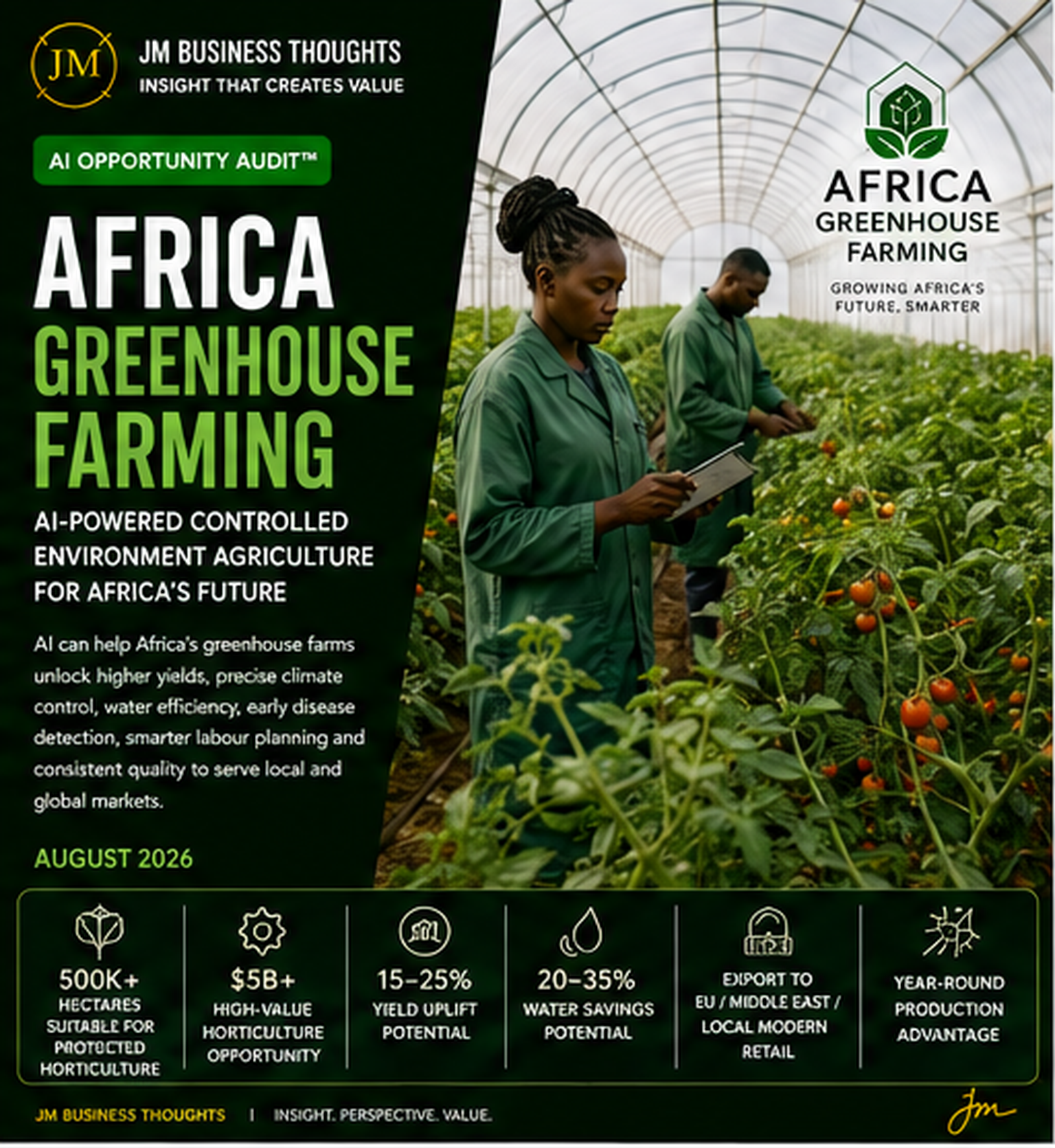
Africa Greenhouse Farming: AI-Powered Controlled Environment Agriculture. research poster
All Research

The Hidden AI Operating System Audit Series™

Where AI creates new profit pools—not just productivity.

38AI Opportunity Audit™ 19 min readAugust 2026
Coverage · Africa · Continental · Institutional CoverageSector · Controlled Environment Agriculture · HorticultureFormat · Six-page audit

Africa Greenhouse FarmingGrowing Africa's Future, Smarter — Yield, Water, Quality And Export Access.

An AI Opportunity Audit™ across Africa's protected horticulture estate — climate control, irrigation, yield forecasting, disease detection, labour planning, quality grading and market linkage — identifying $180M – $320M+ of annual AI-driven value by 2030 across 500K+ hectares suitable for protected cultivation.

Hectares Suitable

500K+

High-Value Horticulture Opportunity

$5B+

Yield Uplift Potential

15–25%

Water Savings Potential

20–35%

Market Size (2024 Est.)

$2B+

Export Potential By 2030

$3B+

Market CAGR (2024–2030)

12–18%

Annual AI Value By 2030

$180M – $320M+

The Thesis

Africa's greenhouse farming sector is fragmented but high-upside. Protected cultivation already solves the continent's hardest agronomic constraints — rainfall volatility, pest pressure and quality inconsistency — yet the structures themselves are run on manual judgement: vents opened by feel, water applied on schedule, disease found when it is visible, labour deployed on habit. A greenhouse is a closed system with measurable inputs and outputs; it is the single most instrumentable asset in African agriculture and the least instrumented. Our analysis identifies $180M – $320M+ of annual AI-driven value by 2030 across seven multipliers.

Exhibit · Report Cover

38 · AI Opportunity Audit™

Africa Greenhouse Farming: AI-Powered Controlled Environment Agriculture. report cover
Africa Greenhouse Farming: AI-Powered Controlled Environment Agriculture.August 2026 · Africa · Continental · Institutional Coverage
01

Executive summary: the most controllable asset in African agriculture

Africa's greenhouse farming sector is fragmented but high-upside. With rising demand for year-round, high-quality produce, AI can create margin through precision growing, input efficiency and better market consistency.

By embedding AI across climate control, irrigation, crop health, labour planning and market linkage, Africa can unlock $180M – $320M+ in annual value by 2030 against a 500K+ hectare suitable land base and a $5B+ high-value horticulture opportunity.

This report identifies seven AI value multipliers and estimates the financial and strategic impact. The headline outcomes are 15–25% yield uplift, 20–35% water savings, and export readiness for EU, Middle East and local modern retail — all from the same instrumentation layer.

$180M – $320M+ per year by 2030 — on 500K+ hectares and a $5B+ horticulture opportunity.
  • Climate & environment control: £20M – £45M / year
  • Irrigation optimisation: £15M – £35M / year
  • Yield forecasting & crop planning: £20M – £40M / year
  • Disease & pest detection: £20M – £40M / year
  • Labour planning & automation: £15M – £30M / year
  • Quality grading & traceability: £20M – £40M / year
  • Market linkage & pricing intelligence: £20M – £50M / year
02

Market overview: demand is structural, not cyclical

Global demand for safe, traceable, high-quality produce is rising sharply. Africa's greenhouse farming market sits above $2B and is poised for 12–18% CAGR growth through 2030, driven by urbanisation, climate volatility and export opportunity.

Export potential by 2030 exceeds $3B, with an 80%+ adoption opportunity — the vast majority of protected structures on the continent are currently un-instrumented, which means the addressable base for AI is effectively the whole sector.

AI adoption will be the key differentiator for efficiency, quality, sustainability and profitability. Water is the binding constraint in most African growing regions; a 20–35% reduction in water per kilogram is not an efficiency metric, it is a licence to expand.

03

Competitive landscape: five distinct operator classes

Commercial greenhouse operators hold the capital and the compliance capability. Export horticulture farms hold the buyer relationships. Input and irrigation technology providers hold the hardware channel. Agri-platforms and market-linkage players hold demand data. Informal and open-field growers transitioning upward hold the volume.

No single class can build the intelligence layer alone, and each has partial data the others need. The value accrues to whoever assembles the shared model — typically a platform operator or a development-finance-backed consortium rather than an individual farm.

The winner is not the biggest grower. It is whoever owns the agronomic model across growers.
04

AI maturity snapshot

Data and analytics: data exists but is siloed across farms with no comparability of agronomic outcomes.

AI capabilities: early use cases and pilots in progress, concentrated in the largest export operators.

Technology platforms: fragmented platforms with low integration. Operations remain manual and reactive in decision-making.

People and culture: skills gaps and change-management needs dominate. Overall maturity: early stage, high potential — the profile with the steepest available return on shared infrastructure.

05

Financial impact model: five-year transformation

Scenario: full AI transformation over five years. Indexed revenue rises from 100 to 255 (20–21% annual growth). EBITDA rises from 15 to 60, expanding margin from 15.0% to 23.5%.

Water use efficiency improves from 10.0 to 4.6 litres per kilogram — a 54% reduction. Yield per square metre rises from 30kg to 55kg. Free cash flow moves from 5 to 42.

Cumulative five-year value creation: cost savings of £75M, revenue uplift of £150M, margin uplift of £38M and total value of £188M — converging on a $180M – $320M+ annual run-rate by 2030.

  • EBITDA margin: 15.0% → 23.5%
  • Water use: 10.0 L/kg → 4.6 L/kg
  • Yield: 30 kg/m² → 55 kg/m²
  • Free cash flow: 5 → 42 (indexed)
06

Transformation roadmap: five phases

Phase 1 (0–6 months) — Foundation: assess readiness, map data sources, define priority use cases and build the data foundation.

Phase 2 (6–12 months) — Pilot and capability: pilot key use cases, build AI capabilities, train teams and measure early impact.

Phase 3 (12–24 months) — Scale and integrate: scale successful pilots, integrate systems, automate workflows and improve data quality.

Phase 4 (24–36 months) — Optimise and expand: optimise operations, expand to new crops, deploy advanced analytics and reduce waste.

Phase 5 (36+ months) — Lead and innovate: innovate new models, adopt an AI-first culture, build ecosystem leadership and export best practices.

07

Assumptions, enablers and risks

Key assumptions: a three-to-five-year adoption period, improving climate stability within protected structures, input-cost optimisation, expanding market access, declining technology cost and policy support for food security.

Key enablers: modern greenhouse infrastructure, IoT sensors and automation, cloud and AI platforms, skilled talent and training, access to finance, and supportive policy and incentives.

Success factors: strong leadership and vision, cross-functional collaboration, quality data infrastructure, a farmer-centric approach and a continuous learning culture. The dominant failure mode is hardware purchased without the agronomic model to interpret it — sensors without decisions.

The Multiplier Framework

7 compounding levers

Seven multipliers turn a controlled environment into a predictable, exportable, financeable production system.

01

Climate Control Intelligence

Maintain optimal growing conditions continuously — reducing plant stress and loss.

  • Temperature, humidity and CO₂ modelling per structure
  • Light and ventilation control on predicted rather than current state
  • Dynamic setpoints tuned to crop stage

Outcome · £20M – £45M / year — stable climate, fewer losses, higher quality.
02

Precision Irrigation Optimisation

Reduce water use and improve nutrient efficiency against the continent's hardest constraint.

  • Soil-moisture sensing and evapotranspiration-based scheduling
  • Fertigation dosing tied to crop-stage demand
  • Leak and distribution-loss detection

Outcome · £15M – £35M / year — water savings and input efficiency.

03

Yield Forecasting & Crop Planning

Improve planning, mix and profitability across the growing calendar.

  • AI yield models per crop, structure and season
  • Scenario planning against buyer contracts
  • Planting-window optimisation to hit price peaks

Outcome · £20M – £40M / year — better planning, higher yields.

04

Disease & Pest Detection

Early detection reduces crop losses and treatment cost across the estate.

  • Computer vision on canopy imagery and scouting photos
  • Image analytics with automated alerts to growers
  • Targeted intervention replacing blanket spraying

Outcome · £20M – £40M / year — early detection, reduced crop loss.

05

Labour & Workflow Automation

Improve productivity and lower labour cost per kilogram harvested.

  • Task scheduling against predicted crop readiness
  • Digital workflows replacing paper instruction
  • Performance analytics by team and structure

Outcome · £15M – £30M / year — labour productivity and cost control.

06

Quality Grading & Traceability

Ensure consistent quality and unlock premium export pricing.

  • AI grading on packhouse imagery
  • Traceability records from structure to carton
  • Automated compliance packs for EU and Gulf buyers

Outcome · £20M – £40M / year — consistent quality, premium pricing.

07

Market Linkage & Revenue Intelligence

Better pricing, stronger market access and demand matching.

  • Price analytics across export and modern-retail channels
  • Demand forecasting matched to planned harvest volume
  • Buyer matching on verified quality and volume profiles

Outcome · £20M – £50M / year — better prices and demand matching.

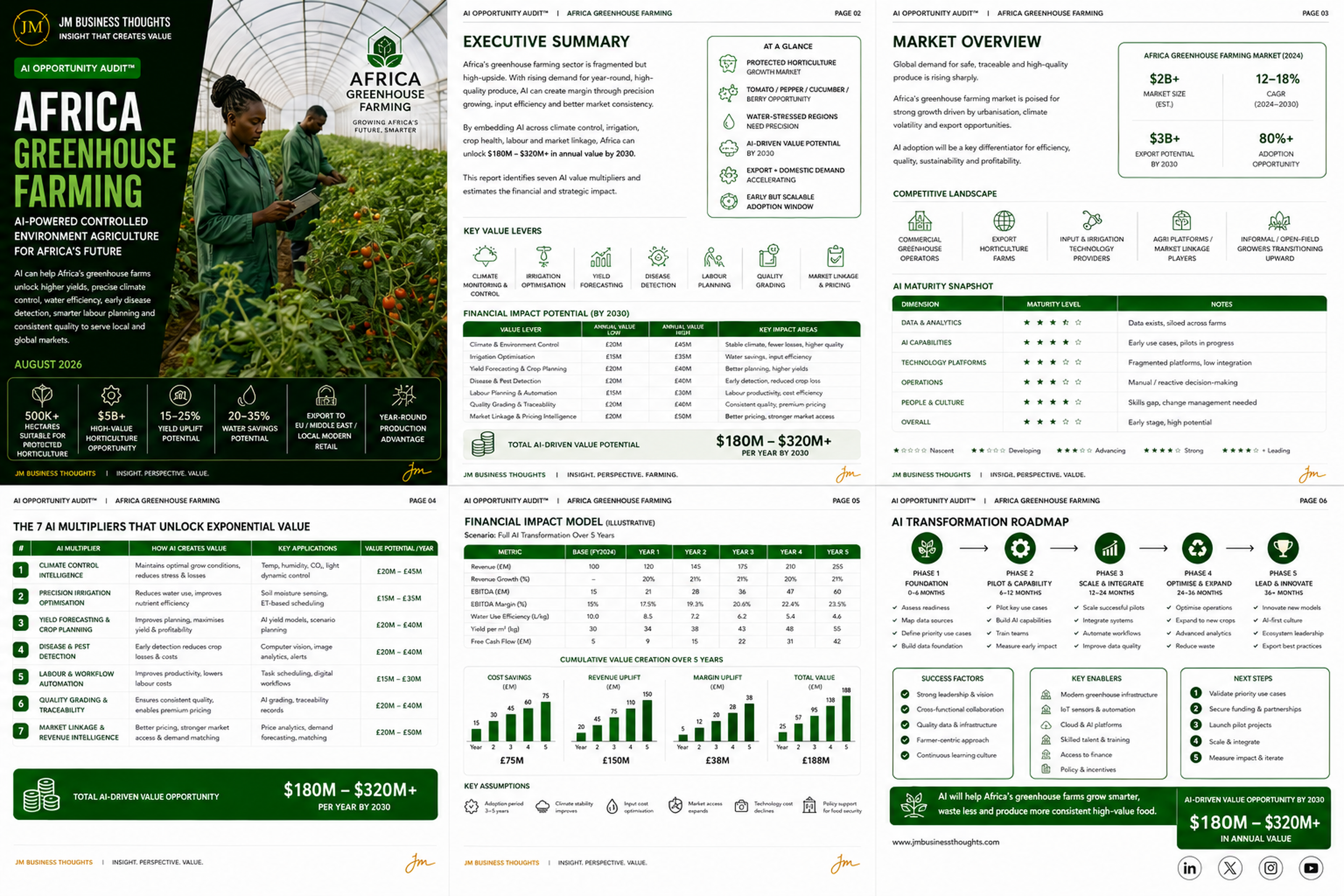
Africa Greenhouse Farming: AI-Powered Controlled Environment Agriculture. full strategic breakdown
Africa Greenhouse Farming — AI Opportunity Audit™, six-panel institutional sheet: executive summary, market overview, seven multipliers, financial impact model and transformation roadmap.

The Verdict

A greenhouse is already a controlled system — it is simply not yet a measured one. Instrumenting the 500K+ hectares suitable for protected cultivation in Africa converts weather risk into production certainty and turns a $2B market into a $3B+ export business. AI will help Africa's greenhouse farms grow smarter, waste less and produce more consistent high-value food.

JM founder signature
68 · PureGym — Fitness At Scale. More Personal. More Inclusive.67 · SIXT — Smarter Mobility. Greater Availability. A More Connected Tomorrow.66 · Sendwave — Money That Moves With Intelligence.65 · McDonald’s — Serving The Future With AI.64 · Compare the Market — Smarter Comparison. Better Matches. Brighter Tomorrows.63 · WeBuyAnyCar — Smarter Pricing. Faster Offers. Better Conversion.62 · Primark — Affordable Fashion. Greater Possibilities With AI.61 · Starbucks — Smarter Stores. Stronger Loyalty. Better Margins.60 · IKEA — AI-Powered Home Retail at Global Scale59 · H&M — Smarter Fashion. Brighter Tomorrow.58 · WeWork — The Value Wasn't Lost. It Was Mispriced.57 · Yahoo — The Value Wasn't Lost. It Was Mispriced.56 · Nando's UK — Smarter Restaurants. Stronger Loyalty. Better Margins.55 · The Amplifier54 · The Body Shop53 · Arcadia Group52 · Cazoo51 · Blockbuster50 · Carpetright49 · Wilko48 · Mothercare47 · Phones 4u46 · Farfetch45 · Jumia44 · Toys ‘R’ Us43 · The Collateral Gap — Part One41 · The Amplifier40 · Africa Bee Farming39 · Kenya Airways36 · Boots UK35 · Biffa (UK)34 · NatWest33 · Skip Hire Companies UK33 · The Audit32 · The Lean Company31 · Africa Mushroom Farming29 · The Rider Economy Nobody Verified28 · The Layer Underneath the Layer27 · Independent Timber Yards & Jewson Timber26 · Link Up TV & GRM Daily25 · East African Portland Cement42 · International Student Credential & Financial Verification — Part One24 · The Supply Chain Inside the Supply Chain23 · The White Space, Mapped22 · The Real Opportunity21 · Greencore20 · West Ham United19 · Roofings Group Uganda18 · Mombasa Port17 · Auto Trader UK16 · Uganda Coffee Development Authority15 · Brookside Dairy14 · GraceKennedy13 · Rightmove12 · Manchester United11 · Greggs30 · Twiga Foods10 · Uchumi09 · Konga08 · Edcon09 · GAME07 · Debenhams06 · Claire's05 · Boohoo04 · Argos