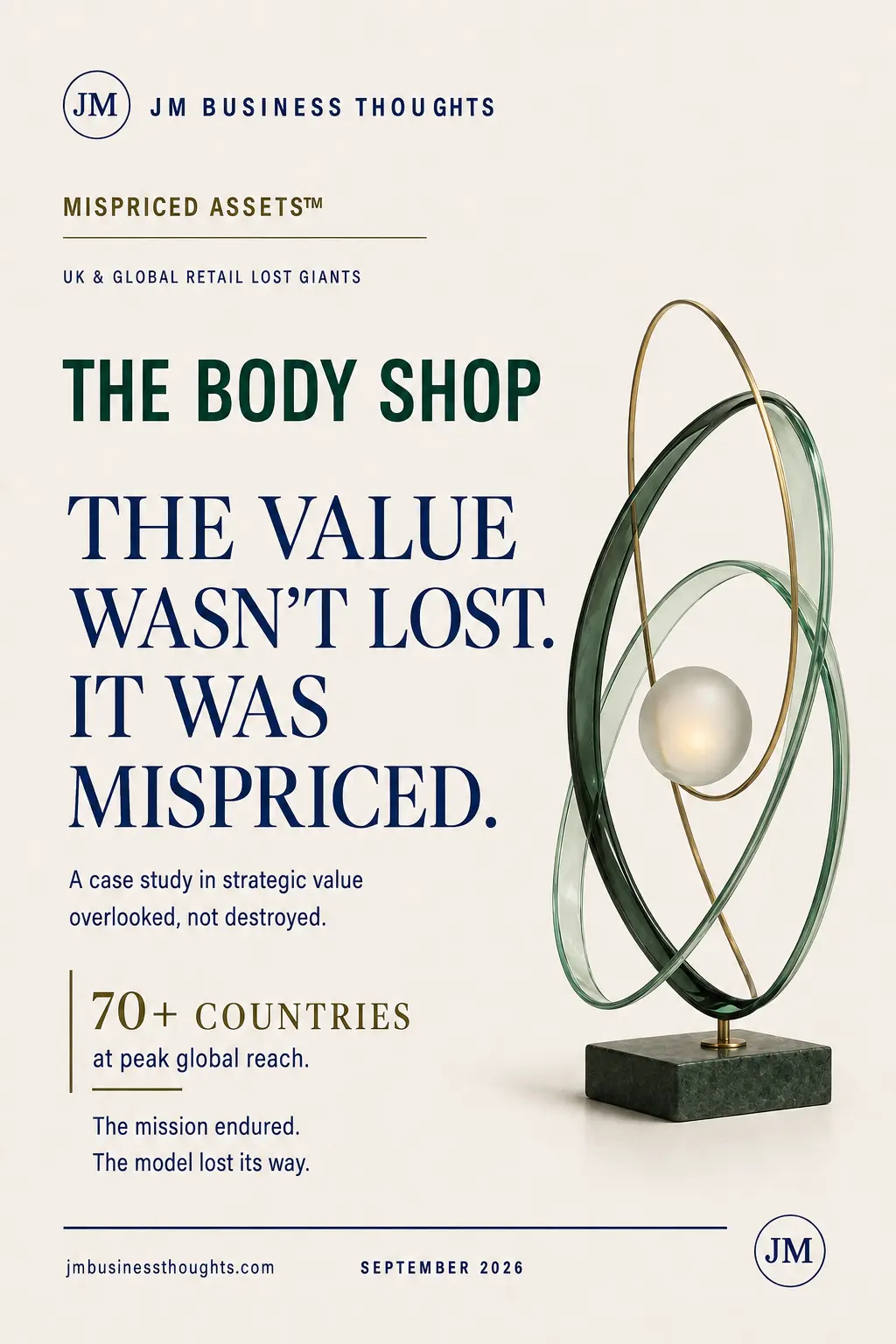
The Body Shop: The Value Wasn’t Lost. It Was Mispriced. research poster
All Research
54Mispriced Assets™ 20 min readSeptember 2026
Coverage · United Kingdom · 70+ Countries · Institutional CoverageSector · Beauty & Personal Care · Ethical Brand, Retail & DTC CommerceFormat · Six-page audit

The Body ShopA Case Study In Strategic Value Overlooked, Not Destroyed.

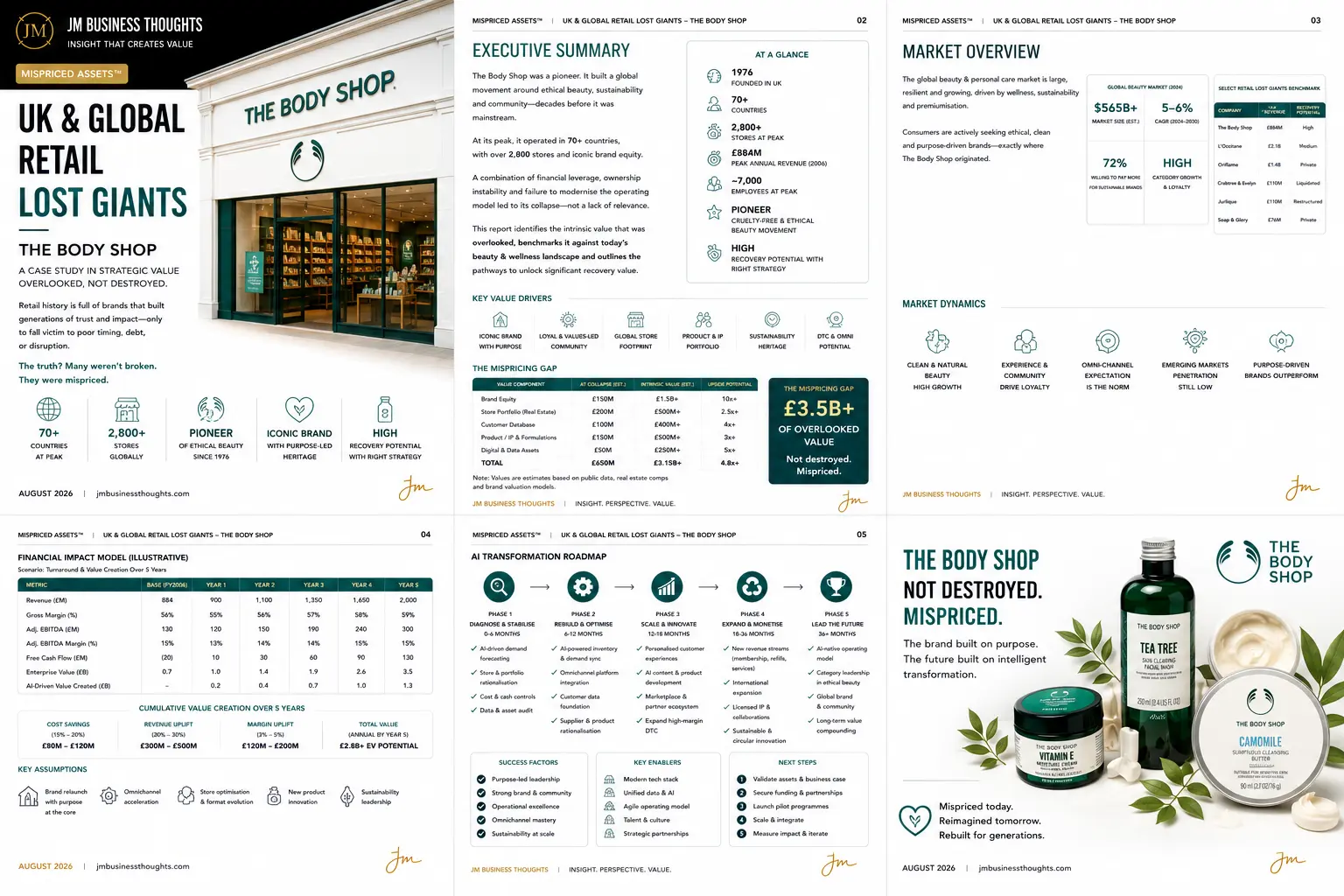
The Body Shop was a pioneer. Founded in 1976, it built a global movement around ethical beauty, sustainability and community decades before it was mainstream. At its peak it operated in 70+ countries with over 2,800 stores, £884M of peak annual revenue and roughly 7,000 employees. Financial leverage, ownership instability and failure to modernise the operating model led to its collapse — not a lack of relevance. This audit identifies £3.5BN+ of overlooked value and the pathways to recover it.

Founded In UK

1976

Countries At Peak

70+

Stores Globally

2,800+

Peak Annual Revenue (2006)

£884M

Employees At Peak

~7,000

The Mispricing Gap

£3.5BN+

Global Beauty Market

$565BN+

Enterprise Value Potential

£2.8BN+

The Thesis

The Body Shop invented purpose-led beauty. Cruelty-free formulation, community trade sourcing, refill culture and activist retail were its positions decades before the market rewarded any of them. Today 72% of consumers say they are willing to pay more for sustainable brands and category growth in clean and natural beauty is the highest in the sector — which means the brand collapsed into the exact demand curve it created. What failed was financial: leverage, four ownership changes in twenty years, and an operating model that never modernised into digital, DTC or data. At collapse the separable assets carried an estimated £650M of value against £3.15BN+ intrinsic — a £3.5BN+ gap. The mission endured. The model lost its way.

Exhibit · Report Cover

54 · Mispriced Assets™

The Body Shop: The Value Wasn’t Lost. It Was Mispriced. report cover
The Body Shop: The Value Wasn’t Lost. It Was Mispriced.September 2026 · United Kingdom · 70+ Countries · Institutional Coverage
01

Executive summary: a pioneer that outlived its own model

The Body Shop was a pioneer. It built a global movement around ethical beauty, sustainability and community — decades before it was mainstream.

At its peak it operated in 70+ countries with over 2,800 stores and iconic brand equity, generating £884M of annual revenue in 2006 with roughly 7,000 employees.

A combination of financial leverage, ownership instability and failure to modernise the operating model led to its collapse — not a lack of relevance.

This report identifies the intrinsic value that was overlooked, benchmarks it against today’s beauty and wellness landscape and outlines the pathways to unlock significant recovery value.

Key value drivers: an iconic brand with purpose, a loyal values-led community, a global store footprint, product and IP portfolio, sustainability heritage, and DTC and omni-channel potential.

£650M at collapse against £3.15BN+ of intrinsic value. A £3.5BN+ mispricing gap.
  • 1976 founded in the UK; 70+ countries at peak
  • 2,800+ stores globally; £884M peak annual revenue (2006)
  • ~7,000 employees at peak
  • Pioneer of the cruelty-free and ethical beauty movement
02

The mispricing gap: component by component

Every Body Shop asset class has a live market comparator, and every one was written down below it.

Brand equity: £150M at collapse against £1.5BN+ intrinsic — 10x upside, the widest gap in this series. Purpose-led authenticity earned over five decades cannot be manufactured by a challenger brand at any marketing budget.

Store portfolio and real estate: £200M against £500M+ — 2.5x.

Customer database: £100M against £400M+ — 4x. A values-led community, not a mailing list, in a category with high repeat purchase frequency.

Product and IP formulations: £150M against £500M+ — 3x. Community trade sourcing relationships and formulation IP with genuine provenance.

Digital and data assets: £50M against £250M+ — 5x.

Total: £650M against £3.15BN+ — a £3.5BN+ gap at a 4.8x aggregate multiple. Values are estimates based on public data, real estate comparables and brand valuation models.

Brand equity alone: £150M written down against £1.5BN+ intrinsic. Ten times.
  • Brand equity: £150M → £1.5BN+ (10x)
  • Store portfolio and real estate: £200M → £500M+ (2.5x)
  • Customer database: £100M → £400M+ (4x)
  • Product and IP formulations: £150M → £500M+ (3x)
  • Digital and data assets: £50M → £250M+ (5x)
03

Market overview: $565BN and premiumising

The global beauty and personal care market is large, resilient and growing, driven by wellness, sustainability and premiumisation.

Market size is estimated at $565BN+ with a 5–6% CAGR through 2030. Seventy-two percent of consumers are willing to pay more for sustainable brands — exactly where The Body Shop originated — and category growth and loyalty are both rated high.

The lost giants benchmark: The Body Shop, £884M UK revenue, high recovery potential. L’Occitane, £2.1BN, medium. Oriflame, £1.4BN, private. Crabtree & Evelyn, £110M, liquidated. Jurlique, £110M, restructured. Soap & Glory, £76M, private.

Market dynamics: clean and natural beauty is the highest-growth segment; experience and community drive loyalty; omni-channel expectation is the norm; emerging markets penetration is still low; and purpose-driven brands outperform.

Five of five dynamics favour the brand. That is what makes the write-down a mispricing rather than an obsolescence.

72% will pay more for sustainable brands — in the category The Body Shop invented.
  • Global beauty market: $565BN+, 5–6% CAGR
  • 72% willing to pay more for sustainable brands
  • Clean and natural beauty is the highest-growth segment
  • Emerging markets penetration remains low — headroom, not saturation
04

Where the value actually leaked

Four leaks explain how a £884M brand with 56% gross margin arrived at insolvency.

Ownership instability is the first, and it is upstream of everything else. Four owners in twenty years means four strategies, four capital plans and no continuous investment in the operating model.

Digital and DTC underinvestment is the second. Beauty is now the most digitally native large retail category — subscription, refill, sampling and content commerce — and The Body Shop entered that shift with a store-first cost base.

Store economics is the third. A 2,800-store estate carrying full occupancy cost in a category where DTC gross margins run far higher is a structural drag once footfall softens.

Product and range discipline is the fourth. Formulation IP and community trade sourcing are genuine differentiators only when the range is edited, merchandised and told properly — which requires data the business never built.

  • Ownership gap: four owners in twenty years, no continuity of investment
  • Digital gap: store-first cost base entering a DTC-led category shift
  • Store gap: full occupancy cost against higher-margin direct channels
  • Range gap: differentiated formulation IP without merchandising intelligence
05

Financial impact model: base FY2006 to Year 5

The illustrative model runs a turnaround and value creation scenario over five years from a base FY2006.

Revenue (£M): 884 → 900 → 1,100 → 1,350 → 1,650 → 2,000. Gross margin: 56% → 55% → 56% → 57% → 58% → 59%.

Adjusted EBITDA (£M): 130 → 120 → 150 → 190 → 240 → 300, with margin at 15% → 13% → 14% → 14% → 15% → 15%. Free cash flow (£M): (20) → 10 → 30 → 60 → 90 → 130.

Enterprise value (£BN): 0.7 → 1.0 → 1.4 → 1.9 → 2.6 → 3.5, with AI-driven value created (£BN) of — → 0.2 → 0.4 → 0.7 → 1.0 → 1.3.

Cumulative value creation over five years: cost savings of 15–20% worth £80M – £120M; revenue uplift of 20–30% worth £300M – £500M; margin uplift of 3–5% worth £120M – £200M; total annual value by year five of £2.8BN+ of enterprise value potential.

Key assumptions: a brand relaunch with purpose at the core, omnichannel acceleration, store optimisation and format evolution, new product innovation and sustainability leadership.

Revenue £884M → £2.0BN. Enterprise value £0.7BN → £3.5BN over five years.
  • Revenue (£M): 884 → 900 → 1,100 → 1,350 → 1,650 → 2,000
  • Gross margin: 56% → 59%
  • Adjusted EBITDA (£M): 130 → 120 → 150 → 190 → 240 → 300
  • Free cash flow (£M): (20) → 10 → 30 → 60 → 90 → 130
  • Enterprise value (£BN): 0.7 → 3.5
06

AI transformation roadmap: five phases

Phase 1 (0–6 months) — Diagnose and stabilise: AI-driven demand forecasting, store and portfolio rationalisation, cost and cash controls, data and asset audit.

Phase 2 (6–12 months) — Rebuild and optimise: AI-powered inventory and demand sync, omnichannel platform integration, customer data foundation, supplier and product rationalisation.

Phase 3 (12–18 months) — Scale and innovate: personalised customer experiences, AI content and product development, marketplace and partner ecosystem, expansion of high-margin DTC.

Phase 4 (18–36 months) — Expand and monetise: new revenue streams across membership, refills and services, international expansion, licensed IP and collaborations, sustainable and circular innovation.

Phase 5 (36+ months) — Lead the future: an AI-native operating model, category leadership in ethical beauty, global brand and community, long-term value compounding.

Success factors: purpose-led leadership, strong brand and community, operational excellence, omnichannel mastery and sustainability at scale. Key enablers: a modern tech stack, unified data and AI, an agile operating model, talent and culture, and strategic partnerships. Next steps: validate assets and business case, secure funding and partnerships, launch pilot programmes, scale and integrate, and measure impact and iterate.
The brand built on purpose. The future built on intelligent transformation.

The Multiplier Framework

7 compounding levers

Seven AI multipliers rebuilding a purpose-led beauty platform on direct customer relationships — aggregating to £80M – £120M of annual cost savings, £300M – £500M of revenue uplift and £2.8BN+ of enterprise value potential by year five.

01

Personalised Beauty & Regimen AI

Skin, hair and values-based matching in a high-repeat category.

  • AI diagnostic and regimen recommendation
  • Ingredient and sensitivity matching
  • Replenishment timing on known usage cycles

Outcome · £70M – £120M per year

02

Community & Loyalty Intelligence

Convert a values-led community into a measured membership base.

  • AI segmentation on values and behaviour
  • Membership, refill and subscription programmes
  • Advocacy and referral engines

Outcome · £60M – £100M per year

03

Demand Forecasting & Inventory

Fewer stockouts and less obsolescence on short-shelf-life product.

  • Forecasting by market, season and SKU
  • Allocation and replenishment optimisation
  • Shelf-life and batch intelligence

Outcome · £50M – £90M per year

04

Sustainability & Supply Traceability

Prove the claim that the whole brand rests on.

  • Community trade sourcing traceability
  • Carbon and packaging analytics
  • Refill network optimisation

Outcome · £40M – £80M per year

05

DTC & Digital Commerce

Shift mix to the highest-margin channel in beauty.

  • Semantic search and AI merchandising
  • Content commerce and sampling programmes
  • Marketplace and partner expansion

Outcome · £80M – £140M per year

06

Store Format & Experience Intelligence

Right estate, right format, experience-led.

  • Trade area and catchment modelling
  • Format and refill-station performance analytics
  • Staff scheduling and service quality

Outcome · £40M – £70M per year

07

Data & Decision Intelligence

Run a 70-country brand on one evidence base.

  • Unified global data platform
  • Executive dashboards and anomaly detection
  • Product innovation analytics from review and search data

Outcome · £40M – £80M per year

The Body Shop: The Value Wasn’t Lost. It Was Mispriced. full strategic breakdown
Mispriced Assets™ · UK & Global Retail Lost Giants — The Body Shop: the full six-page institutional report covering the cover and key value drivers, executive summary with the at-a-glance estate and the mispricing gap table, global beauty market overview and lost giants benchmark, the five-year financial impact model with key assumptions, the five-phase AI transformation roadmap, and the closing brand reimagination case.

The Verdict

Founded 1976, 70+ countries, 2,800+ stores and £884M of peak revenue — written down to £650M against £3.15BN+ of intrinsic value, with brand equity alone mispriced ten times over. The mission endured; the model lost its way. In a $565BN market where 72% of consumers pay more for sustainable brands, the category moved toward The Body Shop, not away from it. Seven multipliers rebuild it on direct customer relationships for £300M – £500M of revenue uplift and £2.8BN+ of enterprise value. Mispriced today. Reimagined tomorrow. Rebuilt for generations.

JM founder signature
68 · PureGym — Fitness At Scale. More Personal. More Inclusive.67 · SIXT — Smarter Mobility. Greater Availability. A More Connected Tomorrow.66 · Sendwave — Money That Moves With Intelligence.65 · McDonald’s — Serving The Future With AI.64 · Compare the Market — Smarter Comparison. Better Matches. Brighter Tomorrows.63 · WeBuyAnyCar — Smarter Pricing. Faster Offers. Better Conversion.62 · Primark — Affordable Fashion. Greater Possibilities With AI.61 · Starbucks — Smarter Stores. Stronger Loyalty. Better Margins.60 · IKEA — AI-Powered Home Retail at Global Scale59 · H&M — Smarter Fashion. Brighter Tomorrow.58 · WeWork — The Value Wasn't Lost. It Was Mispriced.57 · Yahoo — The Value Wasn't Lost. It Was Mispriced.56 · Nando's UK — Smarter Restaurants. Stronger Loyalty. Better Margins.55 · The Amplifier52 · Cazoo51 · Blockbuster50 · Carpetright49 · Wilko48 · Mothercare47 · Phones 4u46 · Farfetch45 · Jumia44 · Toys ‘R’ Us43 · The Collateral Gap — Part One41 · The Amplifier40 · Africa Bee Farming39 · Kenya Airways38 · Africa Greenhouse Farming37 · Uganda Tourism Board36 · Boots UK35 · Biffa (UK)34 · NatWest33 · Skip Hire Companies UK33 · The Audit32 · The Lean Company31 · Africa Mushroom Farming29 · The Rider Economy Nobody Verified28 · The Layer Underneath the Layer27 · Independent Timber Yards & Jewson Timber26 · Link Up TV & GRM Daily25 · East African Portland Cement42 · International Student Credential & Financial Verification — Part One24 · The Supply Chain Inside the Supply Chain23 · The White Space, Mapped22 · The Real Opportunity21 · Greencore20 · West Ham United19 · Roofings Group Uganda18 · Mombasa Port17 · Auto Trader UK16 · Uganda Coffee Development Authority15 · Brookside Dairy14 · GraceKennedy13 · Rightmove12 · Manchester United11 · Greggs30 · Twiga Foods10 · Uchumi09 · Konga08 · Edcon09 · GAME07 · Debenhams06 · Claire's05 · Boohoo04 · Argos