The Supply Chain Inside the Supply Chain: NHS Mental Health as an Untapped AI Infrastructure Vertical research poster
All Research

The Infrastructure Layer Series™

Who owns the rails underneath the AI economy — and where nobody has built them yet.

24Infrastructure Layer™ 20 min readAugust 2026
Coverage · United Kingdom (England)Sector · Health Infrastructure · Vertical AIFormat · Six-page audit

The Supply Chain Inside the Supply ChainDeep Dive, Chapter 3

Three stages. Three bottlenecks. One missing layer, repeated three times: nothing in English mental health care connects real-time demand to real-time supply. Referral triage, bed placement-matching and medication availability are each regulated, each quantified, each funded — and none of them has a national matching layer.

Open MH Referrals, England

1.7M

Open ADHD Assessments

735,000

Median Referral→Contact

37 DAYS

90th-Percentile Wait

169 DAYS

Out-of-Area Cost, Adults

£164M/YR

Concentrated in Two Providers

>60%

Reset Placement Deadline

MAR 2027

Capital Committed, Beds

£75M

The Thesis

Mental health care in England runs through three sequential stages — referral is triaged, a bed or care pathway is matched to capacity, and a treatment is dispensed. Billions of pounds and multiple government targets sit on each stage. At every single stage the connective tissue — the system that matches real-time demand to real-time available supply — does not exist. What exists instead is manual triage reinvented Trust by Trust, phone calls between pharmacies checking stock by hand, and two private hospital groups absorbing the overflow because no dynamic national matching layer exists. This is not a funding story. It is an infrastructure story, and it is the clearest Layer-2 opportunity we have mapped in a developed-market public system.

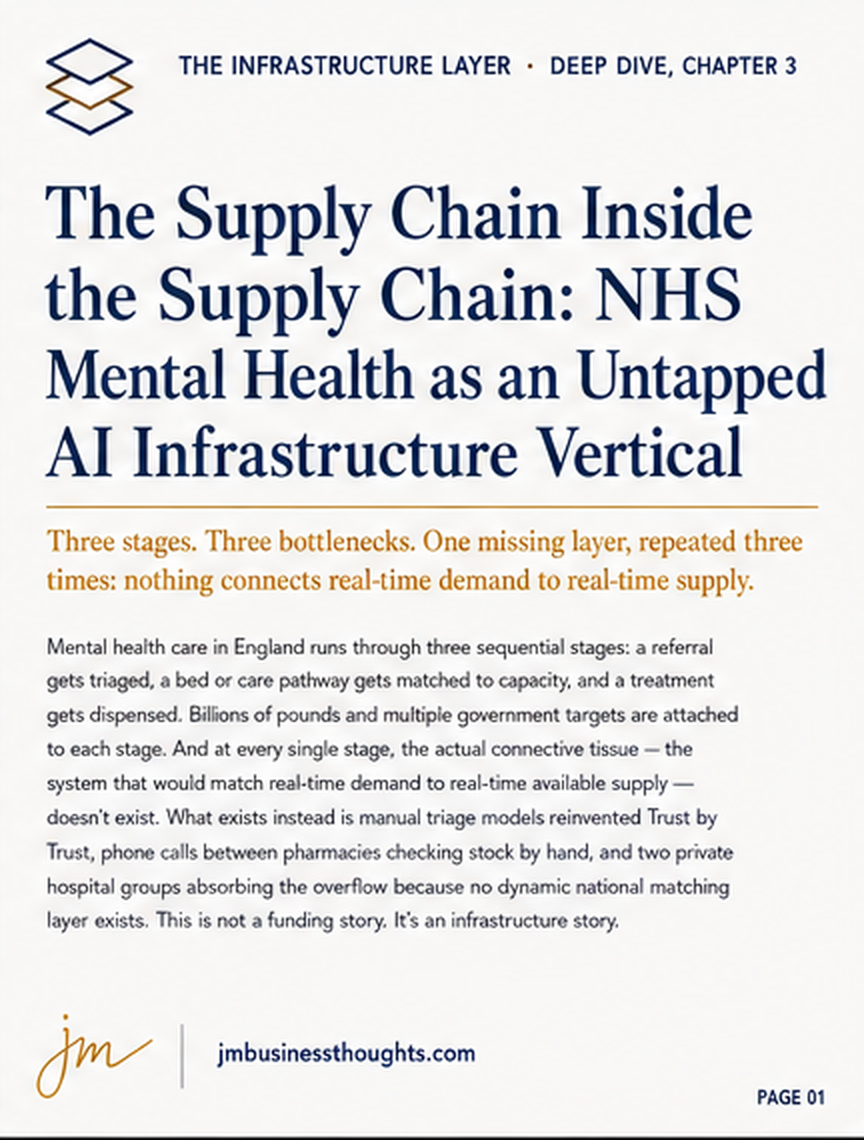
Exhibit · Report Cover

24 · Infrastructure Layer™

The Supply Chain Inside the Supply Chain: NHS Mental Health as an Untapped AI Infrastructure Vertical report cover
The Supply Chain Inside the Supply Chain: NHS Mental Health as an Untapped AI Infrastructure VerticalAugust 2026 · United Kingdom (England)
01

The shape of the problem: one missing layer, three times

English mental health care is best read as a supply chain rather than a service. A referral enters at the front end and is triaged against community capacity. If escalation is required, a bed or intensive pathway is matched against inpatient capacity. If a diagnosis lands, a medication is dispensed against pharmacy and wholesaler stock. Each stage has its own regulator, its own funding envelope and its own political deadline.

What none of the three stages has is a real-time matching layer. Triage happens against a local, static picture of capacity. Bed placement happens over the phone. Medication availability is resolved pharmacy by pharmacy, day by day, area by area. In supply-chain language, England has warehouses and hauliers but no order-management system — and it has been substituting human effort for that missing system for a decade.

That distinction matters commercially. A capacity problem is solved with capital and workforce, both of which are slow, politically contested and already committed. A matching problem is solved with software, data standards and integration — which is fast, cheap relative to the value released, and unclaimed. The three exhibits that follow each quantify a matching problem that has been consistently mis-diagnosed as a capacity problem.

This is not a funding story. It is an infrastructure story.
  • Stage 1 — Referral & triage routing: fragmented, rebuilt Trust by Trust
  • Stage 2 — Bed capacity & placement matching: missed once, second deadline now live
  • Stage 3 — Medication availability & verification: manual, phone-based, day-to-day
  • Common failure mode: no national layer connecting real-time demand to real-time supply
02

Exhibit A — Referral and triage routing infrastructure

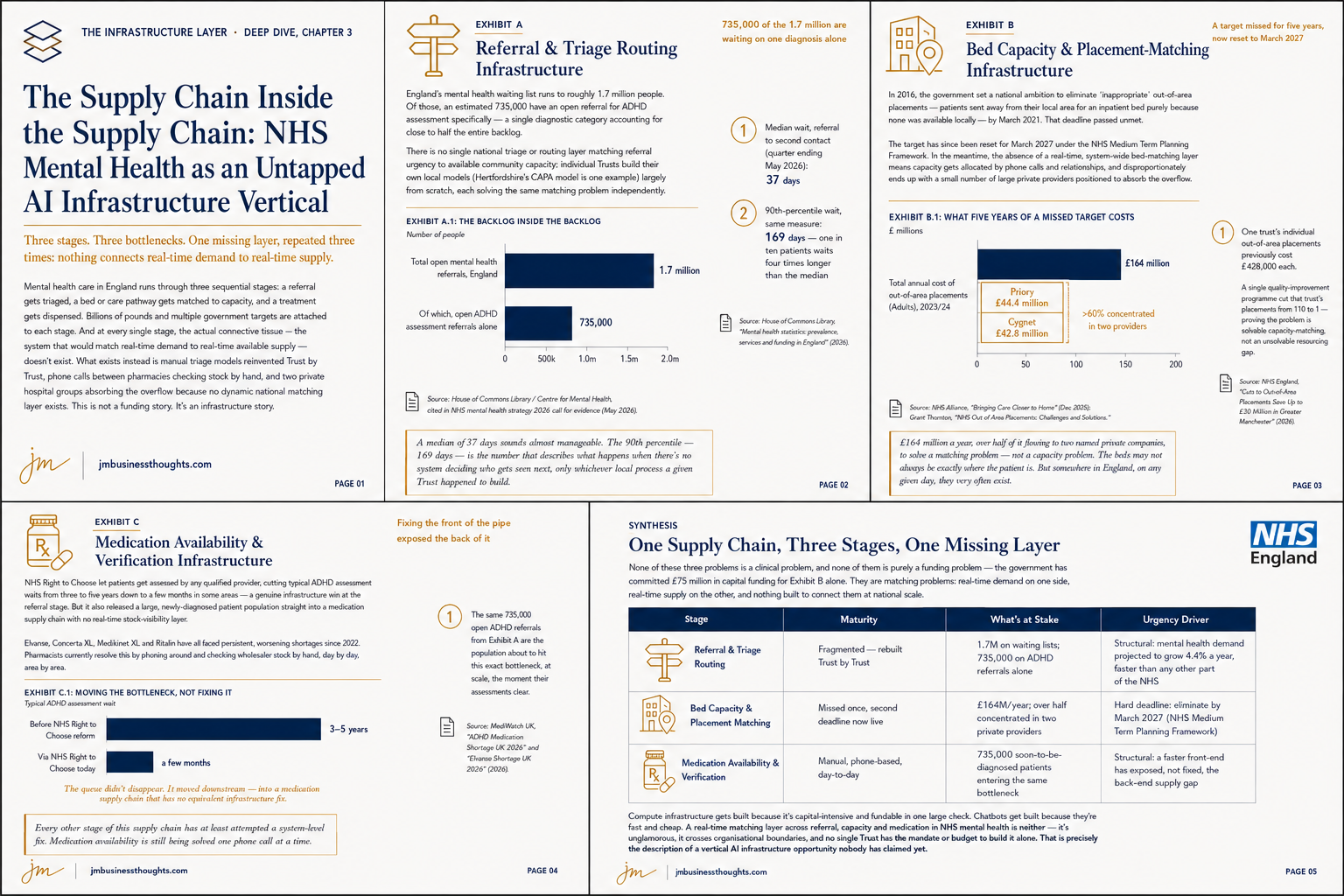
England's mental health waiting list runs to roughly 1.7 million people. Of those, an estimated 735,000 hold an open referral for ADHD assessment specifically — a single diagnostic category accounting for close to half the entire backlog. That concentration is the tell: this is not diffuse demand across dozens of pathways, it is one dominant queue that a routing layer could address directly.

There is no single national triage or routing layer matching referral urgency to available community capacity. Individual Trusts build their own local models — Hertfordshire's CAPA model is one widely cited example — largely from scratch, each solving the same matching problem independently and each carrying the full build and maintenance cost alone.

The distribution, not the average, is where the damage sits. Median wait from referral to second contact for the quarter ending May 2026 is 37 days. The 90th-percentile wait on the same measure is 169 days: one in ten patients waits more than four times longer than the median. A median of 37 days sounds almost manageable. The 90th percentile is the number that describes what happens when there is no system deciding who gets seen next — only whichever local process a given Trust happened to build.

37 days is the average. 169 days is what happens when nobody owns the routing.
  • 1.7 million open mental health referrals, England
  • 735,000 of those are open ADHD assessment referrals alone
  • Median referral-to-second-contact: 37 days (quarter ending May 2026)
  • 90th percentile on the same measure: 169 days
  • Source: House of Commons Library / Centre for Mental Health, cited in the 2026 national mental health strategy call for evidence
03

Exhibit B — Bed capacity and placement-matching infrastructure

In 2016 the government set a national ambition to eliminate 'inappropriate' out-of-area placements — patients sent away from their local area for an inpatient bed purely because none was available locally — by March 2021. That deadline passed unmet. The target has since been reset to March 2027 under the NHS Medium Term Planning Framework, and £75 million of capital has been committed against it.

In the meantime, the absence of a real-time, system-wide bed-matching layer means capacity gets allocated by phone calls and relationships. The predictable consequence is concentration: a small number of large private providers are positioned to absorb the overflow, because they are the reliable answer when a Trust's local search fails.

The total annual cost of adult out-of-area placements ran to £164 million in 2023/24. Over half of that flows to two named private companies — Priory at £44.4 million and Cygnet at £42.8 million. One Trust's individual out-of-area placements previously cost £428,000 each; a single quality-improvement programme cut that Trust's placements from 110 to 1, demonstrating that the problem is solvable capacity-matching, not an unsolvable resourcing gap.

That last data point is the investment case in one line. If a single Trust-level improvement programme can take placements from 110 to 1, the binding constraint was never bed supply. It was visibility of bed supply.

£164 million a year, over half of it flowing to two named private companies, to solve a matching problem — not a capacity problem.
  • £164M total annual cost of adult out-of-area placements, 2023/24
  • Priory £44.4M and Cygnet £42.8M — over 60% concentrated in two providers
  • £428,000: one Trust's cost per individual out-of-area placement
  • 110 → 1 placements after a single quality-improvement programme
  • Hard deadline: eliminate inappropriate placements by March 2027
  • Sources: NHS Alliance, 'Bringing Care Closer to Home' (Dec 2025); Grant Thornton, 'NHS Out of Area Placements: Challenges and Solutions'; NHS England, 'Cuts to Out-of-Area Placements Save Up to £30 Million in Greater Manchester' (2026)
04

Exhibit C — Medication availability and verification infrastructure

NHS Right to Choose let patients get assessed by any qualified provider, cutting typical ADHD assessment waits from three-to-five years down to a few months in some areas. That is a genuine infrastructure win at the referral stage — a routing reform that worked because it created optionality where there had been a single queue.

But it also released a large, newly-diagnosed patient population straight into a medication supply chain with no real-time stock-visibility layer. Elvanse, Concerta XL, Medikinet XL and Ritalin have all faced persistent, worsening shortages since 2022. Pharmacists currently resolve this by phoning around and checking wholesaler stock by hand, day by day, area by area.

The queue did not disappear. It moved downstream — into a medication supply chain that has no equivalent infrastructure fix. And the same 735,000 open ADHD referrals from Exhibit A are the population about to hit this exact bottleneck, at scale, the moment their assessments clear.

Every other stage of this supply chain has at least attempted a system-level fix. Medication availability is still being solved one phone call at a time.

Fixing the front of the pipe exposed the back of it.
  • Typical ADHD assessment wait before Right to Choose: 3–5 years
  • Via Right to Choose today: a few months in some areas
  • Persistent shortages since 2022 across Elvanse, Concerta XL, Medikinet XL, Ritalin
  • 735,000 soon-to-be-diagnosed patients entering the same bottleneck
  • Source: MedWatch UK, 'ADHD Medication Shortage UK 2026' and 'Elvanse Shortage UK 2026' (2026)
05

Synthesis — one supply chain, three stages, one missing layer

None of these three problems is a clinical problem, and none of them is purely a funding problem — the government has committed £75 million in capital for Exhibit B alone. They are matching problems: real-time demand on one side, real-time supply on the other, and nothing built to connect them at national scale.

Stage 1, referral and triage routing, is fragmented and rebuilt Trust by Trust, with 1.7 million on waiting lists and 735,000 on ADHD referrals alone. Its urgency driver is structural: mental health demand is projected to grow 4.4% a year, faster than any other part of the NHS. Stage 2, bed capacity and placement matching, has already missed one deadline and now carries a hard second one for March 2027, at £164 million a year with over half concentrated in two private providers. Stage 3, medication availability and verification, remains manual and phone-based, with 735,000 soon-to-be-diagnosed patients entering the same bottleneck.

Compute infrastructure gets built because it is capital-intensive and fundable in one large cheque. Chatbots get built because they are fast and cheap. A real-time matching layer across referral, capacity and medication in NHS mental health is neither — it is unglamorous, it crosses organisational boundaries, and no single Trust has the mandate or budget to build it alone. That is precisely the description of a vertical AI infrastructure opportunity nobody has claimed yet.
Unglamorous, cross-boundary, and unownable by any single Trust — which is exactly why it is unclaimed.
  • Mental health demand projected to grow 4.4% per year — fastest in the NHS
  • Buyer is identifiable at ICB and NHS England level, with existing budget lines
  • Entry cost is integration and information governance, not capital
  • March 2027 statutory deadline creates a forced procurement window
06

Where the value accrues — and what would break the thesis

Value in a matching layer accrues to whoever holds the canonical, real-time picture of supply. In practice that means the party that integrates first across enough Trusts to make its view the default answer. Network effects are strong but geographically bounded: an ICB-level footprint is defensible, and a multi-ICB footprint becomes the de facto national layer without ever being procured as one.

The commercial model most likely to work is not per-seat software. It is a share of avoided cost — out-of-area placement spend avoided, locum and administrative hours avoided, breach penalties avoided — because the buyer already measures those numbers and reports them publicly.

Three things would break the thesis. First, NHS England builds the layer centrally and mandates it, collapsing the addressable market to integration services. Second, information-governance friction across Trust boundaries proves slower than the procurement cycle, so no vendor reaches critical density before budgets reset. Third, the March 2027 deadline is quietly moved a second time, removing the forcing function that turns a good idea into a funded programme. Of the three, the second is the most likely and the most survivable — it delays rather than eliminates.

  • Watch: quarterly out-of-area placement spend and provider concentration
  • Watch: referral-to-second-contact 90th percentile, not median
  • Watch: NHS England central procurement notices for matching or routing platforms
  • Watch: ADHD medication serious shortage protocols issued per quarter
  • Watch: any restatement of the March 2027 placement deadline

The Multiplier Framework

5 compounding levers

Five infrastructure positions sit inside this one supply chain. Each is separately fundable, each has an identifiable buyer with an existing budget line, and each compounds the others: the routing layer generates the demand signal, the capacity layer prices it, and the medication layer protects the outcome.

01

National Referral Routing Layer

Match urgency to capacity, not postcode to queue

  • Standardise referral urgency scoring across Trusts into one schema
  • Publish live community capacity by pathway rather than static caseload
  • Route the 735,000-strong ADHD queue against real assessment slots
  • Target the 90th percentile explicitly — 169 days is the KPI, not 37

Outcome · Compress tail waits toward the median and end Trust-by-Trust rebuilds

02

Real-Time Bed Visibility Exchange

Turn phone calls into an order book

  • Instrument inpatient availability at bed level across the ICB footprint
  • Expose local capacity before escalation to out-of-area search
  • Price and log every placement decision against the £428k benchmark
  • Report against the March 2027 elimination deadline automatically

Outcome · Recapture a material share of £164M annual out-of-area spend

03

Medication Stock Visibility Grid

Stop resolving shortages one phone call at a time

  • Aggregate pharmacy and wholesaler stock signals at area level
  • Flag Elvanse, Concerta XL, Medikinet XL and Ritalin gaps before dispensing
  • Route prescriptions to stocked sites rather than nearest sites
  • Forecast demand from cleared assessments in the routing layer

Outcome · Convert a manual daily search into an automated availability answer

04

Credential & Provider Verification Rail

Make Right to Choose scale without quality drift

  • Verify qualified-provider status continuously rather than at onboarding
  • Bind outcome data to provider records across the choice network
  • Give commissioners a single view of independent-sector performance
  • Reduce contracting friction for new capacity entering the market

Outcome · Expand assessment supply safely instead of capping it by caution

05

Demand Forecasting & Avoided-Cost Reporting

Bill against numbers the buyer already publishes

  • Model the 4.4% annual demand growth at ICB granularity
  • Attribute avoided out-of-area, locum and administrative cost per decision
  • Produce board-grade evidence packs against national deadlines
  • Anchor commercial terms in avoided cost, not per-seat licensing

Outcome · A procurement case written in the buyer's own reported metrics

The Supply Chain Inside the Supply Chain: NHS Mental Health as an Untapped AI Infrastructure Vertical full strategic breakdown
The Infrastructure Layer · Deep Dive, Chapter 3 — full five-page audit: the missing matching layer, Exhibits A–C (referral routing, bed placement, medication availability) and the synthesis matrix.

The Verdict

England has spent a decade adding capacity to a supply chain that cannot see itself. The referral backlog, the £164 million out-of-area bill and the medication shortages are not three separate crises — they are one missing layer, observed at three points. The government has already committed the capital, set the deadline and published the numbers that would price the fix. What it has not done is build, or buy, the thing that connects real-time demand to real-time supply. That is the position: unglamorous, cross-boundary, forced by a March 2027 deadline, and still unowned.

JM founder signature
68 · PureGym — Fitness At Scale. More Personal. More Inclusive.67 · SIXT — Smarter Mobility. Greater Availability. A More Connected Tomorrow.66 · Sendwave — Money That Moves With Intelligence.65 · McDonald’s — Serving The Future With AI.64 · Compare the Market — Smarter Comparison. Better Matches. Brighter Tomorrows.63 · WeBuyAnyCar — Smarter Pricing. Faster Offers. Better Conversion.62 · Primark — Affordable Fashion. Greater Possibilities With AI.61 · Starbucks — Smarter Stores. Stronger Loyalty. Better Margins.60 · IKEA — AI-Powered Home Retail at Global Scale59 · H&M — Smarter Fashion. Brighter Tomorrow.58 · WeWork — The Value Wasn't Lost. It Was Mispriced.57 · Yahoo — The Value Wasn't Lost. It Was Mispriced.56 · Nando's UK — Smarter Restaurants. Stronger Loyalty. Better Margins.55 · The Amplifier54 · The Body Shop53 · Arcadia Group52 · Cazoo51 · Blockbuster50 · Carpetright49 · Wilko48 · Mothercare47 · Phones 4u46 · Farfetch45 · Jumia44 · Toys ‘R’ Us43 · The Collateral Gap — Part One41 · The Amplifier40 · Africa Bee Farming39 · Kenya Airways38 · Africa Greenhouse Farming37 · Uganda Tourism Board36 · Boots UK35 · Biffa (UK)34 · NatWest33 · Skip Hire Companies UK33 · The Audit32 · The Lean Company31 · Africa Mushroom Farming29 · The Rider Economy Nobody Verified28 · The Layer Underneath the Layer27 · Independent Timber Yards & Jewson Timber26 · Link Up TV & GRM Daily25 · East African Portland Cement42 · International Student Credential & Financial Verification — Part One22 · The Real Opportunity21 · Greencore20 · West Ham United19 · Roofings Group Uganda18 · Mombasa Port17 · Auto Trader UK16 · Uganda Coffee Development Authority15 · Brookside Dairy14 · GraceKennedy13 · Rightmove12 · Manchester United11 · Greggs30 · Twiga Foods10 · Uchumi09 · Konga08 · Edcon09 · GAME07 · Debenhams06 · Claire's05 · Boohoo04 · Argos