Wilko: The Value Wasn’t Lost. It Was Mispriced. research poster
All Research
49Mispriced Assets™ 20 min readAugust 2026
Coverage · United Kingdom · Nationwide · Institutional CoverageSector · Value Retail · Home, Garden & Household EssentialsFormat · Six-page audit

WilkoA Case Study In Strategic Value Overlooked, Not Destroyed.

Wilko entered administration in 2023 with roughly 400 stores, 12,000 colleagues and more than 90 years of high-street trust in home, garden and household essentials. The value proposition never stopped working — UK value retail kept growing straight through the collapse. What failed was cost structure, ranging discipline and a digital and data capability that never arrived. This audit separates the assets destroyed from the assets written off, and sizes £30M – £55M+ of annual AI-driven value on a rebuilt estate.

Years On The High Street

90+

Stores At Administration

~400

Colleagues

~12,000

Weekly Customers (Peak)

7M+

Own-Brand SKUs

14,000+

UK Value Retail Growth

Structurally Positive

Annual AI Value Potential

£30M – £55M+

Recovery Horizon

3 – 5 Years

The Thesis

Wilko’s failure is routinely read as proof that the discount high street died. The data says the opposite: UK value retail expanded through the exact period Wilko contracted, and the operators who took its share — B&M, Home Bargains, The Range, Poundland — grew on precisely the categories Wilko owned. What Wilko lost was not customers or relevance. It lost cost control on a legacy town-centre estate, ranging discipline across 14,000+ own-brand SKUs, and any meaningful digital or data capability while its competitors built one. Those are operating failures with known fixes. The brand, the own-label range architecture, the supplier base and the 7M-customer-a-week habit are the mispriced assets — and rebuilt on modern data and AI infrastructure they support £30M – £55M+ of annual value.

Exhibit · Report Cover

49 · Mispriced Assets™

Wilko: The Value Wasn’t Lost. It Was Mispriced. report cover
Wilko: The Value Wasn’t Lost. It Was Mispriced.August 2026 · United Kingdom · Nationwide · Institutional Coverage
01

Executive summary: the category grew while the operator shrank

Wilko is not a story about a dead format. Value retail in the UK is the single most resilient consumer segment of the last decade, and it compounded through the cost-of-living period that supposedly killed Wilko.

What the market missed: 90+ years of high-street trust, a nationwide estate anchored in town centres competitors had already exited, 14,000+ own-brand SKUs with genuine price architecture, and 7M+ customers a week in the peak years — a habit asset, not a traffic statistic.

What we see: a value retail platform with own-label margin, national coverage and a customer base that never defected on proposition, only on availability and execution.

Our thesis: rebuild on a disciplined estate, a rationalised own-label range and a data and AI operating layer that Wilko never had — targeting £30M – £55M+ of annual AI-driven value within three to five years.

Investment highlights: a nationally recognised value brand; own-label economics with structurally higher gross margin; town-centre locations at post-2023 lease terms; a supplier base built over decades; and a category with proven, non-cyclical demand.

Value retail grew through the exact period Wilko contracted. That gap is the entire mispricing.
  • 90+ years of high-street trust in home, garden and household essentials
  • ~400 stores, ~12,000 colleagues, 7M+ weekly customers at peak
  • 14,000+ own-brand SKUs with genuine price-point architecture
  • £30M – £55M+ annual AI-driven value potential on a rebuilt estate
02

What actually failed in 2023

Three failures compounded, and none of them were demand.

Cost structure. A legacy estate of large town-centre units on pre-cost-inflation lease and labour terms, against competitors operating newer retail-park boxes at materially lower cost-to-serve. The proposition was priced for a cost base Wilko no longer had.

Ranging and availability. 14,000+ own-brand SKUs with insufficient forecasting and allocation discipline produced the worst possible combination in value retail: gaps on the essentials customers came for, and terminal stock on the long tail they did not. Value customers do not tolerate an empty shelf — the trip is the product.

Digital and data absence. Through the decade in which B&M, Home Bargains and The Range built modern supply-chain analytics and Wilko’s grocery-adjacent competitors built full digital estates, Wilko’s data capability barely moved. It ran a national retailer on regional intuition.

The estate was cleared, the brand licensed onward and the supplier relationships dispersed — while the category they served kept growing. That is the definition of a write-off at the wrong number.

Gaps on the essentials, terminal stock on the tail. In value retail, the trip is the product.
  • Cost structure: legacy town-centre estate against lower-cost retail-park competition
  • Ranging: 14,000+ SKUs without forecasting or allocation discipline
  • Availability: stockouts on core essentials, markdown on the long tail
  • Data and digital: a national retailer operating without an intelligence layer
03

Structural tailwinds in UK value retail

The demand environment for value retail is structurally favourable and has been for a decade.

Household budget pressure has permanently normalised trading down; value retail is no longer a recession trade but a default shopping behaviour across income bands, including the mid-market customers Wilko historically converted.

Home, garden and household essentials is the most repeat-purchase-dense category in non-food retail — cleaning, storage, seasonal garden, DIY consumables, stationery and pet. Frequency, not basket size, drives the economics, and frequency is exactly what a trusted town-centre brand delivers.

Town-centre real estate has re-rated downward since 2023, which means the estate that broke Wilko at old lease terms is materially accretive at new ones. The cost problem was contractual, not locational.

And own-label penetration continues to rise across UK retail. Wilko’s 14,000+ SKU own-brand architecture is precisely the asset the market rewards now — higher gross margin, direct supplier control and pricing power against branded equivalents.
The estate that broke Wilko at old lease terms is accretive at new ones. The cost problem was contractual.
  • Trading down normalised across income bands — structural, not cyclical
  • Home, garden and household: the highest repeat-frequency non-food category
  • Town-centre rents re-rated downward post-2023
  • Own-label penetration rising — higher margin, direct supplier control
04

The mispricing: what was destroyed versus what was written off

Four asset classes survived and were realised far below comparable value.

The brand. Ninety-plus years of recognition with an unusually specific association — the place you go for the practical thing you need today. That is a demand-capture asset in the highest-frequency category in retail, and heritage value brands with equivalent recall trade at multiples the administration never tested.

The own-label range architecture. 14,000+ SKUs with established price points, packaging, specification and supplier tooling represents a decade of range development. A new entrant cannot build it at any speed — and it was dispersed rather than monetised as a range asset.

The supplier base. Decades of direct sourcing relationships, tooling investment and terms across household, garden and DIY manufacture. Rebuilding it costs years, not pounds.

The customer habit. 7M+ weekly customers is not a marketing list, it is a routine. Routines survive an operator's failure far longer than balance sheets do — which is why the share went to adjacent value retailers rather than out of the category.

The share went to other value retailers, not out of the category. Customers stayed. The operator left.
  • Brand: 90+ years of practical-purchase recall at national scale
  • Own-label: 14,000+ SKUs of range, price and supplier architecture
  • Supply chain: decades of direct sourcing relationships and tooling
  • Customer habit: 7M+ weekly trips, a routine rather than a list
05

Where AI closes the exact gaps that caused the failure

The three failures that destroyed Wilko — cost structure, ranging discipline and data absence — map one-to-one onto the highest-value AI applications in modern retail. That correspondence is why this is a rebuild case and not a nostalgia case.

Availability and demand forecasting is the first and largest. In a 14,000-SKU, high-frequency, seasonally-weighted range, store-level demand prediction is the difference between a completed trip and a lost customer. Better availability on the core essentials and disciplined exit on the tail is worth £8M – £14M a year.

Own-label price and margin architecture is the second. Elasticity modelling across price points, competitor tracking and margin-mix optimisation directly protect the proposition while lifting gross margin — £6M – £11M a year.

Store and labour productivity is the third, and it is where the cost structure failure gets permanently fixed: demand-linked scheduling, task automation and cost-to-serve visibility by store, worth £5M – £9M a year.

Supply chain, digital commerce, customer intelligence and shrink and loss prevention complete the set — collectively another £11M – £21M a year against a category where every point of gross margin is decisive.

The three failures that destroyed Wilko map one-to-one onto the highest-value AI applications in retail.
  • Availability and forecasting: £8M – £14M per year
  • Own-label pricing and margin: £6M – £11M per year
  • Store and labour productivity: £5M – £9M per year
  • Supply chain, digital, customer and loss prevention: £11M – £21M per year
06

Financial impact model: reset to value creation

The illustrative model runs from an FY2025E reset through FY2029E on a rebuilt, disciplined estate.

Revenue (£M) moves 640 → 780 → 930 → 1,080 → 1,230, driven by store productivity and range discipline rather than estate expansion.

Gross profit (£M) moves 218 → 277 → 344 → 411 → 480, with gross margin expanding 34.1% → 35.5% → 37.0% → 38.1% → 39.0% as own-label mix and pricing intelligence take hold.

EBITDA (£M) moves 22 → 48 → 82 → 118 → 155, margin 3.4% → 6.2% → 8.8% → 10.9% → 12.6%. Net profit after tax (£M) moves 4 → 21 → 43 → 68 → 94.

Free cash flow (£M) moves 10 → 30 → 58 → 86 → 116. AI investment (£M) runs 6 → 9 → 10 → 9 → 8 against AI-driven value (£M) of 5 → 14 → 26 → 40 → 52 — cumulative £137M against £42M of investment, with payback inside year two.

Value creation outlook: £150M+ run-rate EBITDA by FY2029E, £30M – £55M+ of annual AI-driven value, strong free cash generation funding growth and a balance sheet rebuilt on operating performance rather than refinancing.

Revenue £640M → £1,230M. Gross margin 34.1% → 39.0%. Cumulative AI value £137M on £42M invested.
  • Revenue (£M): 640 → 780 → 930 → 1,080 → 1,230
  • Gross profit (£M): 218 → 277 → 344 → 411 → 480 (34.1% → 39.0%)
  • EBITDA (£M): 22 → 48 → 82 → 118 → 155 (3.4% → 12.6%)
  • Net profit after tax (£M): 4 → 21 → 43 → 68 → 94
  • Free cash flow (£M): 10 → 30 → 58 → 86 → 116
  • AI value (£M): 5 → 14 → 26 → 40 → 52 (cumulative £137M)
07

Transformation roadmap: stabilise, rebuild, scale

Phase 1 (0–6 months) — Stabilise: reset the estate to profitable catchments on post-2023 lease terms; rationalise the range from 14,000+ SKUs to a disciplined core plus managed seasonal; install cost-to-serve reporting by store; re-establish availability on the top essentials.

Phase 2 (6–18 months) — Rebuild: deploy demand forecasting and allocation; launch pricing and elasticity modelling across own-label; implement demand-linked labour scheduling; rebuild direct supplier terms and tooling; stand up a modern digital and click-and-collect layer.

Phase 3 (18–36 months) — Scale: expand into re-rated town-centre and retail-park catchments; scale own-label range development on live demand data; build customer intelligence and loyalty on trip frequency; extend into adjacent household and garden categories on proven margin.

Execution risk sits in three places, all of them the 2023 failures in disguise: the estate must be signed on turnover-linked or short-cycle terms; range rationalisation must precede growth spend, not follow it; and the data layer must be operational before the estate expands, or the business rebuilds the exact blind spot that broke it.

The operating principle is unchanged: availability first, own-label margin second, expansion last.

Availability first. Own-label margin second. Expansion last.
  • Phase 1 (0–6m) Stabilise — estate reset, range rationalisation, cost visibility, availability
  • Phase 2 (6–18m) Rebuild — forecasting, pricing, labour, supplier terms, digital layer
  • Phase 3 (18–36m) Scale — catchment expansion, range development, loyalty, adjacencies
  • Risk controls: flexible leases, range before growth, data before expansion

The Multiplier Framework

7 compounding levers

Seven AI multipliers rebuilt directly onto the three failures that caused the 2023 administration — aggregating to £30M – £55M+ of annual value and £137M of cumulative value over five years.

01

Availability & Demand Forecasting

Store-level, SKU-level prediction across a seasonally weighted range.

  • Demand forecasting by store, season and category
  • Allocation and replenishment on the core essentials
  • Automated exit discipline on long-tail and terminal stock

Outcome · £8M – £14M per year

02

Own-Label Pricing & Margin

Protect the value proposition while expanding gross margin.

  • Elasticity modelling across established price points
  • Competitor price tracking across the value set
  • Margin-mix optimisation across 14,000+ SKUs

Outcome · £6M – £11M per year

03

Store & Labour Productivity

Permanently fix the cost structure that caused the failure.

  • Demand-linked scheduling and task allocation
  • Cost-to-serve visibility by store and catchment
  • Automation of back-of-house and replenishment tasks

Outcome · £5M – £9M per year

04

Supply Chain Intelligence

Direct sourcing economics with modern planning discipline.

  • Supplier performance and lead-time modelling
  • Container, inbound and DC flow optimisation
  • Tooling and range development on live demand data

Outcome · £4M – £7M per year

05

Digital Commerce & Click-Collect

The channel Wilko never built, on the estate it already had.

  • Semantic search and assortment surfacing
  • Click-and-collect fulfilled from town-centre stock
  • Digital-led trip planning against local availability

Outcome · £4M – £7M per year

06

Customer & Trip Intelligence

Convert a 7M-a-week habit into measurable frequency and basket growth.

  • Trip-frequency and mission segmentation
  • Next-best-category prompts across household and garden
  • Local catchment range tailoring

Outcome · £3M – £5M per year

07

Shrink & Loss Prevention

Protect margin in a category where every point is decisive.

  • Anomaly detection across till, stock and transfer data
  • High-risk SKU and location targeting
  • Waste and damages control on seasonal lines

Outcome · £2M – £4M per year

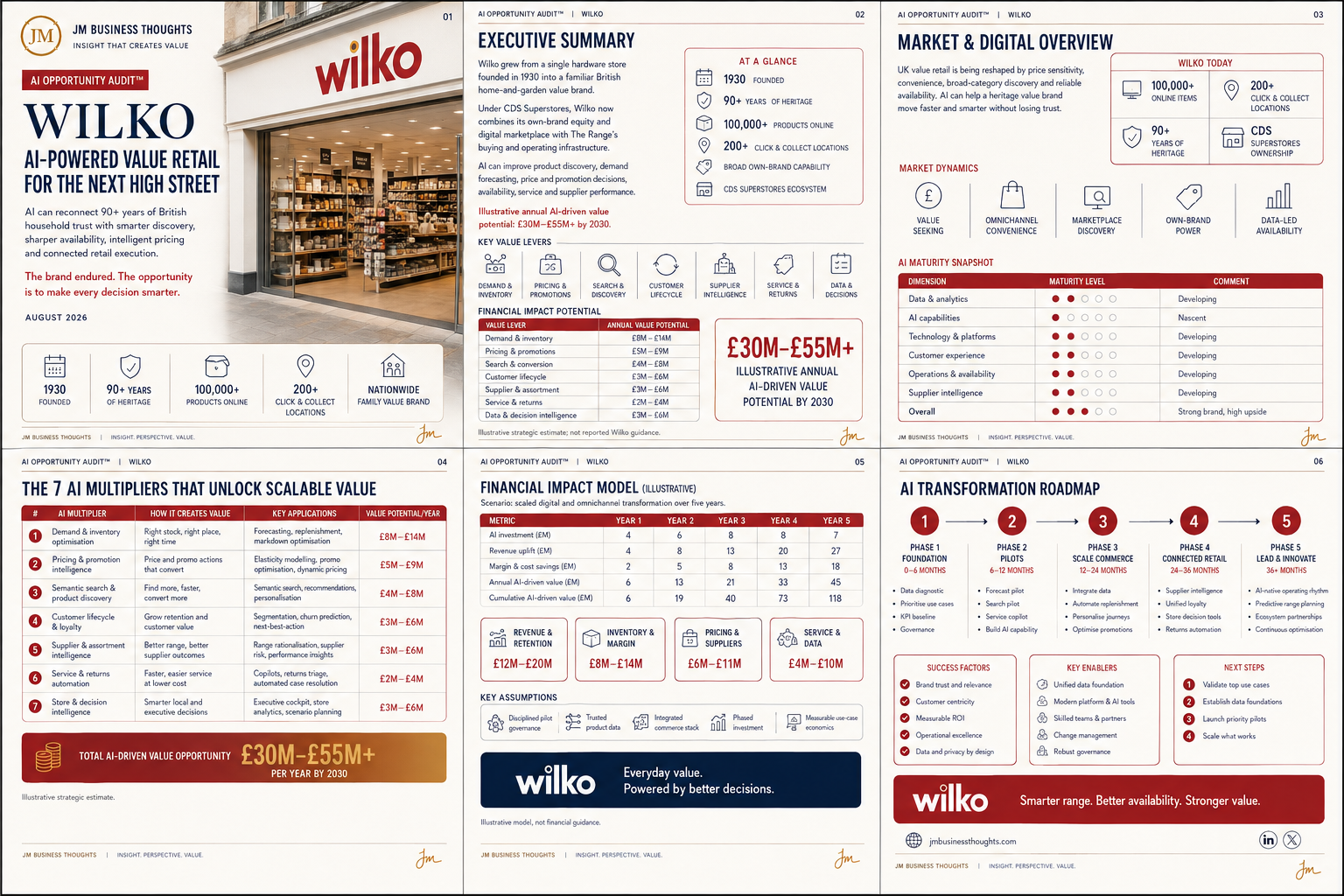
Wilko: The Value Wasn’t Lost. It Was Mispriced. full strategic breakdown
Mispriced Assets™ · UK & Global Retail Lost Giants — Wilko: the full six-page institutional case study covering the cover and thesis, executive summary and investment highlights, market overview and structural tailwinds in UK value retail, the seven AI value multipliers, the FY2025E–FY2029E financial impact model and value creation outlook, and the three-phase transformation roadmap.

The Verdict

Ninety-plus years of trust, ~400 stores, 14,000+ own-brand SKUs and 7M customers a week — written off in 2023 while the category they served kept growing and the share moved to adjacent value retailers. Wilko did not lose its customers; it lost cost control, ranging discipline and any data capability while its competitors built one. Those three failures map exactly onto the highest-value AI applications in retail. Rebuilt on re-rated leases, a disciplined range and a real intelligence layer, the same business supports £1.23BN of revenue, 39.0% gross margin, £155M of EBITDA and £30M – £55M+ of annual AI-driven value. The value wasn’t lost. It was mispriced.

JM founder signature
68 · PureGym — Fitness At Scale. More Personal. More Inclusive.67 · SIXT — Smarter Mobility. Greater Availability. A More Connected Tomorrow.66 · Sendwave — Money That Moves With Intelligence.65 · McDonald’s — Serving The Future With AI.64 · Compare the Market — Smarter Comparison. Better Matches. Brighter Tomorrows.63 · WeBuyAnyCar — Smarter Pricing. Faster Offers. Better Conversion.62 · Primark — Affordable Fashion. Greater Possibilities With AI.61 · Starbucks — Smarter Stores. Stronger Loyalty. Better Margins.60 · IKEA — AI-Powered Home Retail at Global Scale59 · H&M — Smarter Fashion. Brighter Tomorrow.58 · WeWork — The Value Wasn't Lost. It Was Mispriced.57 · Yahoo — The Value Wasn't Lost. It Was Mispriced.56 · Nando's UK — Smarter Restaurants. Stronger Loyalty. Better Margins.55 · The Amplifier54 · The Body Shop53 · Arcadia Group52 · Cazoo51 · Blockbuster50 · Carpetright47 · Phones 4u46 · Farfetch45 · Jumia44 · Toys ‘R’ Us43 · The Collateral Gap — Part One41 · The Amplifier40 · Africa Bee Farming39 · Kenya Airways38 · Africa Greenhouse Farming37 · Uganda Tourism Board36 · Boots UK35 · Biffa (UK)34 · NatWest33 · Skip Hire Companies UK33 · The Audit32 · The Lean Company31 · Africa Mushroom Farming29 · The Rider Economy Nobody Verified28 · The Layer Underneath the Layer27 · Independent Timber Yards & Jewson Timber26 · Link Up TV & GRM Daily25 · East African Portland Cement42 · International Student Credential & Financial Verification — Part One24 · The Supply Chain Inside the Supply Chain23 · The White Space, Mapped22 · The Real Opportunity21 · Greencore20 · West Ham United19 · Roofings Group Uganda18 · Mombasa Port17 · Auto Trader UK16 · Uganda Coffee Development Authority15 · Brookside Dairy14 · GraceKennedy13 · Rightmove12 · Manchester United11 · Greggs30 · Twiga Foods10 · Uchumi09 · Konga08 · Edcon09 · GAME07 · Debenhams06 · Claire's05 · Boohoo04 · Argos