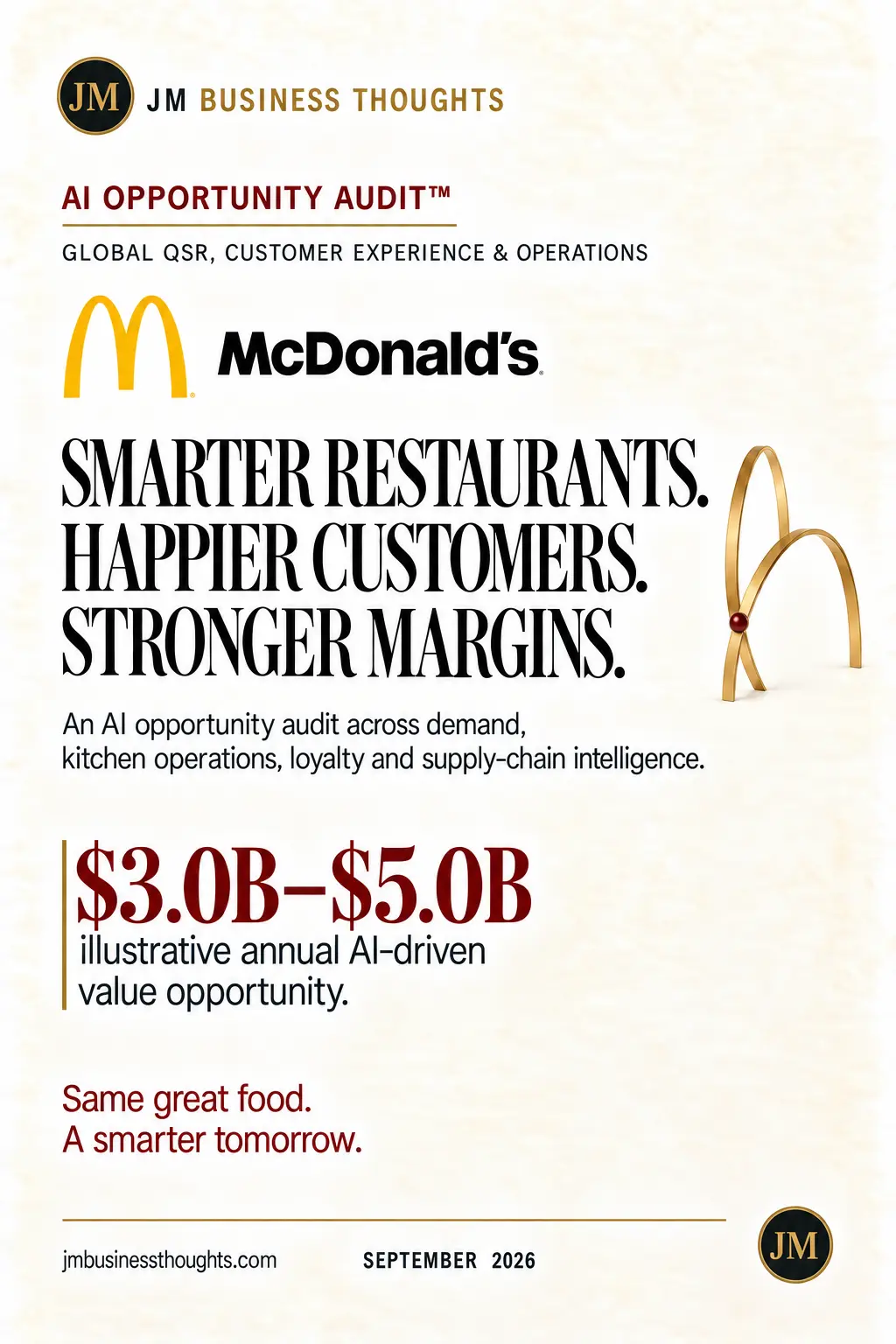
Sendwave — Money That Moves With Intelligence. research poster
All Research

The Hidden AI Operating System Audit Series™

Where AI creates new profit pools—not just productivity.

66AI Opportunity Audit™ 17 min readSeptember 2026
Coverage · Global Remittance Corridors · Africa, Asia & Diaspora · Institutional CoverageSector · Cross-Border Payments, Compliance & Digital Financial ServicesFormat · Six-page audit

Sendwave — Money That Moves With Intelligence.Lower cost. Faster settlement. Deeper trust in every corridor.

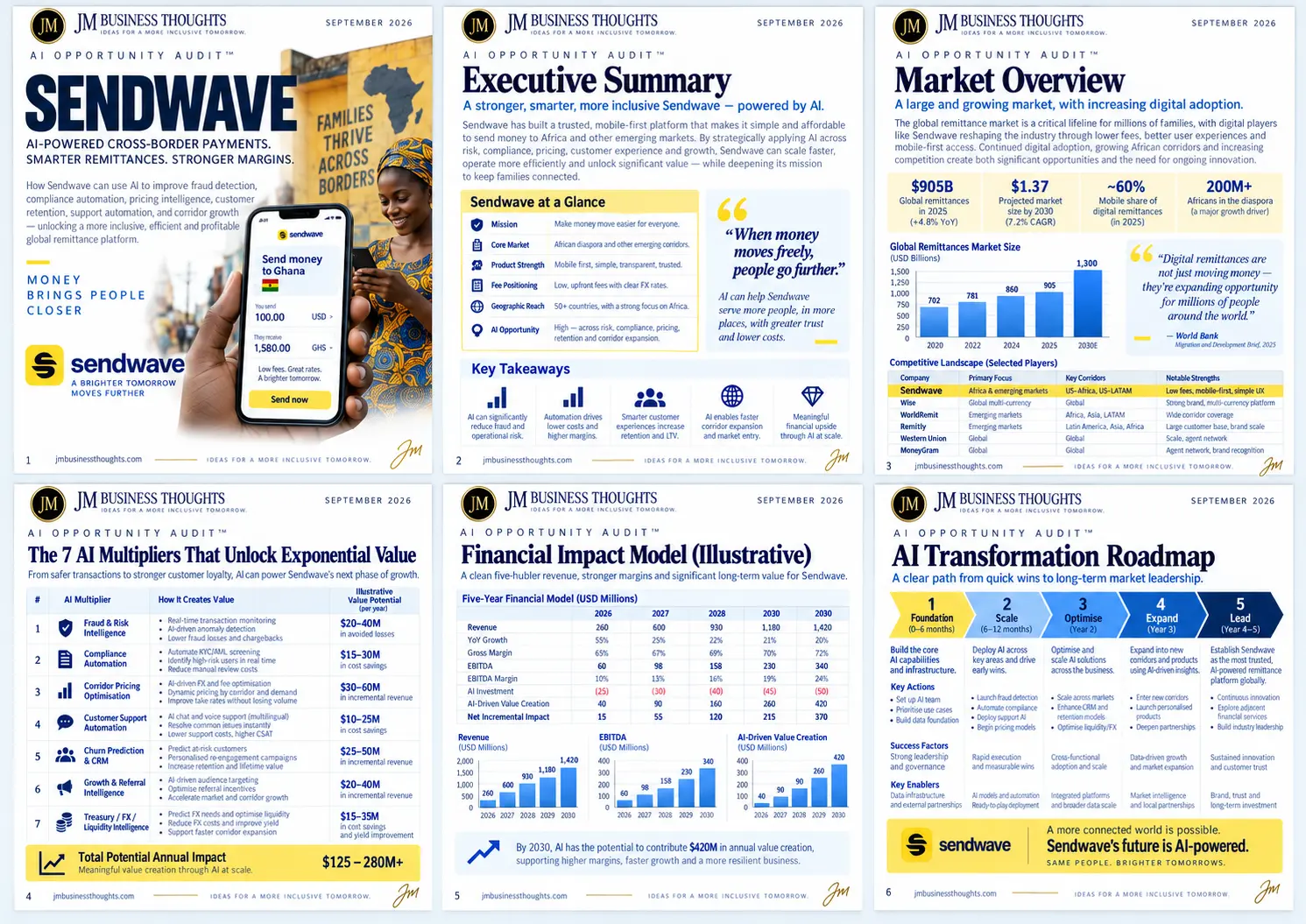
Sendwave built its position on a simple promise in one of the world’s hardest markets: fast, low-cost mobile remittances into Africa and Asia, where the global remittance flow exceeds $860BN a year and the average cost of sending $200 still runs above 6%. This audit sizes $120M–$260M+ of illustrative annual AI-driven value by 2030 across seven multipliers spanning fraud and AML, onboarding and KYC, treasury and FX, corridor pricing, customer support automation, retention and payout-partner intelligence.

Annual AI Value by 2030

$120M – $260M+

Global Remittance Flows

$860BN+

Flows To Low & Middle Income Markets

$685BN+

Average Cost To Send $200

6.2%

UN SDG Target Cost

3.0%

Digital Remittance CAGR

12–15%

Cost To Serve Reduction

25–40%

Value Multipliers

7

The Thesis

Remittances are the most consequential consumer financial flow in the world: $860BN+ a year, exceeding foreign direct investment into most receiving economies, and paid for almost entirely by the people who can least afford the spread. Sendwave’s proposition — fast, low-cost, mobile-first transfers into Africa and Asia — attacks exactly that spread. But the economics of a low-fee remittance business are unforgiving: margin per transaction is thin, so profitability is determined by four costs the customer never sees — fraud losses, compliance and onboarding, FX and pre-funded liquidity, and cost to serve. Each of those is a model problem before it is a headcount problem. AI does not change the promise; it makes the promise sustainable at scale, and lets the saving be passed to the sender rather than absorbed by the operation.

Exhibit · Report Cover

66 · AI Opportunity Audit™

Sendwave — Money That Moves With Intelligence. report cover
Sendwave — Money That Moves With Intelligence.September 2026 · Global Remittance Corridors · Africa, Asia & Diaspora · Institutional Coverage
01

Executive summary — thin margins, heavy trust, high AI leverage

At a glance: $860BN+ of annual global remittance flows, $685BN+ into low and middle income countries, an average cost of 6.2% to send $200 against a UN Sustainable Development Goal target of 3.0%, and digital remittance growth compounding at 12–15% a year.

Sendwave competes on speed, price and trust in corridors where all three are hard to hold simultaneously. Every basis point of fraud loss, every hour of manual compliance review and every point of FX spread is a direct claim on a thin per-transaction margin.

Six key value levers frame the audit: fraud and AML intelligence; onboarding and KYC automation; treasury, FX and liquidity optimisation; corridor pricing intelligence; customer support automation; and retention with payout-partner performance analytics.

Illustrative annual AI-driven value potential by 2030: $120M – $260M+, delivered through lower fraud and compliance cost, better FX and liquidity management, higher onboarding conversion and a 25–40% reduction in cost to serve.

The customer sees the fee. The margin lives in fraud, compliance, FX and cost to serve.
  • $860BN+ global remittance flows · $685BN+ into LMICs
  • Average cost to send $200: 6.2% against a 3.0% SDG target
  • Digital remittance growth: 12–15% CAGR
  • $120M – $260M+ illustrative annual AI value by 2030
02

Market and competitive overview — digital-first, corridor-specific, trust-led

Five market trends define the environment: rapid migration of remittance volume from cash agents to mobile wallets; mobile money penetration in East and West Africa exceeding traditional banking reach; regulatory tightening on AML, sanctions and beneficial ownership; growing price transparency as comparison tools mature; and stablecoin and real-time payment rails compressing settlement times.

The competitive landscape includes Wise, Remitly, WorldRemit, Western Union, MoneyGram and Chipper Cash, alongside mobile money operators who both distribute and compete. Sendwave’s illustrative positioning is very high on speed and mobile-first simplicity, high on price competitiveness and corridor depth, and medium on applied AI in compliance, treasury and service automation.

Corridor economics differ sharply. A corridor is not a market; it is a distinct combination of regulation, payout partner reliability, FX volatility and fraud typology. Models trained corridor-by-corridor materially outperform global models — which is an advantage available to focused operators and difficult for generalists.

Trust is the binding constraint. In remittance, a single failed or delayed payout does not lose a transaction; it loses a household and its referral network.

A corridor is not a market. It is a distinct regulatory, FX and fraud environment.
  • Competitive set: Wise, Remitly, WorldRemit, Western Union, MoneyGram, Chipper Cash
  • Mobile money reach now exceeds traditional banking in key corridors
  • Regulatory tightening on AML, sanctions and beneficial ownership
  • Corridor-specific models materially outperform global models
03

The trust layer — fraud, AML and onboarding

Fraud and AML intelligence ($30m–$65m by 2030) is the largest single lever: behavioural fraud models, network analysis on sender and recipient graphs, and transaction monitoring tuned per corridor. In remittance, fraud and compliance are the same discipline viewed from two regulators.

The under-appreciated win is false positives. Manual review of legitimate transactions is expensive twice — the analyst hour, and the customer who is delayed and does not return. Reducing false positives improves cost and retention with a single model.

Onboarding and KYC automation ($20m–$45m) applies document intelligence, liveness checks and risk-based verification to lift completion rates. Onboarding drop-off in this category is among the highest in consumer fintech, and every abandoned sign-up is fully paid-for demand lost.

Together, this layer converts compliance from a fixed cost of operating into a variable, measurable and improvable process — while strengthening rather than weakening regulatory posture.

A false positive costs twice: the analyst hour, and the customer who does not come back.
  • 01 Fraud & AML intelligence · $30m–$65m — the largest lever
  • 02 Onboarding & KYC automation · $20m–$45m
  • False-positive reduction improves cost and retention simultaneously
  • Compliance becomes measurable and improvable, not merely fixed
04

The economics layer — treasury, pricing, service and partners

Treasury, FX and liquidity optimisation ($25m–$55m) forecasts corridor-level volume to size pre-funding, reduce idle float and time FX execution. Pre-funded liquidity is the largest balance-sheet cost in a fast-payout model, and it is almost entirely a forecasting problem.

Corridor pricing intelligence ($15m–$35m) models elasticity by corridor, sender segment and send amount — allowing price to be lowered where it wins volume and held where it does not, instead of moving uniformly.

Customer support automation ($15m–$30m) deploys multilingual AI assistants and agent augmentation across time zones, contributing most of the 25–40% cost-to-serve reduction while improving first-contact resolution on payout status enquiries — the dominant contact driver.

Retention and referral intelligence ($10m–$20m) plus payout-partner performance analytics ($5m–$10m) close the loop: predicting send-cycle timing, and routing payouts to the partner most likely to settle successfully first time in each corridor.

Pre-funded liquidity is the largest balance-sheet cost in fast payout — and almost entirely a forecasting problem.
  • 03 Treasury, FX & liquidity optimisation · $25m–$55m
  • 04 Corridor pricing intelligence · $15m–$35m
  • 05 Customer support automation · $15m–$30m
  • 06 Retention & referral · $10m–$20m · 07 Payout-partner analytics · $5m–$10m
05

Financial impact model (illustrative) — lower cost to serve, passed to the sender

Indexed transaction volume grows 100 → 118 → 140 → 166 → 196 → 232 across FY2025 to FY2030E, in line with digital remittance category growth of 12–15%.

Cost to serve per transaction is indexed 100 → 92 → 84 → 76 → 68 → 62 — a 38% reduction driven by support automation, KYC straight-through processing and fraud false-positive reduction.

Fraud loss rate is modelled down by 35–50% from baseline, onboarding completion up 8–15 percentage points, and FX and float cost down 15–25% through corridor-level liquidity forecasting.

AI-driven annual value ($m) builds 15 → 45 → 90 → 160 → 240 on the illustrative path, with contribution margin per transaction expanding while headline customer pricing falls. Key assumptions: continued corridor expansion, regulatory stability, phased model deployment, and disciplined investment. Illustrative JM Business Thoughts scenario — not company guidance.

Cost to serve down 38%, fraud losses down 35–50% — while the price to the sender falls.
  • Transaction volume indexed: 100 → 232 (FY2025–FY2030E)
  • Cost to serve per transaction indexed: 100 → 62
  • Fraud loss rate down 35–50% · onboarding completion up 8–15pp
  • AI-driven annual value: $15m → $240m
06

AI transformation roadmap — five phases

Phase 1, Foundation (0–6 months): unify transaction, customer and corridor data, establish model governance and regulatory explainability standards, and baseline fraud, onboarding and support metrics per corridor.

Phase 2, Pilot & Prove (6–12 months): pilot fraud and false-positive models plus KYC automation in two or three corridors, measure at unit-economics level, and secure regulator comfort with model documentation.

Phase 3, Scale Trust & Service (12–24 months): scale fraud, AML and support automation across all corridors, deploy multilingual assistants, and integrate risk-based verification into the main onboarding flow.

Phase 4, Optimise Economics (24–36 months): deploy treasury and liquidity forecasting, corridor pricing intelligence and payout-partner routing; pass realised savings into customer pricing to compound volume.

Phase 5, Lead & Extend (36+ months): extend into adjacent financial services for the diaspora — savings, credit history portability and bill payment — built on the trust and data already earned. Success factors: regulatory transparency, corridor-level model discipline, payout partner reliability, and unwavering focus on the sender’s cost.

Pass the saving to the sender. Volume, not spread, is the compounding asset.
  • Phase 1 Foundation · 0–6 months · Phase 2 Pilot & Prove · 6–12 months
  • Phase 3 Scale Trust & Service · 12–24 months
  • Phase 4 Optimise Economics · 24–36 months
  • Phase 5 Lead & Extend · 36+ months
07

Sources and method

Market data: World Bank remittance flow estimates and Remittance Prices Worldwide cost benchmarks (2025), including the $860BN+ global flow, $685BN+ LMIC flow and 6.2% average cost to send $200 against the 3.0% SDG target.

Category growth: published digital remittance market research, 2024–2030E, at 12–15% CAGR.

Competitive landscape: positioning for Wise, Remitly, WorldRemit, Western Union, MoneyGram and Chipper Cash; AI maturity assessments are analyst-assigned and directional.

Method note: each multiplier is sized independently against corridor volume and cost-to-serve economics, then netted for overlap before the total annual range is stated. Illustrative JM Business Thoughts scenario — not company guidance.

The Multiplier Framework

7 compounding levers

The seven AI multipliers that make low-cost remittance sustainable at scale — aggregating to $120M – $260M+ of illustrative annual value by 2030 and a 25–40% reduction in cost to serve.

01

Fraud & AML Intelligence

Lower losses, fewer false positives, stronger regulatory posture.

  • Behavioural fraud models tuned per corridor
  • Sender–recipient network analysis
  • Explainable transaction monitoring for regulators

Outcome · $30m – $65m by 2030

02

Onboarding & KYC Automation

Higher completion, faster first send.

  • Document intelligence and liveness checks
  • Risk-based verification tiers
  • Drop-off prediction and recovery

Outcome · $20m – $45m by 2030

03

Treasury, FX & Liquidity Optimisation

Less idle float, better FX execution.

  • Corridor-level volume forecasting
  • Pre-funding optimisation
  • FX timing and hedging intelligence

Outcome · $25m – $55m by 2030

04

Corridor Pricing Intelligence

Price where it wins volume, hold where it does not.

  • Elasticity by corridor, segment and send amount
  • Promotional and first-send offer optimisation
  • Competitive price monitoring

Outcome · $15m – $35m by 2030

05

Customer Support Automation

Faster resolution across languages and time zones.

  • Multilingual AI assistants on payout status
  • Agent augmentation and quality analytics
  • Proactive delay notification

Outcome · $15m – $30m by 2030

06

Retention & Referral Intelligence

Predict the send cycle, earn the referral.

  • Send-cycle timing prediction
  • Churn and lapse modelling
  • Diaspora community referral targeting

Outcome · $10m – $20m by 2030

07

Payout-Partner Performance Analytics

Route to the partner that settles first time.

  • Partner success-rate and latency scoring
  • Dynamic payout routing per corridor
  • Failure prediction and automatic re-routing

Outcome · $5m – $10m by 2030

Sendwave — Money That Moves With Intelligence. full strategic breakdown
AI Opportunity Audit™ · Sendwave — the full six-page institutional report covering the cover and market at a glance, the executive summary and key value levers, the global remittance market and competitive overview, the seven AI multipliers with value ranges, the illustrative financial impact model, and the five-phase AI transformation roadmap.

The Verdict

A $860BN+ flow still costing senders 6.2% against a 3.0% target, served by an operator whose entire promise is speed and price — with applied AI maturity in compliance, treasury and service still rated medium. Seven multipliers, led by fraud and AML intelligence, KYC automation and liquidity forecasting, size $120M – $260M+ of illustrative annual value by 2030, cut cost to serve by 38% and reduce fraud losses by 35–50%. Lower cost. Faster settlement. Deeper trust in every corridor.

JM founder signature
68 · PureGym — Fitness At Scale. More Personal. More Inclusive.67 · SIXT — Smarter Mobility. Greater Availability. A More Connected Tomorrow.64 · Compare the Market — Smarter Comparison. Better Matches. Brighter Tomorrows.63 · WeBuyAnyCar — Smarter Pricing. Faster Offers. Better Conversion.62 · Primark — Affordable Fashion. Greater Possibilities With AI.61 · Starbucks — Smarter Stores. Stronger Loyalty. Better Margins.60 · IKEA — AI-Powered Home Retail at Global Scale59 · H&M — Smarter Fashion. Brighter Tomorrow.58 · WeWork — The Value Wasn't Lost. It Was Mispriced.57 · Yahoo — The Value Wasn't Lost. It Was Mispriced.56 · Nando's UK — Smarter Restaurants. Stronger Loyalty. Better Margins.55 · The Amplifier54 · The Body Shop53 · Arcadia Group52 · Cazoo51 · Blockbuster50 · Carpetright49 · Wilko48 · Mothercare47 · Phones 4u46 · Farfetch45 · Jumia44 · Toys ‘R’ Us43 · The Collateral Gap — Part One41 · The Amplifier40 · Africa Bee Farming39 · Kenya Airways38 · Africa Greenhouse Farming37 · Uganda Tourism Board36 · Boots UK35 · Biffa (UK)34 · NatWest33 · Skip Hire Companies UK33 · The Audit32 · The Lean Company31 · Africa Mushroom Farming29 · The Rider Economy Nobody Verified28 · The Layer Underneath the Layer27 · Independent Timber Yards & Jewson Timber26 · Link Up TV & GRM Daily25 · East African Portland Cement42 · International Student Credential & Financial Verification — Part One24 · The Supply Chain Inside the Supply Chain23 · The White Space, Mapped22 · The Real Opportunity21 · Greencore20 · West Ham United19 · Roofings Group Uganda18 · Mombasa Port17 · Auto Trader UK16 · Uganda Coffee Development Authority15 · Brookside Dairy14 · GraceKennedy13 · Rightmove12 · Manchester United11 · Greggs30 · Twiga Foods10 · Uchumi09 · Konga08 · Edcon09 · GAME07 · Debenhams06 · Claire's05 · Boohoo04 · Argos