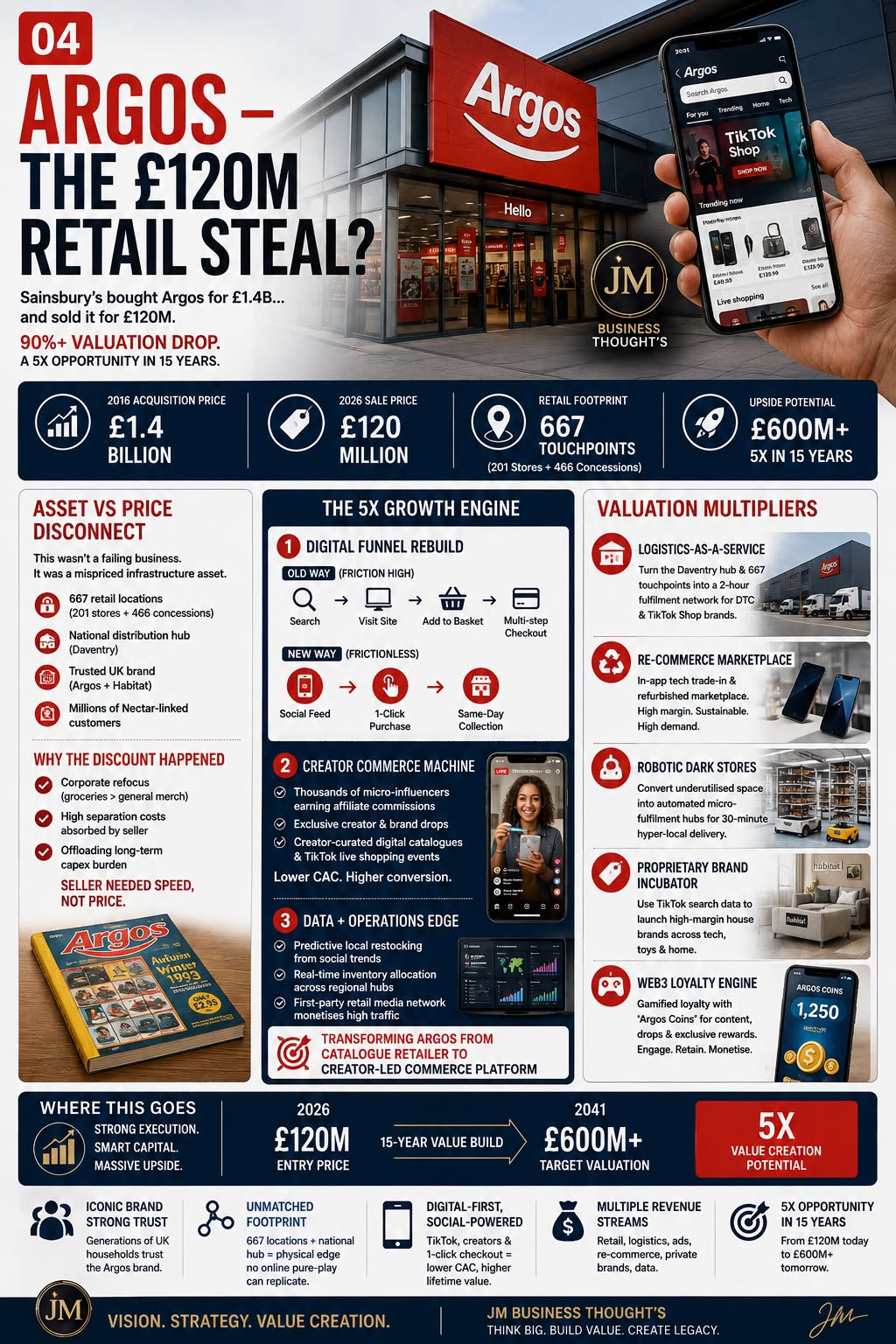
01
Test-and-Repeat Supply Engine
Speed is the asset.
- Concept to shelf in weeks with small first runs
- Scale only proven winners, kill losers early
- Near-shore capacity for reactive replenishment
Outcome · Lower markdown risk and cleaner inventory
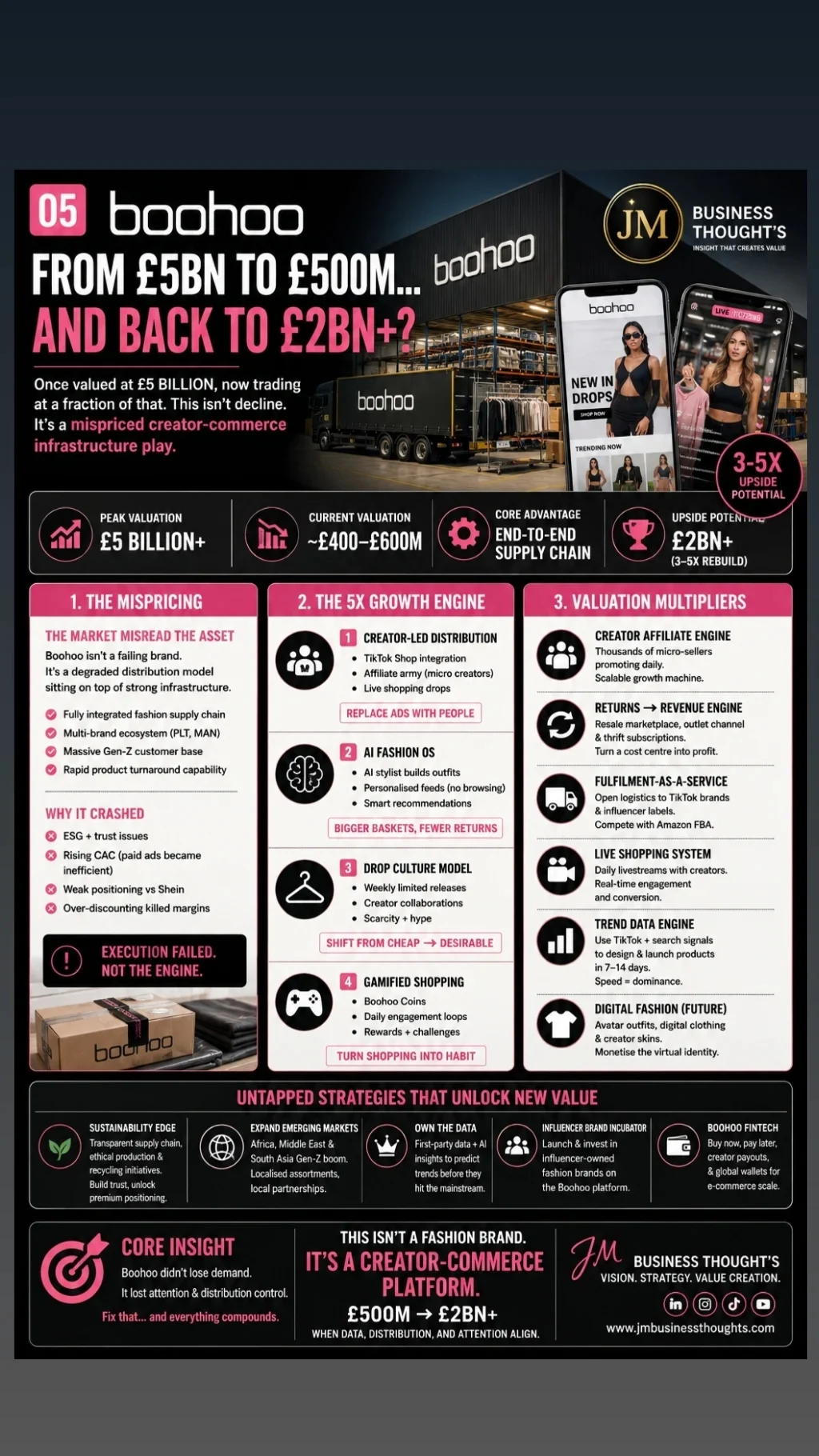
A degraded distribution model sitting on top of strong infrastructure. Execution failed — not the engine.
Peak Cap
£5BN
Trough
£500M
Owned Brands
12+
Recovery Case
£2BN+
The Thesis
Boohoo built one of the fastest test-and-repeat supply chains in Western fashion, then attached it to a brand portfolio the market stopped trusting. The infrastructure retained its value. The narrative did not.
Exhibit · Report Cover
05 · Creator Economy
Boohoo can move a design from concept to shelf in a matter of weeks, with small initial runs and rapid scale-up on winners. That capability is genuinely scarce and extremely expensive to replicate.
What collapsed was demand quality: heavy discounting, returns leakage and a customer trained to wait for the next promotion.
The supply chain is an asset. The discount habit is the liability.
Three forces compounded: post-pandemic normalisation, an ESG and governance shock that damaged institutional confidence, and the arrival of ultra-low-cost competition that reset the price floor.
Each individually was survivable. Together they removed the premium the market once paid for growth.
Recovery does not require a return to hypergrowth. It requires the portfolio to be treated as separable assets: distinct brands with distinct customers, some monetised, some spun, some scaled.
Layer creator-led demand generation on top of the existing supply engine and the business converts from a discount retailer into a fashion platform with owned distribution.
If pricing power does not return, the infrastructure advantage becomes a commoditised logistics business. Speed only creates value when the customer is willing to pay for newness rather than cheapness.
The Multiplier Framework
Five levers re-price the customer and convert a discount retailer into a fashion platform with owned supply and owned distribution.
Speed is the asset.
Outcome · Lower markdown risk and cleaner inventory
Twelve brands, twelve P&Ls.
Outcome · Value unlocked from assets hidden inside the group
Own audiences, rent none.
Outcome · Structurally lower customer acquisition cost
Margin lives in the last mile.
Outcome · Gross margin recovery without a price increase
Cheaper capital is a growth lever.
Outcome · A lower cost of capital and a restored multiple
The Verdict
Rarely does the market get to buy world-class operational infrastructure at distressed-brand prices. The question is whether management can re-price the customer.