01
Dynamic Pricing & Valuation
More accurate, real-time pricing and higher conversion.
- ML pricing models on five million transactions
- Live market data and residual signals
- Vehicle condition analysis in the price
Outcome · £30m – £60m by 2030
The Hidden AI Operating System Audit Series™
Where AI creates new profit pools—not just productivity.
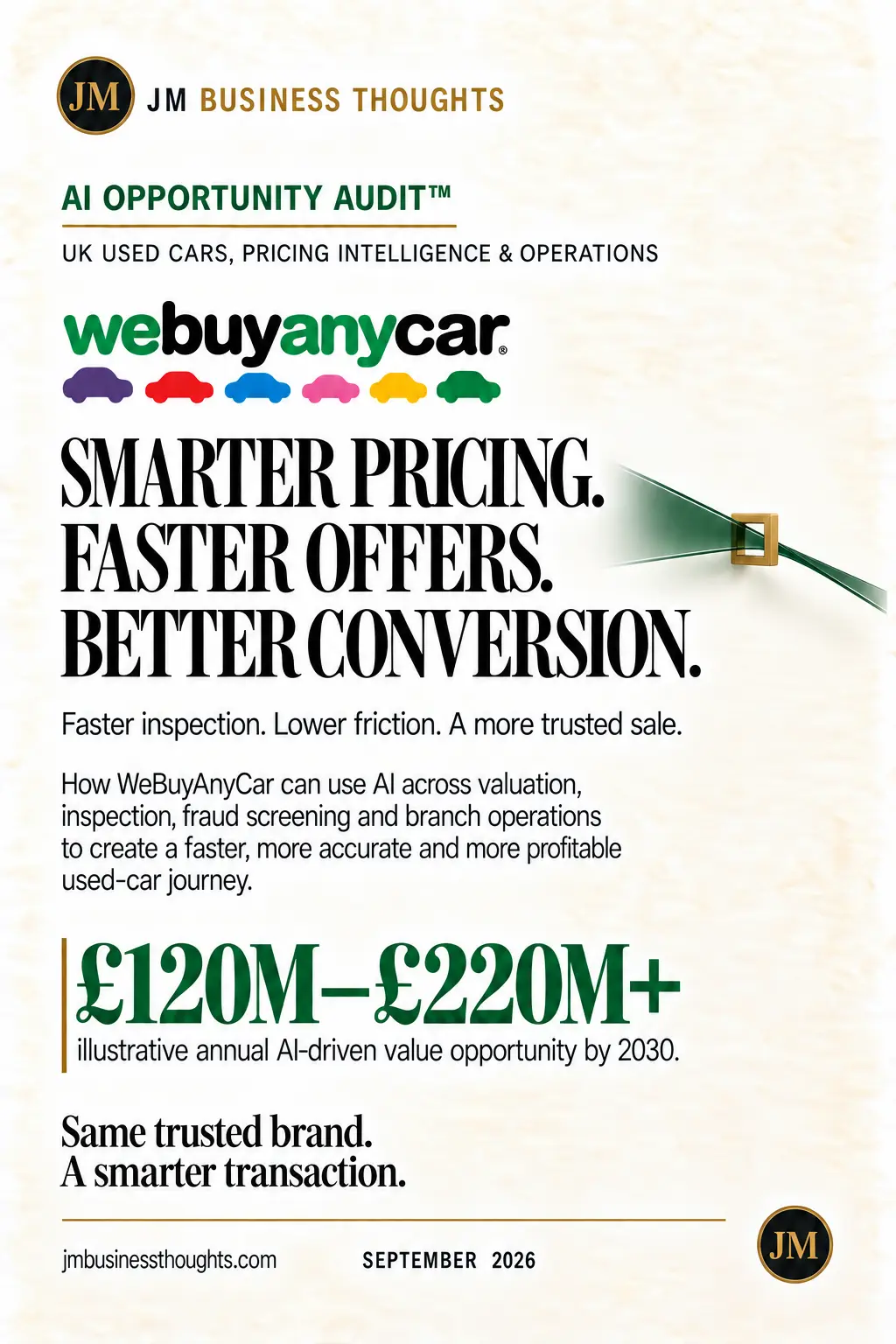
WeBuyAnyCar is one of the UK's most recognisable consumer brands: 550+ branches, 20 years in operation, 5M+ cars bought to date and a digital quote engine that sets the market's reference price. This audit sizes £120M–£220M+ of illustrative annual AI-driven value by 2030 across valuation, inspection, lead conversion, branch operations, fraud screening, reconditioning and retention — creating a faster, more accurate and more profitable used-car journey without changing the promise that made the brand.
Annual AI Value by 2030
£120M – £220M+
Branches Across The UK
550+
Years In Operation
20
Cars Bought To Date
5M+
Revenue (FY2025)
£1,020M
UK Used-Car Market (2030E)
£115BN
Conversion Rate (FY25 → FY30E)
28.0% → 36.0%
Value Multipliers
7
The Thesis
WeBuyAnyCar's moat is convenience, a trusted brand, a unique pricing engine and a nationwide branch network — a powerful platform to amplify with AI. The business model is deceptively simple and unusually data-rich: every online quote, every branch inspection, every completed and abandoned sale is a labelled training example on price accuracy and customer intent. The economics turn on three numbers — conversion from quote to completed sale, the precision of the price at which a car is bought, and the cost of the inspection and branch time required to complete it. All three are model problems. AI can unlock significant additional value by improving conversion, increasing pricing precision, strengthening fraud detection, standardising inspection quality and boosting branch productivity. Same trusted brand. A smarter transaction.
Exhibit · Report Cover
63 · AI Opportunity Audit™
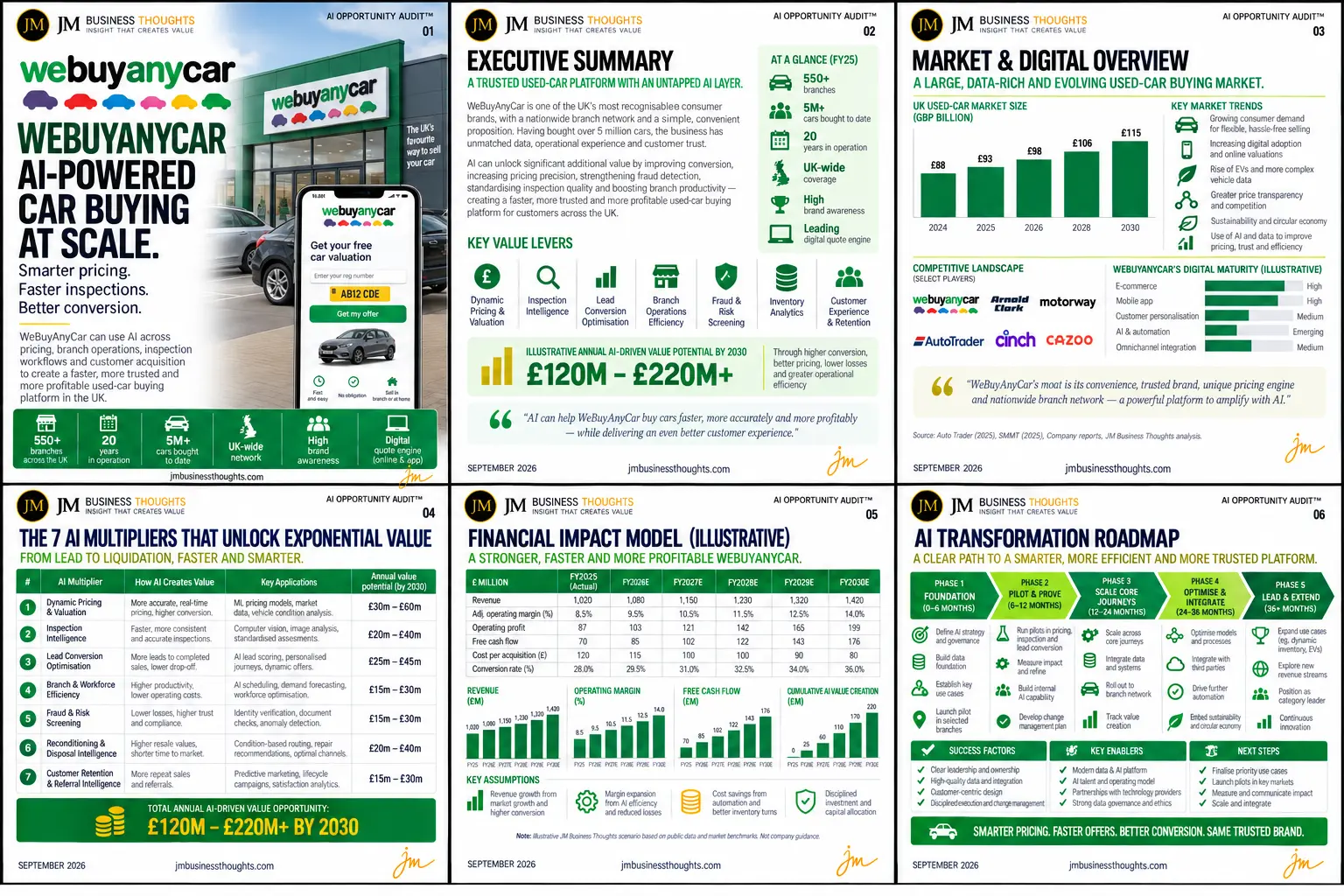
At a glance for FY25: 550+ branches, 5M+ cars bought to date, 20 years in operation, UK-wide coverage, high brand awareness and a leading digital quote engine.
WeBuyAnyCar is one of the UK's most recognisable consumer brands, with a nationwide branch network and a simple, convenient proposition. Having bought over 5 million cars, the business has unmatched pricing data, operational experience and customer trust.
Six key value levers frame the audit: dynamic pricing and valuation; inspection intelligence; lead conversion optimisation; branch operations efficiency; fraud and risk screening; and inventory analytics with customer experience and retention.
Illustrative annual AI-driven value potential by 2030: £120M – £220M+, delivered through higher conversion, better pricing, lower losses and greater operational efficiency.
Five million cars bought is not a track record. It is a training set.
The UK used-car market is modelled at £88bn (2024), £93bn (2025), £98bn (2026), £106bn (2028) and £115bn (2030) — a market growing steadily while becoming structurally more digital.
Five market trends define the environment: growing consumer demand for flexible, hassle-free selling; increasing digital adoption and online valuations; the rise of EVs and more complex vehicle data; greater price transparency and competition; and the use of AI and data to improve pricing, trust and efficiency.
The competitive landscape includes WeBuyAnyCar, Arnold Clark, Motorway, Auto Trader, Cinch and Cazoo. WeBuyAnyCar's digital maturity is high in e-commerce and mobile app, medium in customer personalisation and omnichannel integration, and emerging in AI and automation — which is exactly where the value sits.
EV complexity is the underappreciated driver. Battery state-of-health, warranty position and residual volatility make accurate valuation harder every year — which raises the return on a model that gets it right.
EVs make valuation harder every year — which raises the return on getting it right.
Dynamic pricing and valuation (£30m–£60m by 2030) delivers more accurate, real-time pricing and higher conversion using ML pricing models, market data and vehicle condition analysis. Price is simultaneously the marketing message and the gross margin — precision compounds on both sides.
Inspection intelligence (£20m–£40m) makes inspections faster, more consistent and more accurate through computer vision, image analysis and standardised assessments. The variance between two branches inspecting the same car is a direct, measurable margin leak.
Fraud and risk screening (£15m–£30m) lowers losses and raises trust and compliance through identity verification, document checks and anomaly detection — essential in a high-value cash-out transaction executed at scale.
Together, this layer converts a subjective, branch-level judgement into a governed, auditable decision that can be measured, improved and defended.
Two branches inspecting the same car differently is not a service issue. It is a margin leak.
Lead conversion optimisation (£25m–£45m) turns more leads into completed sales with lower drop-off through AI lead scoring, personalised journeys and dynamic offers — the fastest path to value because the demand is already paid for.
Branch and workforce efficiency (£15m–£30m) raises productivity and lowers operating costs via AI scheduling, demand forecasting and workforce optimisation across 550+ sites.
Reconditioning and disposal intelligence (£20m–£40m) improves resale values and shortens time to market through condition-based routing, repair recommendations and optimal channel selection — the back half of the transaction, where much of the realised margin is actually set.
Customer retention and referral intelligence (£15m–£30m) generates more repeat sales and referrals through predictive marketing, lifecycle campaigns and satisfaction analytics.
The demand is already paid for. Conversion is the cheapest growth in the model.
Revenue (£m) is modelled at 1,020 (FY2025 actual), 1,080 (FY2026E), 1,150 (FY2027E), 1,230 (FY2028E), 1,320 (FY2029E) and 1,420 (FY2030E).
Adjusted operating margin moves 8.5% → 9.5% → 10.5% → 11.5% → 12.5% → 14.0%, with operating profit (£m) of 87 → 103 → 121 → 142 → 165 → 199 and free cash flow (£m) of 70 → 85 → 102 → 122 → 143 → 176.
Cost per acquisition (£) falls 120 → 115 → 100 → 100 → 90 → 80 while conversion rate rises 28.0% → 29.5% → 31.0% → 32.5% → 34.0% → 36.0%. Cumulative AI value creation (£m) builds — → 25 → 60 → 110 → 170 → 220.
Key assumptions: revenue growth from market growth and higher conversion; margin expansion from AI efficiency and reduced losses; cost savings from automation and better inventory turns; and disciplined investment and capital allocation. Illustrative JM Business Thoughts scenario based on public data and market benchmarks — not company guidance.
Conversion 28% → 36% while acquisition cost falls a third. That is the whole thesis in two lines.
Phase 1, Foundation (0–6 months): define AI strategy and governance, build the data foundation, establish key use cases, and launch a pilot in selected branches.
Phase 2, Pilot & Prove (6–12 months): run pilots in pricing, inspection and lead conversion, measure impact and refine, build internal AI capability, and develop the change management plan.
Phase 3, Scale Core Journeys (12–24 months): scale across core journeys, integrate data and systems, build internal AI capability, and track value creation.
Phase 4, Optimise & Integrate (24–36 months): optimise models and processes, integrate with third parties, drive further automation, and embed sustainability and circular economy practice.
Phase 5, Lead & Extend (36+ months): expand use cases into dynamic inventory and EVs, launch pilots in new markets, position as category leader, and sustain continuous innovation. Success factors: clear leadership and ownership, high-quality data and integration, customer-centric design, and disciplined execution and change management.
Smarter pricing. Faster offers. Better conversion. Same trusted brand.
Company data: WeBuyAnyCar public disclosures and reporting — branch network, years in operation, cumulative cars purchased and UK coverage.
Market sizing: Auto Trader (2025), SMMT (2025), UK used-car market 2024–2030E.
Competitive landscape: positioning for Arnold Clark, Motorway, Auto Trader, Cinch and Cazoo; digital maturity assessments are analyst-assigned and directional.
Method note: each multiplier is sized independently against disclosed transaction and branch scale, then netted for overlap before the total annual range is stated. Illustrative JM Business Thoughts scenario — not company guidance.
The Multiplier Framework
The seven AI multipliers that unlock exponential value — from lead to liquidation, faster and smarter, aggregating to £120M – £220M+ of annual value by 2030.
More accurate, real-time pricing and higher conversion.
Outcome · £30m – £60m by 2030
Faster, more consistent and more accurate inspections.
Outcome · £20m – £40m by 2030
More leads to completed sales, lower drop-off.
Outcome · £25m – £45m by 2030
Higher productivity, lower operating costs.
Outcome · £15m – £30m by 2030
Lower losses, higher trust and compliance.
Outcome · £15m – £30m by 2030
Higher resale values, shorter time to market.
Outcome · £20m – £40m by 2030
More repeat sales and referrals.
Outcome · £15m – £30m by 2030
The Verdict
550+ branches, 20 years, 5M+ cars bought and a quote engine that anchors the market — running on emerging AI maturity. Seven multipliers, led by pricing precision, inspection consistency and lead conversion, size £120M – £220M+ of illustrative annual AI-driven value by 2030, lifting adjusted operating margin from 8.5% to 14.0% and conversion from 28% to 36% while acquisition cost falls from £120 to £80. Same trusted brand. A smarter transaction.