01
Personalised Training & Coaching
Higher engagement, better results, stronger retention.
- AI workout plans and adaptive progression
- Form analysis and coaching prompts
- Confidence-building guidance for new members
Outcome · £20M – £35M by 2030
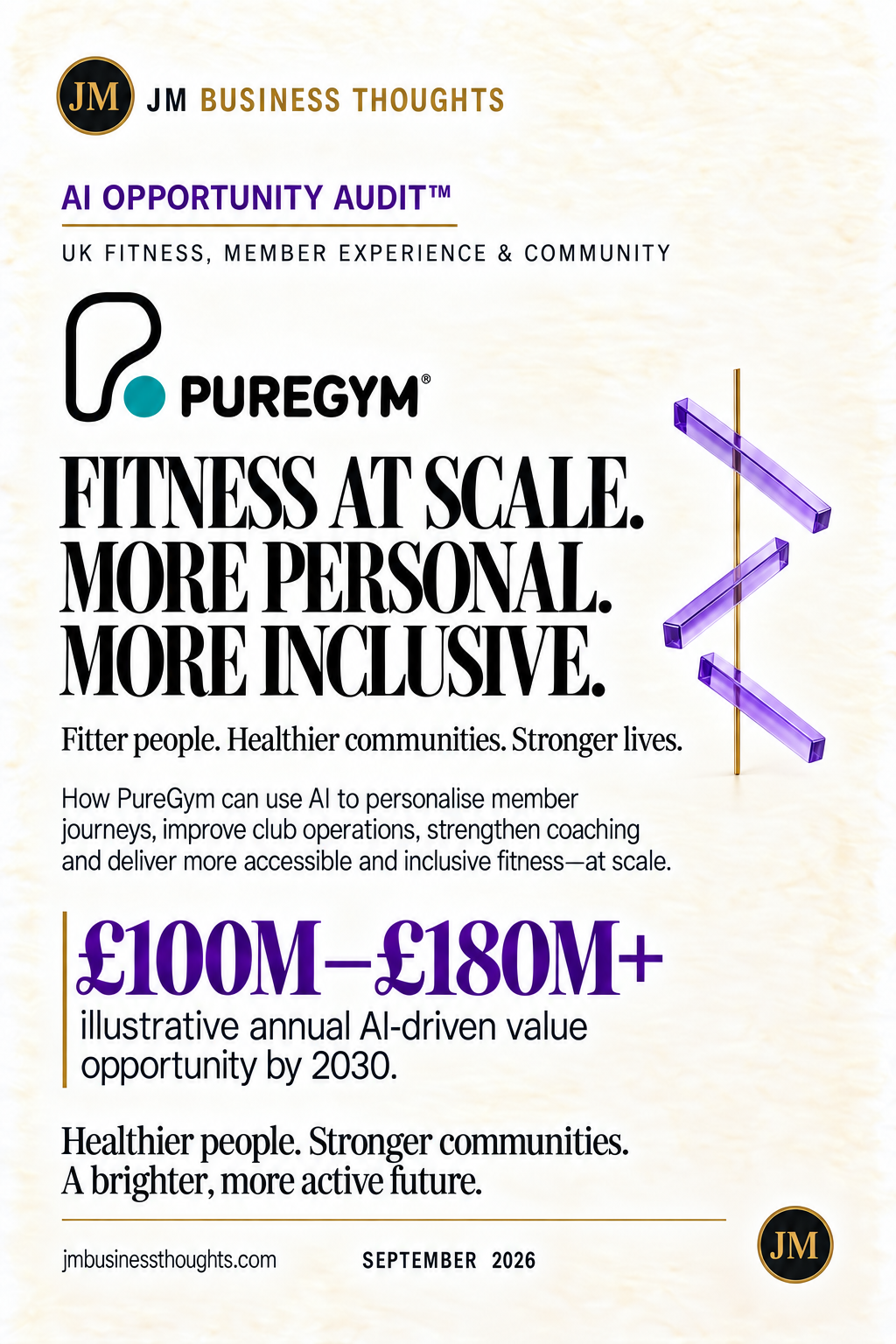
The Hidden AI Operating System Audit Series™
Where AI creates new profit pools—not just productivity.
PureGym is the UK’s leading low-cost gym platform with 1.8M+ members, 700+ clubs, 6,000+ team members, £317M FY2025 revenue and 4.5M+ weekly workouts. This audit sizes £100M–£180M+ of illustrative annual AI-driven value by 2030 across seven multipliers spanning personalised training and coaching, member experience, club operations, demand forecasting, marketing, team productivity and ecosystem growth.
Annual AI Value by 2030
£100M – £180M+
UK Clubs
700+
Members
1.8M+
Team Members
6,000+
FY2025 Revenue
£317M
Weekly Workouts
4.5M+
UK Population Near Clubs
80%+
Value Multipliers
7
The Thesis
PureGym has created one of the most valuable platforms in UK consumer health: a national low-cost estate, high-frequency usage, strong brand accessibility and millions of member journeys measured through access, app, booking and workout behaviour. The next opportunity is not simply more clubs. It is a more intelligent fitness ecosystem: personalised coaching at scale, smarter club operations, better retention, local community engagement and preventive-health partnerships. AI can turn a budget gym model into a mass-market health-support platform, improving commercial performance while making fitness more inclusive and effective.
Exhibit · Report Cover
68 · AI Opportunity Audit™
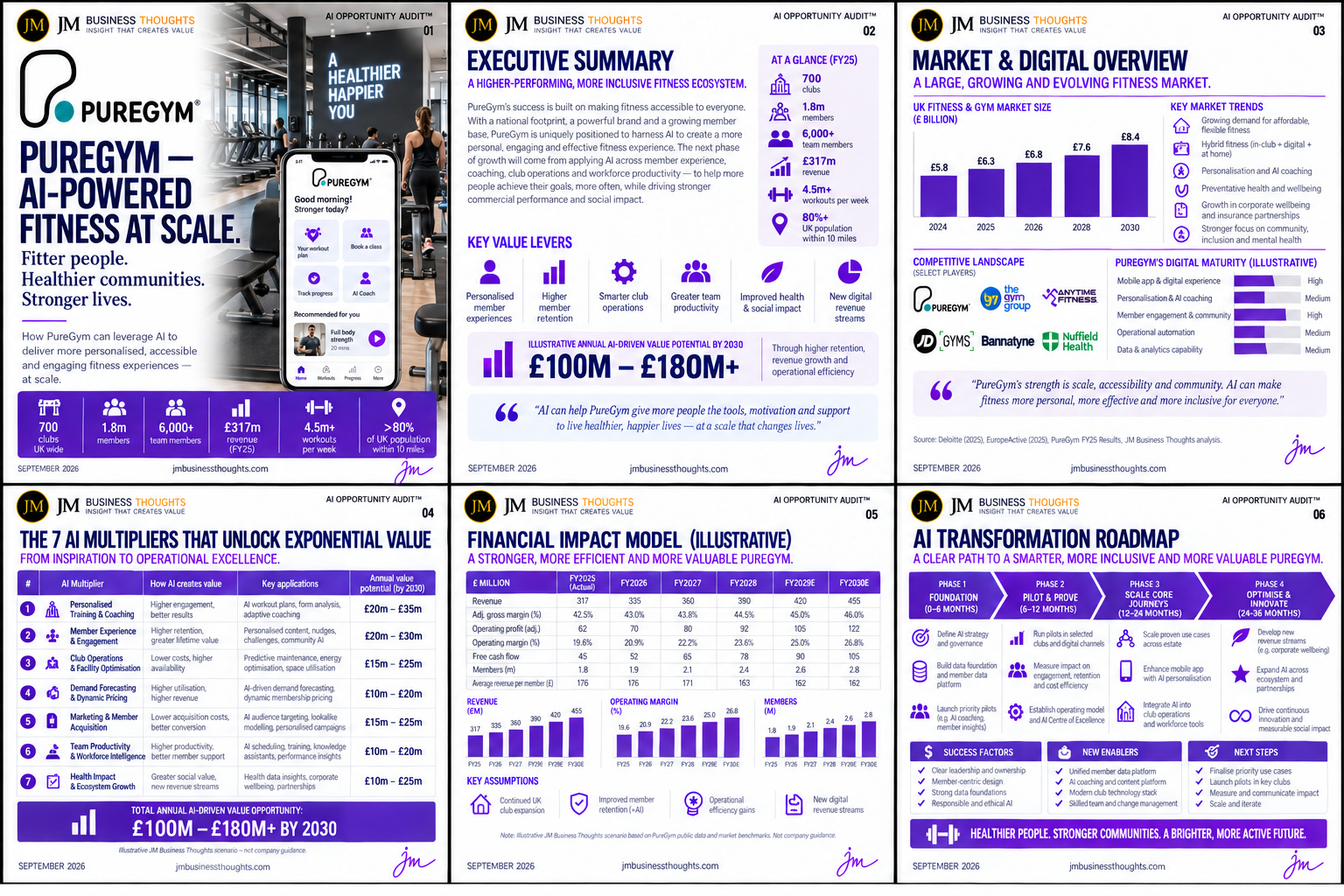
At a glance: 700+ clubs, 1.8M+ members, 6,000+ team members, £317M FY2025 revenue, 4.5M+ workouts per week and more than 80% of the UK population living within ten minutes of a PureGym location.
PureGym’s business model has three unusual advantages for applied AI: high-frequency behavioural data, a large physical footprint and a mission aligned with measurable health outcomes. The gym visit is not an occasional purchase; it is a recurring behavioural loop.
Six key levers frame the opportunity: personalised training and coaching; member experience and engagement; club operations and facility optimisation; demand forecasting and dynamic pricing; marketing and member acquisition; and team productivity, workforce intelligence and health-impact partnerships.
Illustrative annual AI-driven value potential by 2030: £100M – £180M+, delivered through higher retention, revenue growth and operational efficiency.
AI can help PureGym give more people the tools, motivation and support to live healthier, happier lives.
The UK fitness and gym market is modelled at £5.8BN in 2024, £6.3BN in 2025, £6.8BN in 2026, £7.6BN in 2028 and £8.4BN by 2030 as affordable, flexible fitness continues to expand.
Five trends shape the opportunity: rising demand for affordable flexible fitness; hybrid fitness that blends in-club and digital-at-home experiences; personalisation and AI coaching; preventive health and wellbeing; and corporate wellbeing plus insurance partnerships.
The competitive landscape includes The Gym Group, Anytime Fitness, JD Gyms, Bannatyne and Nuffield Health. PureGym’s strengths are scale, accessibility and community; its AI headroom sits in member engagement, coaching, club operations and data intelligence.
The strategic frame is broader than gyms. PureGym can make fitness more personal, more effective and more inclusive for everyone.
Scale is the distribution advantage; personalisation is the next conversion advantage.
Personalised training and coaching (£20M–£35M by 2030) delivers AI workout plans, form analysis, adaptive coaching and progression guidance for members who may never buy a personal trainer but still need structure and confidence.
Member experience and engagement (£20M–£30M) uses hyper-personalised content, nudges, class recommendations and community signals to reduce churn. In a subscription model, the most profitable workout is the one that keeps the member coming back next week.
Marketing and member acquisition (£15M–£25M) improves localised media, joining prompts, lead scoring and campaign optimisation at club catchment level. PureGym’s estate allows market-by-market intelligence rather than national averages.
Health-impact and ecosystem growth (£10M–£25M) connects PureGym with wellbeing, employer, insurance, NHS-adjacent and community-health partners. The data asset becomes not only attendance, but evidence of healthier behaviour.
The value of fitness is created between visits — in motivation, habit and return.
Club operations and facility optimisation (£15M–£25M) reduces downtime, energy cost and maintenance leakage with AI-driven maintenance, energy optimisation, space utilisation and equipment health monitoring.
Demand forecasting and dynamic pricing (£10M–£20M) models member flow, class demand, local events, weather, seasonality and competitor activity to balance capacity, pricing and experience across the estate.
Team productivity and workforce intelligence (£10M–£20M) gives club teams AI scheduling, training support, knowledge assistants and performance insights so smaller teams can deliver a more consistent experience.
The operational win is experience as much as cost: equipment available, cleaner changing rooms, better class scheduling, faster issue resolution and staff in the right place at the right time.
A low-cost gym still competes on certainty: clean, open, available and welcoming.
Revenue is modelled from £317M in FY2025 to £335M, £360M, £390M, £420M and £455M by FY2030E, driven by membership growth, stronger retention, digital services and higher monetisation of the existing estate.
Adjusted gross margin rises from 42.5% to 46.0%, operating profit from £62M to £122M and operating margin from 19.6% to 26.8% as club operations, acquisition efficiency and workforce productivity improve.
Free cash flow builds from £45M to £108M, while members increase from 1.8M to 2.8M and average revenue per member remains disciplined from £176 to £162 as accessibility is protected while value-added services expand.
The model assumes continued UK club expansion, improved member retention through AI, operational-efficiency gains and new digital revenue streams. Illustrative JM Business Thoughts scenario based on public data and market benchmarks — not company guidance.
Revenue £317M → £455M, operating margin 19.6% → 26.8%, members 1.8M → 2.8M.
Phase 1, Foundation (0–6 months): define AI strategy and governance, build data foundation and member data platform, launch priority pilots such as AI coaching and member insights, and prove local club value.
Phase 2, Pilot & Prove (6–12 months): run pilots in selected clubs and digital channels, measure impact on engagement, retention and cost efficiency, and establish the operating model for responsible AI in fitness.
Phase 3, Scale Club Journeys (12–24 months): scale proven use cases across the estate, enhance the mobile app with AI personalisation and integrate AI into club operations and workforce tools.
Phase 4, Optimise & Innovate (24–36 months): deepen new revenue streams such as digital coaching, wellbeing partnerships and corporate-health propositions while optimising club economics continuously.
Phase 5, Lead & Extend (36+ months): expand AI across ecosystem and partnerships, develop preventive-health outcomes and strengthen market leadership. Success factors: member data permission, human-centred coaching design, strong data foundations, responsible and ethical AI, and operational change management.
Healthier people. Stronger communities. A brighter, more active future.
Market data: Deloitte, EuropeActive and published UK fitness-market estimates, 2024–2030E, including club penetration, member growth and fitness-sector revenue.
Company context: PureGym public reporting and market-facing materials on club footprint, member base, workout volume, revenue and accessibility.
Competitive landscape: The Gym Group, Anytime Fitness, JD Gyms, Bannatyne and Nuffield Health; AI maturity assessments are analyst-assigned and directional.
Method note: each multiplier is sized independently against member base, churn, acquisition cost, club utilisation, operating cost and digital-service economics, then netted for overlap before the total annual range is stated. Illustrative JM Business Thoughts scenario — not company guidance.
The Multiplier Framework
The seven AI multipliers that make affordable fitness more personal, inclusive and commercially valuable — aggregating to £100M – £180M+ of illustrative annual AI-driven value by 2030.
Higher engagement, better results, stronger retention.
Outcome · £20M – £35M by 2030
Higher retention and greater lifetime value.
Outcome · £20M – £30M by 2030
Lower cost, higher availability and better experience.
Outcome · £15M – £25M by 2030
Higher utilisation and smarter membership pricing.
Outcome · £10M – £20M by 2030
Lower acquisition cost, better conversion.
Outcome · £15M – £25M by 2030
Higher productivity and better member support.
Outcome · £10M – £20M by 2030
New digital revenue streams and partnerships.
Outcome · £10M – £25M by 2030
The Verdict
A 700+ club platform with 1.8M+ members, 4.5M+ weekly workouts and more than 80% of the UK population within ten minutes of a club — with AI maturity still medium in engagement, operations and data intelligence. Seven multipliers, led by personalised coaching, member engagement and club optimisation, size £100M – £180M+ of illustrative annual value by 2030. Healthier people. Stronger communities. A brighter, more active future.