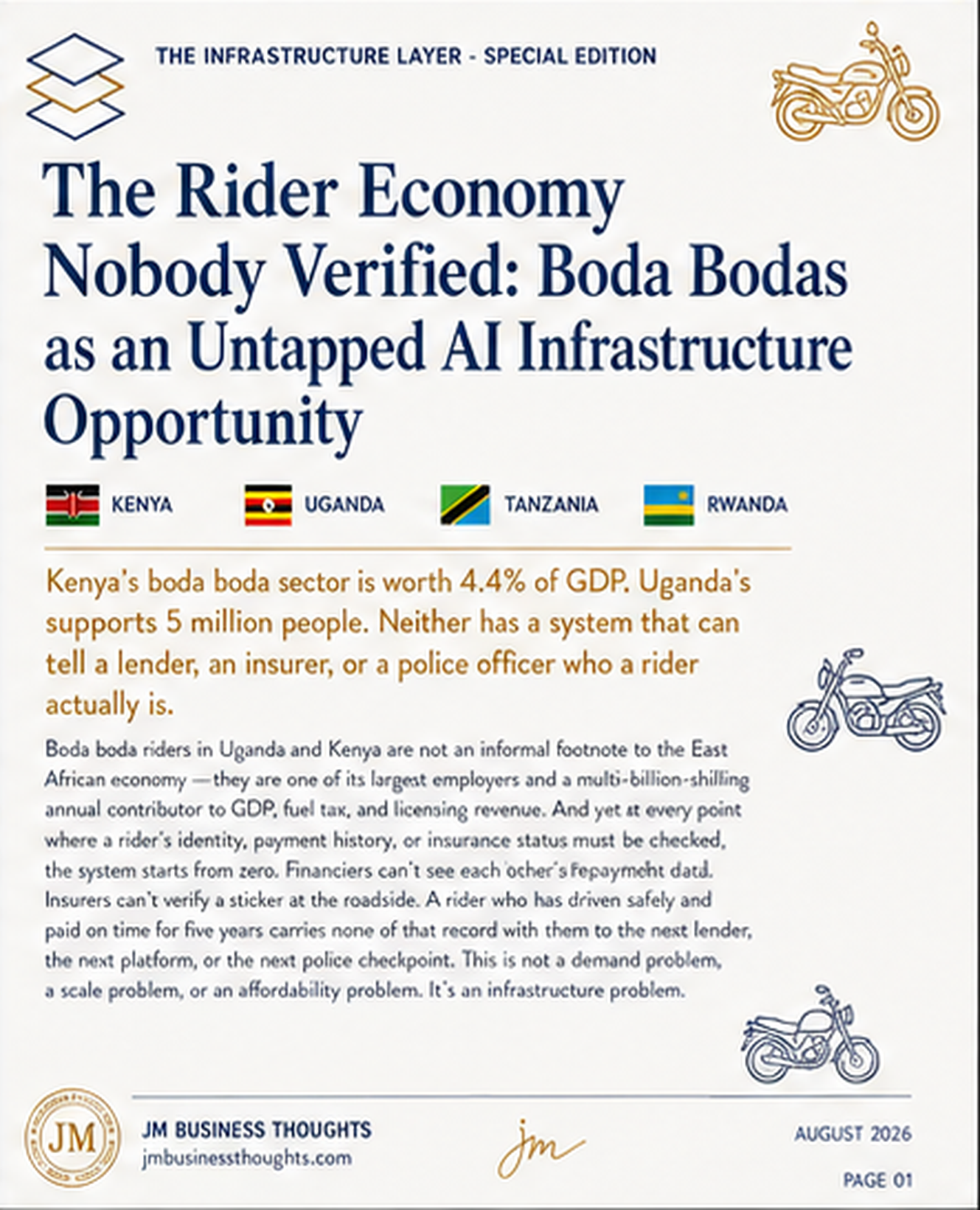
The Rider Economy Nobody Verified: Boda Bodas as an Untapped AI Infrastructure Opportunity research poster
All Research

The Infrastructure Layer Series™

Who owns the rails underneath the AI economy — and where nobody has built them yet.

29Infrastructure Layer™ 17 min readAugust 2026
Coverage · Kenya · Uganda · Tanzania · RwandaSector · Mobility, Credit & Identity Infrastructure · Vertical AIFormat · Six-page audit

The Rider Economy Nobody VerifiedSpecial Edition, East Africa

Kenya’s boda boda sector is worth 4.4% of GDP. Uganda’s supports 5 million people. Neither has a system that can tell a lender, an insurer, or a police officer who a rider actually is. Three separate failures — identity portability, credit data, insurance verification — all resolve to one missing layer.

Kenya Sector, Share of GDP

4.4%

Uganda Livelihoods Supported

5M+

Licensed Riders, Kenya (NTSA)

2,000,000+

Uganda Riders Nationwide

1,500,000

Outside Formal Registration

~500,000

East Africa SME Credit Gap

$37BN

Credit Gap Reached

<3%

Kenya MC Deaths, Q1 2025

431

The Thesis

Boda boda riders are not an informal footnote to the East African economy — they are one of its largest employers and a multi-billion-shilling annual contributor to GDP, fuel tax and licensing revenue. Yet at every point where a rider’s identity, payment history or insurance status must be checked, the system starts from zero. Financiers cannot see each other’s repayment data. Insurers cannot verify a sticker at the roadside. A rider who has driven safely and paid on time for five years carries none of that record to the next lender, the next platform, or the next checkpoint. This is not a demand problem, a scale problem, or an affordability problem. It is an infrastructure problem — and the layer that fixes it does not exist in any of the four markets.

Exhibit · Report Cover

29 · Infrastructure Layer™

The Rider Economy Nobody Verified: Boda Bodas as an Untapped AI Infrastructure Opportunity report cover
The Rider Economy Nobody Verified: Boda Bodas as an Untapped AI Infrastructure OpportunityAugust 2026 · Kenya · Uganda · Tanzania · Rwanda
01

Exhibit A — Identity & reputation portability infrastructure

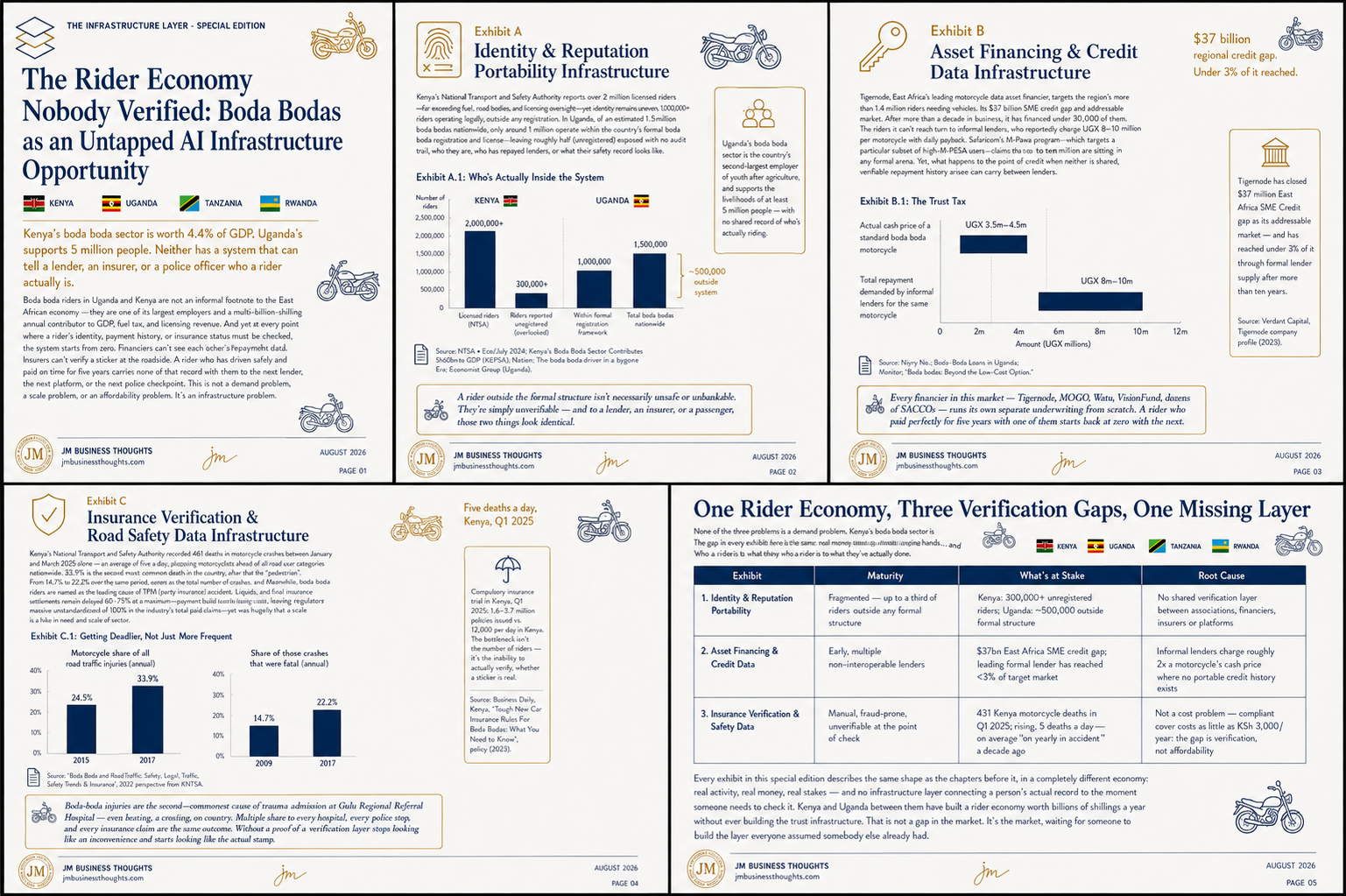
Kenya’s National Transport and Safety Authority reports over 2 million licensed riders — far exceeding fuel, road bodies and licensing oversight — yet identity remains uneven. Roughly 300,000 riders are reported unregistered or operating outside any register at all. In Uganda, of an estimated 1.5 million boda bodas nationwide, only around 1 million operate within the country’s formal boda boda registration and licensing framework — leaving roughly half a million riders exposed with no audit trail of who they are, who they have repaid, or what their safety record looks like.

Uganda’s boda boda sector is the country’s second-largest employer of youth after agriculture and supports the livelihoods of at least 5 million people — with no shared record of who is actually riding. The associations, SACCOs and ride-hailing platforms each hold a fragment: a membership list here, a trip history there, a KYC file somewhere else. None of them interoperate, and none of them survive a rider switching platform.

The consequence is that reputation — the single most valuable asset a rider accumulates — is non-portable. A rider outside the formal structure is not necessarily unsafe or unbankable. They are simply unverifiable, and to a lender, an insurer or a passenger, those two things look identical.

A rider outside the formal structure isn’t necessarily unsafe or unbankable. They’re simply unverifiable — and those two things look identical.
  • Kenya: 2,000,000+ licensed riders (NTSA); 300,000+ reported unregistered
  • Uganda: 1,500,000 riders nationwide; ~1,000,000 inside the formal framework
  • ~500,000 Ugandan riders operating outside any registration layer
  • Second-largest youth employer in Uganda after agriculture
  • Sources: NTSA; Eco/July 2024; KEPSA, Kenya’s Boda Boda Sector Contributes Sh60bn to GDP; Economic Group (Uganda)
02

Exhibit B — Asset financing & credit data infrastructure

Tugende, East Africa’s leading motorcycle asset financier, targets a region with more than 1.4 million riders needing vehicles. Against a $37 billion SME credit gap as its addressable market, after more than a decade in business it has financed under 30,000 of them. That is not a failure of execution — it is what happens when every financier underwrites from scratch because no shared repayment record exists.

Riders who cannot reach formal terms turn to informal lenders, who reportedly charge UGX 8–10 million per motorcycle with daily payback against a cash price of roughly UGX 3.5–4.5 million. Safaricom’s M-Pawa programme — which targets a particular subset of high-M-PESA users — claims the top ten million sit in any formal arena. Yet what happens at the point of credit when neither is shared, verifiable repayment history arises, can carry between lenders.

The gap is a trust tax, and it is measurable: roughly twice the cash price of the asset, charged precisely because no portable credit history exists. Every financier in this market — Tugende, MOGO, Watu, VisionFund, dozens of SACCOs — runs its own separate underwriting from scratch. A rider who paid perfectly for five years with one of them starts back at zero with the next.

Every financier in this market runs its own underwriting from scratch. A rider who paid perfectly for five years starts back at zero with the next.
  • $37BN East Africa SME credit gap; under 3% of it reached
  • 1.4M+ riders needing vehicles; under 30,000 financed by the category leader in a decade
  • Cash price of a standard boda boda: UGX 3.5–4.5M
  • Informal lender total repayment for the same machine: UGX 8–10M
  • Sources: Njoy No.; Boda-Boda Loans in Uganda; Monitor, “Boda bodas: Beyond the Low-Cost Option”; Verdant Capital / Tugende company profile (2023)
03

Exhibit C — Insurance verification & road safety data infrastructure

Kenya’s National Transport and Safety Authority recorded 431 deaths in motorcycle crashes between January and March 2025 alone — an average of five a day, placing motorcyclists ahead of all road user categories nationwide. Motorcycle riders are now named as the leading cause of TPM (third-party) accident claims by share, and boda boda riders are the second-most common death in the country after the pedestrian.

The trajectory matters more than the level. Motorcycle share of all road traffic injuries rose from 24.5% in 2015 to 33.9% in 2017; the share of those crashes that were fatal rose from 14.7% in 2009 to 22.2% in 2017. The sector is not just growing — it is getting deadlier per incident.

Compulsory insurance trials in Kenya in Q1 2025 issued between 1.6 and 3.7 million policies against roughly 12,000 checks per day. The bottleneck is not the number of riders — it is the inability to actually verify, at the roadside, whether a sticker is real. Claims settlements remain delayed 60–75% at a maximum, with payment build times lagging, leaving regulators with massive unstandardised claims of up to 100% of the industry’s total paid claims. Compliant cover costs as little as KSh 3,000 a year: the gap is verification, not affordability.

Without a proof-of-verification layer, an insurance claim stops looking like an inconvenience and starts looking like the actual stamp.
  • 431 Kenya motorcycle deaths, Q1 2025 — five a day, on average
  • Motorcycle share of road traffic injuries: 24.5% (2015) → 33.9% (2017)
  • Share of those crashes that were fatal: 14.7% (2009) → 22.2% (2017)
  • Compulsory insurance trial: 1.6–3.7M policies vs ~12,000 checks per day
  • Compliant cover from KSh 3,000/year — a verification problem, not a cost problem
  • Sources: NTSA; “Boda Boda and Road Traffic: Safety, Legal, Traffic, Safety Trends & Insurance” (2022); Business Daily, “Tough New Car Insurance Rules for Boda Bodas” (2023); KNTSA; Gulu Regional Referral Hospital trauma admissions data
04

Synthesis — one rider economy, three verification gaps, one missing layer

None of the three problems is a demand problem. The gap in every exhibit is the same: real money changing hands, real activity, real stakes — and no infrastructure layer connecting who a rider is to what they have actually done.

Identity and reputation portability is fragmented, with up to a third of riders outside any formal structure; the root cause is that no shared verification layer exists between associations, financiers, insurers or platforms. Asset financing and credit data is early and multiply non-interoperable; the stakes are a $37 billion credit gap where the leading formal lender has reached under 3% of its target market, and the root cause is that informal lenders can charge roughly 2x a motorcycle’s cash price precisely because no portable credit history exists.

Insurance verification and safety data remains manual, fraud-prone and unverifiable at the point of check; the stakes are 431 Kenyan motorcycle deaths in one quarter and rising, and the root cause is not cost — compliant cover runs as little as KSh 3,000 a year — but the absence of verification. Three exhibits, three maturities, one shape.

Kenya and Uganda have built a rider economy worth billions of shillings a year without ever building the trust infrastructure underneath it.
  • Exhibit A · Identity portability — fragmented; no shared verification layer
  • Exhibit B · Credit data — early; multiple non-interoperable lenders
  • Exhibit C · Insurance & safety data — manual, unverifiable at the point of check
  • Common root cause: no portable record connecting a rider to their own history
05

Where the value accrues — and what would break the thesis

Value accrues to whoever holds the canonical, portable record of who a rider is, what they have repaid, and whether they are currently covered. That record is the scarce asset: once it travels with the rider, every lender, insurer, platform and enforcement checkpoint downstream becomes materially cheaper to operate, and the holder of the record sits upstream of all of them.

The commercial model that fits is a per-verification rail plus data licensing, not a consumer app. Lenders already price the absence of history into their rates; insurers already carry fraud loss; platforms already re-run KYC on every rider they onboard. A contract written against a lender’s current default and acquisition cost, or an insurer’s fraudulent-sticker loss rate, is a procurement case in the buyer’s own reported numbers.

Three things break the thesis. First, a national digital ID mandate in Kenya or Uganda absorbs the identity layer into the state, collapsing the market to integration services. Second, one large financier or ride-hailing platform reaches enough scale to make its own private record the de facto standard, and refuses to share it. Third, credit reference bureau regulation moves faster than commercial interoperability, forcing a compliance-shaped product rather than a market-shaped one. The second is the most likely: proprietary scale is the natural enemy of a shared rail.
  • Watch: Kenya and Uganda digital ID rollouts and any rider-registry mandate
  • Watch: interoperability moves between Tugende, MOGO, Watu and SACCO lenders
  • Watch: compulsory motorcycle insurance enforcement and roadside verification tooling
  • Watch: motorcycle share of road fatalities against the 33.9% injury-share baseline
  • Watch: credit reference bureau coverage of informal and asset-finance repayment data

The Multiplier Framework

5 compounding levers

Five positions sit inside the rider verification layer. Each is separately fundable, each has an identified buyer already absorbing the cost of the gap, and each compounds the others — because identity, credit and cover are consumed by the same rider at the same checkpoint.

01

Portable Rider Identity Rail

One verified identity that travels between platform, lender and checkpoint

  • Issue a single rider record keyed to national ID, licence and plate
  • Sign association, SACCO and ride-hailing onboarding as the first write sources
  • Expose a verification API priced per check, not per seat
  • Cover the ~500,000 Ugandan riders outside the formal framework first

Outcome · Turns an unverifiable rider into a queryable record for every counterparty

02

Shared Repayment History Bureau

Portable credit record across every asset financier in the region

  • Pool anonymised repayment performance from asset finance and SACCO lenders
  • Score riders on demonstrated payback, not collateral or referral
  • Route clean-history riders to formal terms and away from 2x informal pricing
  • Target the 97% of the $37BN credit gap the leading lender has never reached

Outcome · Collapses the trust tax that doubles the effective cost of a motorcycle

03

Roadside Insurance Verification

Real-time proof that a policy exists, at the point of check

  • Digitise policy status into a scannable, phone-verifiable record
  • Give enforcement and insurers the same live source of truth
  • Price against fraudulent-sticker loss, not per-policy commission
  • Bundle verified cover into asset finance at origination

Outcome · Converts a KSh 3,000 product from unenforceable to instantly checkable

04

Safety & Claims Data Layer

Underwriting priced on actual riding behaviour

  • Capture trip, incident and claims data against the portable rider ID
  • Feed risk-based pricing that rewards a clean five-year record
  • Give regulators standardised claims data against a rising fatality curve
  • Publish sector-level safety benchmarks as a licensable dataset

Outcome · Turns a 33.9% injury share into a priced, improvable risk variable

05

Rider Financial Graph

Cross-sell rails built on a verified, income-generating population

  • Extend the record into fuel credit, spares finance and health cover
  • License verified rider segments to insurers, banks and mobility platforms
  • Anchor pricing on documented daily earnings rather than proxy scoring
  • Scale the same rail across Kenya, Uganda, Tanzania and Rwanda

Outcome · Monetises a multi-million-rider base that currently generates no reusable data

The Rider Economy Nobody Verified: Boda Bodas as an Untapped AI Infrastructure Opportunity full strategic breakdown
The Infrastructure Layer · Special Edition — full five-page audit: identity and reputation portability, asset financing and credit data, insurance verification and road safety data, and the three-gap synthesis matrix across Kenya, Uganda, Tanzania and Rwanda.

The Verdict

Every exhibit in this special edition describes the same shape as the chapters before it, in a completely different economy: real activity, real money, real stakes — and no infrastructure layer connecting a person’s actual record to the moment someone needs to check it. Kenya and Uganda between them have built a rider economy worth billions of shillings a year without ever building the trust infrastructure. That is not a gap in the market. It is the market, waiting for someone to build the layer everyone assumed somebody else already had.

JM founder signature
68 · PureGym — Fitness At Scale. More Personal. More Inclusive.67 · SIXT — Smarter Mobility. Greater Availability. A More Connected Tomorrow.66 · Sendwave — Money That Moves With Intelligence.65 · McDonald’s — Serving The Future With AI.64 · Compare the Market — Smarter Comparison. Better Matches. Brighter Tomorrows.63 · WeBuyAnyCar — Smarter Pricing. Faster Offers. Better Conversion.62 · Primark — Affordable Fashion. Greater Possibilities With AI.61 · Starbucks — Smarter Stores. Stronger Loyalty. Better Margins.60 · IKEA — AI-Powered Home Retail at Global Scale59 · H&M — Smarter Fashion. Brighter Tomorrow.58 · WeWork — The Value Wasn't Lost. It Was Mispriced.57 · Yahoo — The Value Wasn't Lost. It Was Mispriced.56 · Nando's UK — Smarter Restaurants. Stronger Loyalty. Better Margins.55 · The Amplifier54 · The Body Shop53 · Arcadia Group52 · Cazoo51 · Blockbuster50 · Carpetright49 · Wilko48 · Mothercare47 · Phones 4u46 · Farfetch45 · Jumia44 · Toys ‘R’ Us43 · The Collateral Gap — Part One41 · The Amplifier40 · Africa Bee Farming39 · Kenya Airways38 · Africa Greenhouse Farming37 · Uganda Tourism Board36 · Boots UK35 · Biffa (UK)34 · NatWest33 · Skip Hire Companies UK33 · The Audit32 · The Lean Company31 · Africa Mushroom Farming27 · Independent Timber Yards & Jewson Timber26 · Link Up TV & GRM Daily25 · East African Portland Cement42 · International Student Credential & Financial Verification — Part One24 · The Supply Chain Inside the Supply Chain23 · The White Space, Mapped22 · The Real Opportunity21 · Greencore20 · West Ham United19 · Roofings Group Uganda18 · Mombasa Port17 · Auto Trader UK16 · Uganda Coffee Development Authority15 · Brookside Dairy14 · GraceKennedy13 · Rightmove12 · Manchester United11 · Greggs30 · Twiga Foods10 · Uchumi09 · Konga08 · Edcon09 · GAME07 · Debenhams06 · Claire's05 · Boohoo04 · Argos