01
Smart Berth & Yard Optimisation
KES 6B – 10B / year
- AI berth allocation and yard planning
- Crane and gate optimisation
- Vessel turnaround modelling
Outcome · Increased berth productivity and reduced vessel turnaround time
The Hidden AI Operating System Audit Series™
Where AI creates new profit pools—not just productivity.
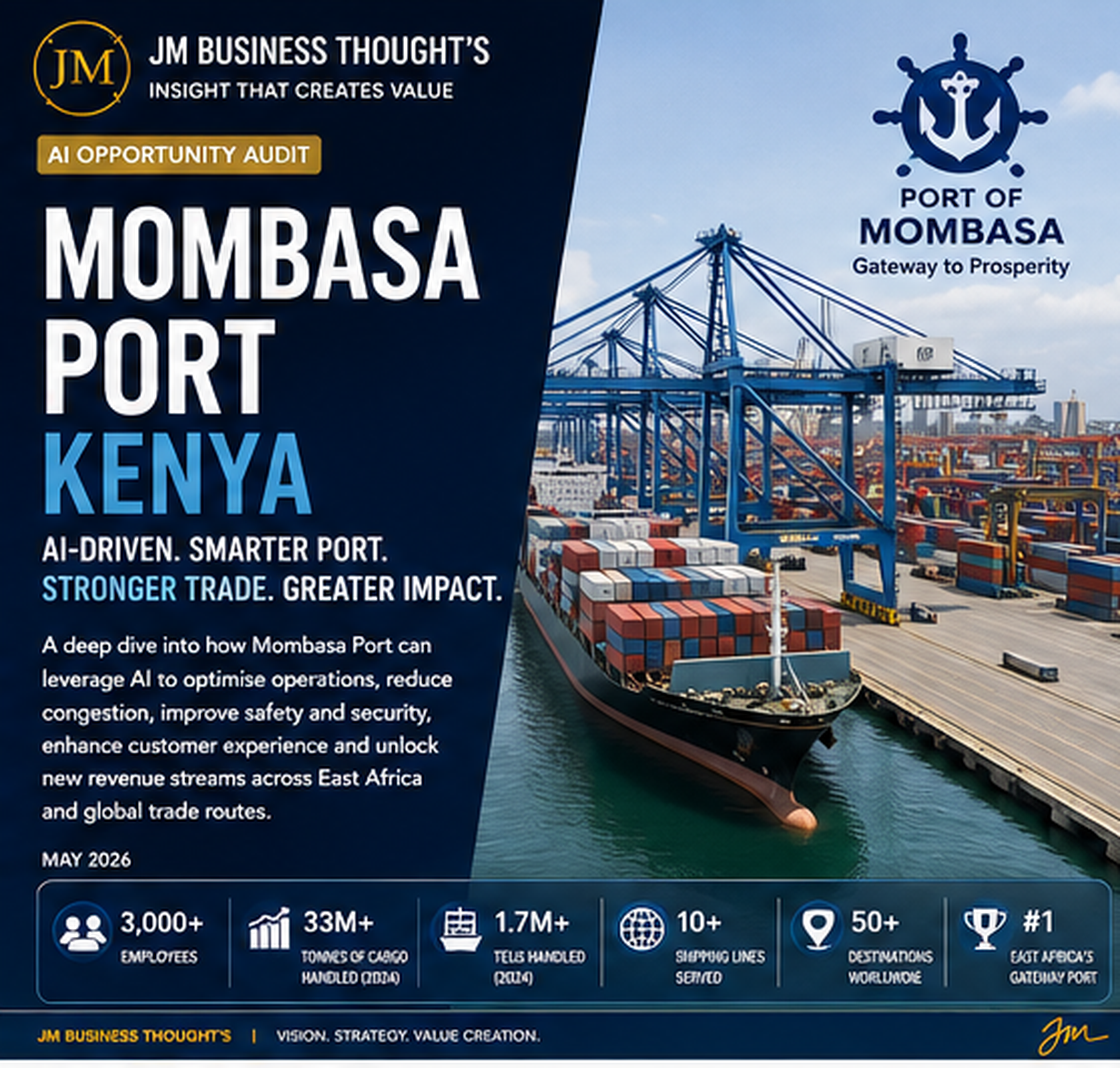
A deep dive into how Mombasa Port can leverage AI to optimise operations, reduce congestion, improve safety and security, enhance customer experience and unlock new revenue streams across East Africa and global trade routes.
Employees
3,000+
Cargo Handled (2024)
33M+ t
TEUs Handled (2024)
1.7M+
Annual AI Value
KES 24B – 42B+
The Thesis
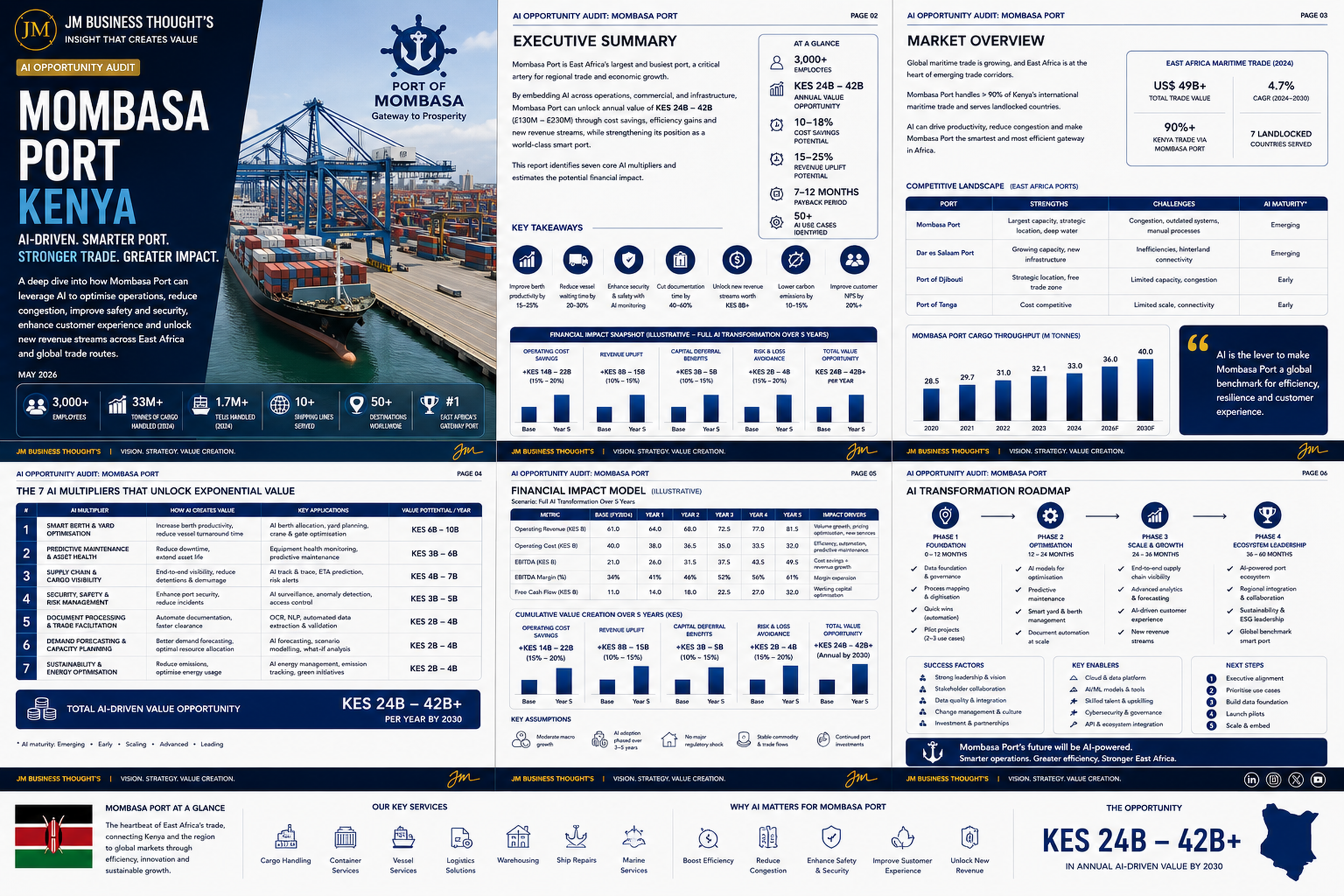
Mombasa Port is East Africa's largest and busiest port, a critical artery for regional trade and economic growth. By embedding AI across operations, commercial and infrastructure, the port can unlock annual value of KES 24B – 42B (£130M – £230M) through cost savings, efficiency gains and new revenue streams, while strengthening its position as a world-class smart port.
Exhibit · Report Cover
18 · AI Opportunity Audit™
Mombasa Port serves 3,000+ employees, handles 33M+ tonnes of cargo and 1.7M+ TEUs a year, serves 10+ shipping lines and 50+ destinations worldwide, and remains East Africa's #1 gateway port.
This report identifies seven core AI multipliers and estimates the potential financial impact — a KES 24B – 42B+ annual AI-driven value opportunity by 2030, with a 7–12 month payback period and 50+ AI use cases identified.
AI is the lever to make Mombasa Port a global benchmark for efficiency, resilience and customer experience.
Global maritime trade is growing, and East Africa sits at the heart of emerging trade corridors. Mombasa Port handles more than 90% of Kenya's international maritime trade and serves seven landlocked countries.
East Africa maritime trade stood at US$49B+ in total trade value in 2024, growing at a 4.7% CAGR to 2030. AI can drive productivity, reduce congestion and make Mombasa the smartest and most efficient gateway in Africa.
Mombasa Port leads on capacity, strategic location and deep water, but is constrained by congestion, outdated systems and manual processes — an emerging AI maturity.
Dar es Salaam is growing capacity with new infrastructure but faces hinterland connectivity gaps; Djibouti offers a strategic location and free trade zone with limited capacity; Tanga competes on cost with limited scale and connectivity.
Modelled illustratively over a five-year full AI transformation: operating revenue moves from KES 61.0B (FY24) to KES 81.5B by Year 5, while operating cost rises far more slowly from KES 40.0B to KES 49.5B on automation and predictive maintenance.
EBITDA grows from KES 21.0B to KES 49.5B, EBITDA margin lifts from 34% to 61%, and free cash flow expands from KES 11.0B to KES 30.0B on working capital optimisation.
+KES 14B – 22B operating cost savings. +KES 8B – 15B revenue uplift. +KES 3B – 5B capital deferral. KES 24B – 42B+ total annual value by 2030.
Phase 1 (0–12 months) — Foundation: data foundation and governance, process mapping and digitisation, quick wins in automation, pilot projects across two or three use cases.
Phase 2 (12–24 months) — Optimisation: AI models for operations, predictive maintenance, smart yard and berth management, document automation at scale.
Phase 3 (24–36 months) — Scale and growth: end-to-end supply chain visibility, advanced analytics and forecasting, AI-driven customer experience, new revenue streams.
Phase 4 (36–60 months) — Ecosystem leadership: an AI-powered port ecosystem, regional integration and collaboration, sustainability and ESG leadership, a global benchmark smart port.
Mombasa is the heartbeat of East Africa's trade, connecting Kenya and the region to global markets through efficiency, innovation and sustainable growth.
Its service lines span cargo handling, container services, vessel services, logistics solutions, warehousing, ship repairs and marine services — every one of them a candidate for AI-led improvement.
The Multiplier Framework
The seven AI multipliers that unlock exponential value — together worth KES 24B – 42B+ per year by 2030.
KES 6B – 10B / year
Outcome · Increased berth productivity and reduced vessel turnaround time
KES 3B – 6B / year
Outcome · Reduced downtime and extended asset life
KES 4B – 7B / year
Outcome · End-to-end visibility, reduced detentions and demurrage
KES 3B – 5B / year
Outcome · Enhanced port security and fewer incidents
KES 2B – 4B / year
Outcome · Automated documentation and faster clearance
KES 2B – 4B / year
Outcome · Better demand forecasting and optimal resource allocation
KES 2B – 4B / year
Outcome · Reduced emissions and optimised energy usage
The Verdict
Mombasa Port's future will be AI-powered. Smarter operations. Greater efficiency. Stronger East Africa — a KES 24B – 42B+ annual AI-driven value opportunity by 2030.