01
Trend & Demand Prediction
More accurate demand, fewer stockouts and markdowns.
- AI trend analysis and social listening
- Market signals data at style level
- Earlier, evidence-based buy decisions
Outcome · €80m – €250m by 2030
The Hidden AI Operating System Audit Series™
Where AI creates new profit pools—not just productivity.
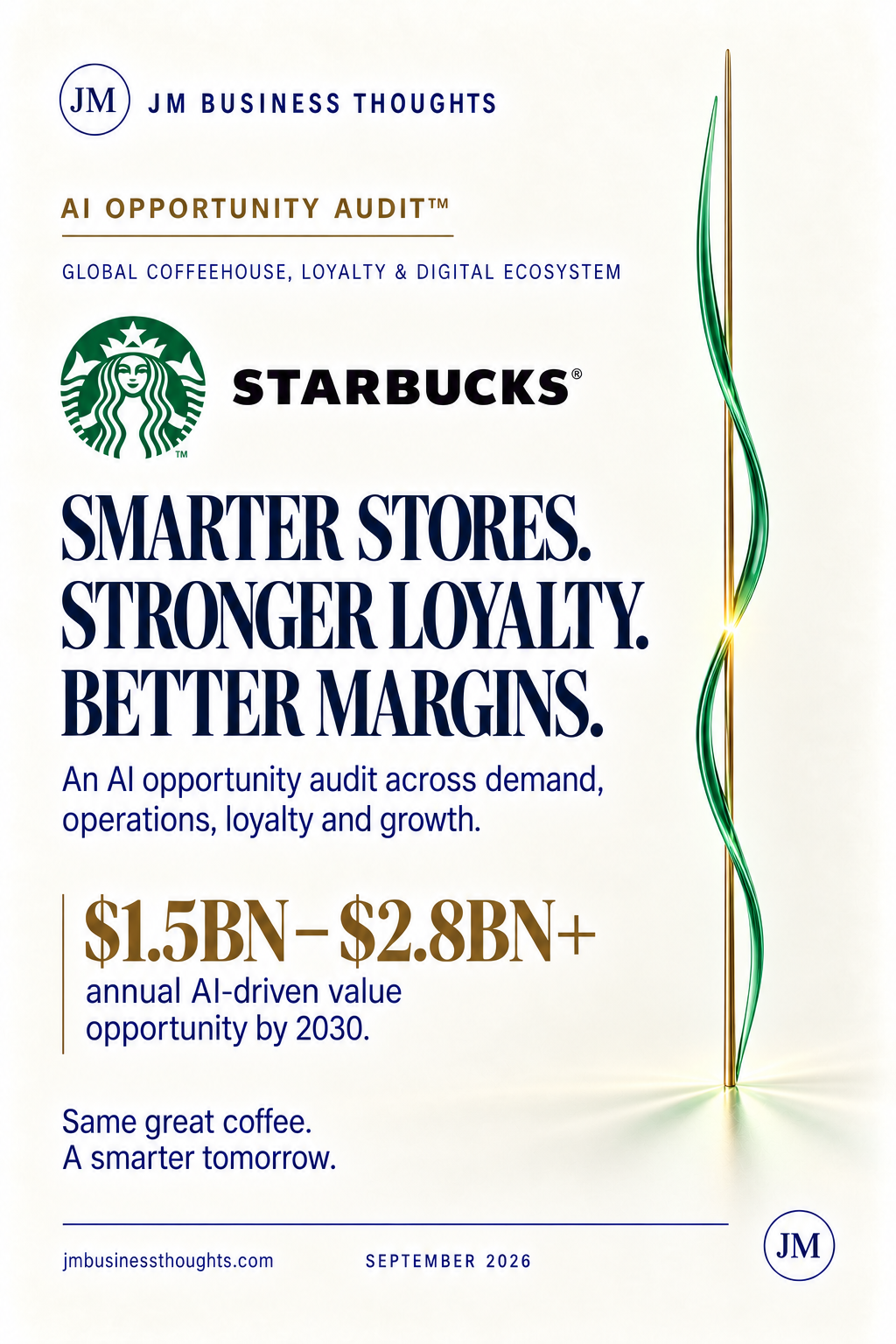
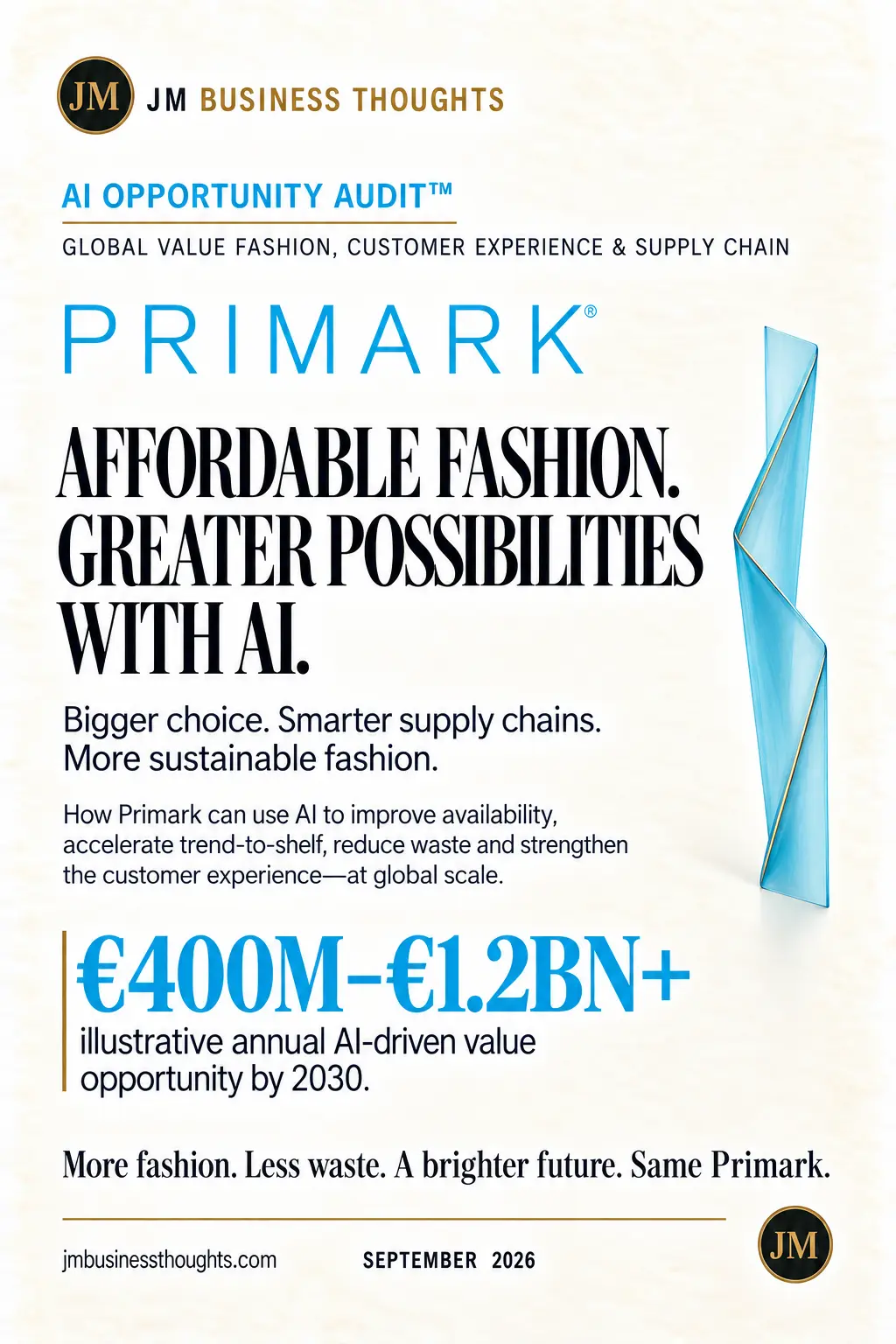
Primark entered FY2024 with €10.2bn of revenue, 448 stores across 17 countries, 80,000+ colleagues and more than 1 billion customer visits a year — built on a value proposition that depends on getting the right product into the right store at the right time. This audit sizes €400M–€1.2BN+ of illustrative annual AI-driven value by 2030 across seven multipliers spanning trend prediction, design, inventory, supply chain, store operations, personalisation and circularity — without compromising on price.
Annual AI Value by 2030
€400M – €1.2BN+
Revenue (FY2024)
€10.2BN
Stores Worldwide
448
Countries
17
Colleagues Globally
80,000+
Customer Visits A Year
1BN+
Global Apparel Market (2030E)
$2.6TN
Value Multipliers
7
The Thesis
Primark is the rarest thing in retail: a value business with genuine brand love. It has built scale on affordable fashion, operational efficiency and a distinctive in-store experience, with a young, trend-driven customer base and a growing international footprint. That model is also unusually exposed to forecast error — in value fashion, the margin lives inside the gap between what was bought and what sold at full price. Markdowns, stockouts and residual inventory are not accounting details; they are the profit pool. AI's opportunity here is not to automate people out of stores but to get the right products, into the right stores, at the right time — while reducing waste, lowering costs and enhancing the customer experience, without compromising on value. More fashion. Less waste. A brighter future. Same Primark.
Exhibit · Report Cover
62 · AI Opportunity Audit™
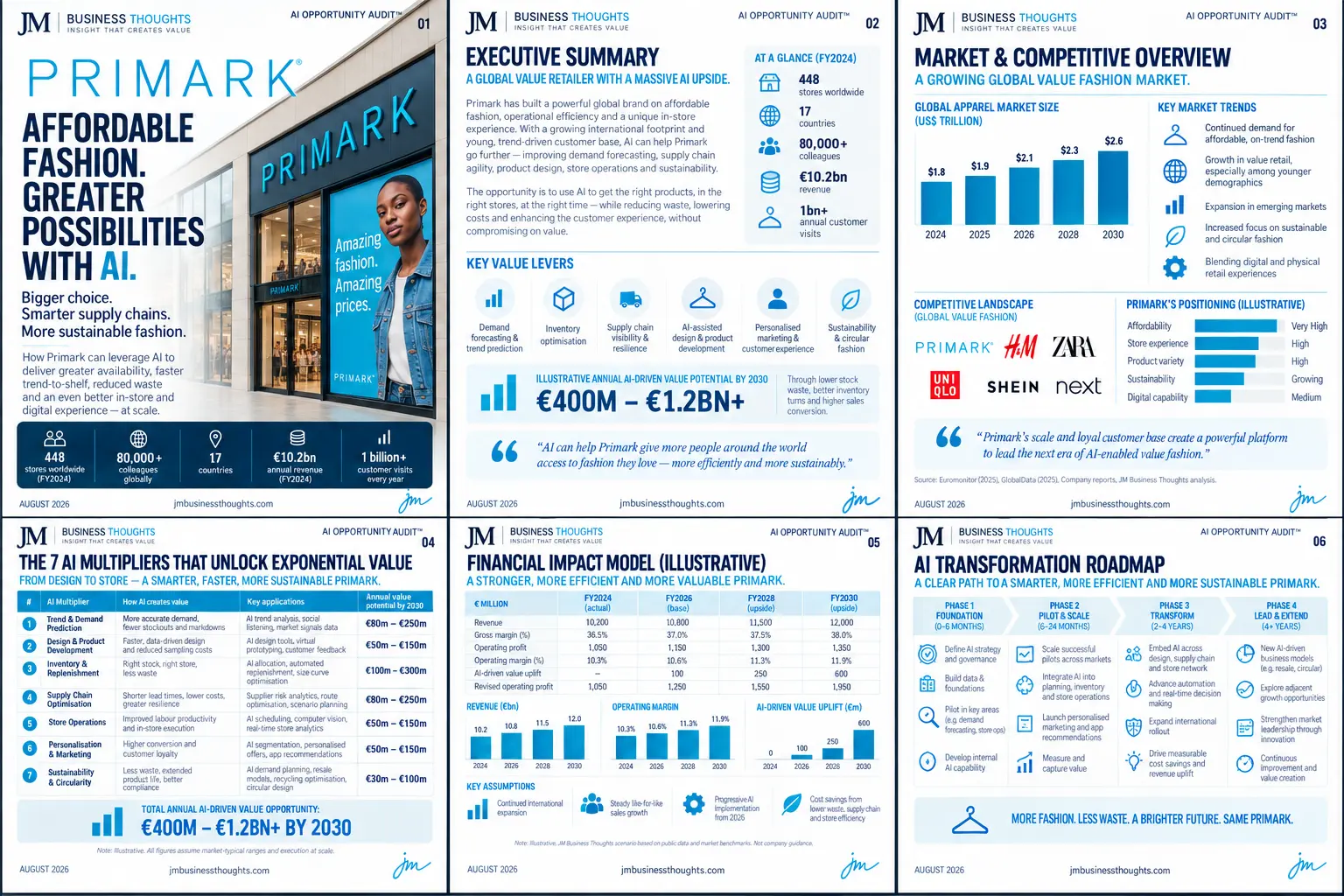
At a glance for FY2024: 448 stores worldwide, 17 countries, 80,000+ colleagues, €10.2bn of revenue and more than 1 billion annual customer visits.
Primark has built a powerful global brand on affordable fashion, operational efficiency and a unique in-store experience. With a growing international footprint and a young, trend-driven customer base, AI can help Primark go further — improving demand forecasting, supply chain agility, product design, store operations and sustainability.
Six key value levers frame the audit: demand forecasting and trend prediction; inventory optimisation; supply chain visibility and resilience; AI-assisted design and product development; personalised marketing and customer experience; and sustainability and circular fashion.
Illustrative annual AI-driven value potential by 2030: €400M – €1.2BN+, delivered through lower stock waste, better inventory turns and higher sales conversion.
€10.2bn of revenue and 1 billion visits a year — against a profit pool that lives inside forecast accuracy.
The global apparel market is modelled at $1.8TN (2024), $1.9TN (2025), $2.1TN (2026), $2.3TN (2028) and $2.6TN (2030) — growth that is structural rather than cyclical.
Five market trends define the environment: continued demand for affordable, on-trend fashion; growth in value retail, especially among younger demographics; expansion in emerging markets; increased focus on sustainable and circular fashion; and the blending of digital and physical retail experiences.
The competitive landscape sets Primark against H&M, Zara, Uniqlo, Shein and Next. Primark's illustrative positioning is very high on affordability, high on store experience and product variety, growing on sustainability, and medium on digital capability — which is precisely where the AI headroom sits.
Primark's scale and loyal customer base create a powerful platform to lead the next era of AI-enabled value fashion. Shein's model demonstrates the competitive risk clearly: the threat is not price, it is trend-to-shelf speed backed by data.
Very high on affordability. Medium on digital capability. That gap is the entire opportunity.
Trend and demand prediction (€80m–€250m by 2030) delivers more accurate demand and fewer stockouts and markdowns using AI trend analysis, social listening and market signals data. In value fashion, an accurate call three weeks earlier is worth more than any margin negotiation.
Design and product development (€50m–€150m) shortens the path from concept to shelf with AI design tools, virtual prototyping and structured customer feedback — faster, data-driven design at reduced sampling cost.
Inventory and replenishment (€100m–€300m) is the single largest lever: right stock, right store, less waste, achieved through AI allocation, automated replenishment and size-curve optimisation. Size curves in particular are a chronically under-modelled source of lost full-price sales.
Taken together, the product layer is where value fashion economics are decided. Every point of markdown avoided flows directly to operating profit because the price architecture cannot absorb it elsewhere.
In value fashion, an accurate trend call three weeks earlier beats any margin negotiation.
Supply chain optimisation (€80m–€250m) shortens lead times, lowers costs and builds resilience through supplier risk analytics, route optimisation and scenario planning — material for a business sourcing at global scale into 17 markets.
Store operations (€50m–€150m) improves labour productivity and in-store execution via AI scheduling, computer vision and real-time store analytics. With 1bn+ annual visits, small execution gains compound quickly.
Personalisation and marketing (€50m–€150m) drives higher conversion and customer loyalty through AI segmentation, personalised offers and app recommendations — the layer where Primark's medium digital maturity converts into upside fastest.
Sustainability and circularity (€30m–€100m) delivers less waste, extended product life and better compliance through AI demand planning, resale models and recycling optimisation — increasingly a licence-to-operate requirement as much as a value lever.
1 billion visits a year means small execution gains compound into large numbers.
Revenue (€m) is modelled at 10,200 (FY2024 actual), 10,800 (FY2026 base), 11,500 (FY2028 upside) and 12,000 (FY2030 upside).
Gross margin moves from 36.5% to 37.0%, 37.5% and 38.0% across the same path — a 150-basis-point expansion earned through mix, markdown avoidance and sourcing intelligence rather than price increases.
Operating profit (€m) runs 1,050 → 1,150 → 1,300 → 1,350 with operating margin of 10.3% → 10.6% → 11.3% → 11.9%. AI-driven value uplift adds — → 100 → 250 → 600, producing revised operating profit of 1,050 → 1,250 → 1,550 → 1,950.
Key assumptions: continued international expansion; steady like-for-like sales growth; progressive AI implementation from 2025; and cost savings from lower waste, supply chain and store efficiency. Illustrative JM Business Thoughts scenario based on public data and market benchmarks — not company guidance.
Revised operating profit €1,050m → €1,950m. Nearly half of the delta is the AI uplift.
Phase 1, Foundation (0–6 months): define AI strategy and governance, build data and foundations, pilot in key areas such as demand forecasting and store operations, and develop internal AI capability.
Phase 2, Pilot & Scale (6–24 months): scale successful pilots across markets, integrate AI into planning, inventory and store operations, launch personalised marketing and app recommendations, and measure and capture value.
Phase 3, Transform (2–4 years): embed AI across design, supply chain and the store network, advance automation and real-time decision making, expand international rollout, and drive measurable cost savings and revenue uplift.
Phase 4, Lead & Extend (4+ years): build new AI-driven business models such as resale and circular fashion, explore adjacent growth opportunities, strengthen market leadership through innovation, and sustain continuous improvement and value creation.
More fashion. Less waste. A brighter future. Same Primark.
Company data: Primark FY2024 disclosures — revenue, store count, country footprint, colleague numbers and annual customer visits.
Market sizing: Euromonitor (2025), GlobalData (2025), global apparel market 2024–2030E.
Competitive landscape: positioning for H&M, Zara, Uniqlo, Shein and Next; maturity assessments are analyst-assigned and directional.
Method note: each multiplier is sized independently against disclosed revenue and store scale, then netted for overlap before the total annual range is stated. All figures assume market-typical ranges and execution at scale. Illustrative JM Business Thoughts analysis — not company guidance.
The Multiplier Framework
The seven AI multipliers that unlock exponential value — from design to store, a smarter, faster, more sustainable Primark, aggregating to €400M – €1.2BN+ of annual value by 2030.
More accurate demand, fewer stockouts and markdowns.
Outcome · €80m – €250m by 2030
Faster, data-driven design at reduced sampling cost.
Outcome · €50m – €150m by 2030
Right stock, right store, less waste.
Outcome · €100m – €300m by 2030
Shorter lead times, lower costs, greater resilience.
Outcome · €80m – €250m by 2030
Improved labour productivity and in-store execution.
Outcome · €50m – €150m by 2030
Higher conversion and customer loyalty.
Outcome · €50m – €150m by 2030
Less waste, extended product life, better compliance.
Outcome · €30m – €100m by 2030
The Verdict
€10.2bn of revenue, 448 stores, 17 countries and more than a billion visits a year — with digital capability rated medium against affordability rated very high. That asymmetry is the opportunity. Seven multipliers, weighted toward inventory, trend prediction and supply chain, size €400M – €1.2BN+ of illustrative annual AI-driven value by 2030 and lift operating margin from 10.3% to 11.9% without touching the price architecture. More fashion. Less waste. A brighter future. Same Primark.