01
AI-Powered Personalisation
Increase conversion, AOV and customer loyalty across 60M+ active customers.
- Recommendations and dynamic ranking
- Dynamic bundles and next-best-offer
- Personalised home and category feeds
Outcome · £30M – £50M per year
The Hidden AI Operating System Audit Series™
Where AI creates new profit pools—not just productivity.
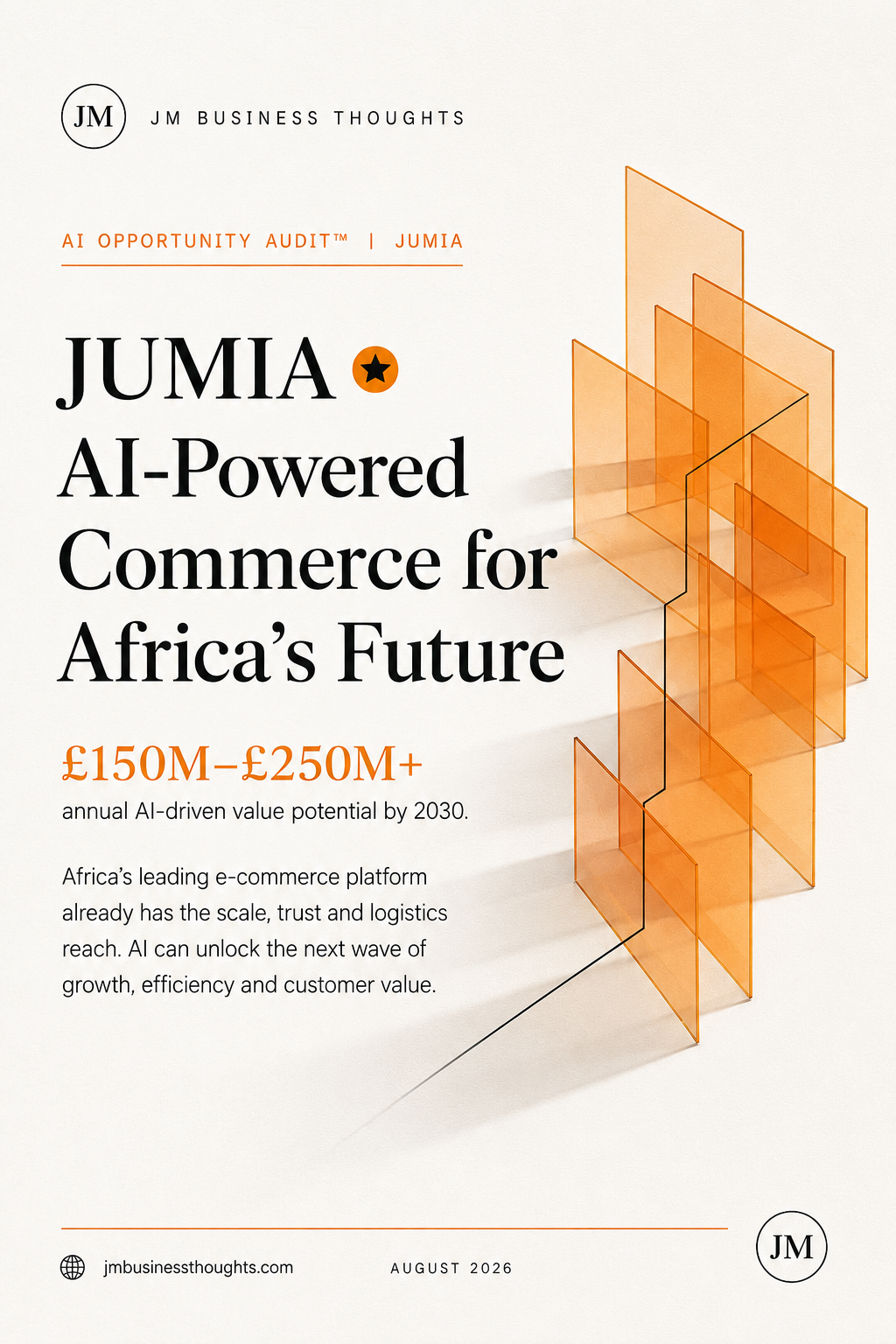
An AI Opportunity Audit™ across Jumia’s marketplace, logistics, seller and payments estate in 11+ African countries — personalisation, demand and pricing, delivery intelligence, seller enablement, fraud control, service automation and decision intelligence — identifying £150M – £250M+ of annual AI-driven value by 2030 against a €260M revenue and 1.20 GMV (€BN) base.
Countries Of Operation
11+
Active Customers
60M+
Sellers On The Platform
30,000+
Products Live
1M+
Annual Visits
200M+
Africa E-Commerce Market (2024)
$49B+
Market Opportunity By 2030
$75B+
Annual AI Value By 2030
£150M – £250M+
The Thesis
Jumia is the only operator that has already paid the hardest cost in African e-commerce: distribution across 11+ countries, 60M+ customer relationships, 30,000+ sellers and a first-party logistics and payments rail that reaches addresses formal couriers will not serve. That estate is currently run as a marketplace. It is priced as a marketplace. But every economic variable that determines whether Jumia compounds — conversion per visit, contribution per parcel, retention per cohort, loss per fraudulent order — is a prediction problem sitting on data nobody else in Africa has at this density. Our analysis identifies £150M – £250M+ in annual AI-driven value by 2030 through seven multipliers, delivered without entering a single new country.
Exhibit · Report Cover
45 · AI Opportunity Audit™
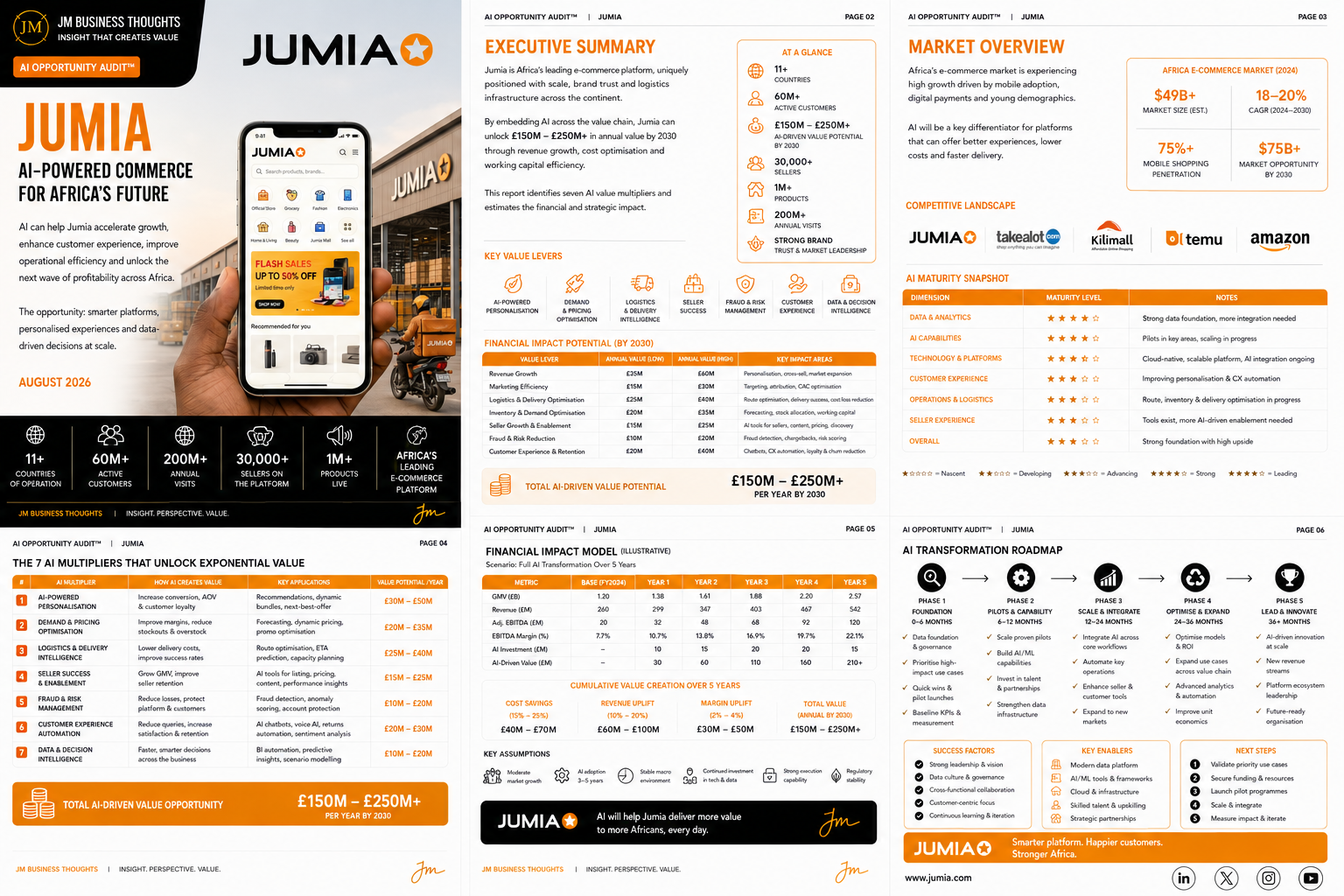
Jumia is Africa’s leading e-commerce platform, uniquely positioned with scale, brand trust and logistics infrastructure across the continent. By embedding AI across the value chain, Jumia can unlock £150M – £250M+ in annual value by 2030 through revenue growth, cost optimisation and working capital efficiency.
The at-a-glance position is unusual for a company of its revenue size: 11+ countries, 60M+ active customers, 30,000+ sellers, 1M+ products live and 200M+ annual visits, underpinned by the strongest brand trust and market leadership position in African e-commerce.
This report identifies seven AI value multipliers and estimates the financial and strategic impact. The value is not framed as productivity: it resolves into six distinct P&L lines — revenue growth (£35M – £60M), marketing efficiency (£15M – £30M), logistics and delivery optimisation (£25M – £40M), inventory and demand optimisation (£20M – £35M), seller growth and enablement (£15M – £25M), fraud and risk reduction (£10M – £20M) and customer experience and retention (£20M – £40M).
£150M – £250M+ per year by 2030 — on a €260M revenue and 1.20 (€BN) GMV base.
Africa’s e-commerce market is experiencing high growth driven by mobile adoption, digital payments and young demographics. Market size is estimated at $49B+ in 2024, compounding at 18–20% CAGR through 2030 toward a $75B+ opportunity.
Mobile shopping penetration already exceeds 75%, which changes the design problem: the interface is a low-bandwidth phone screen with limited attention, not a desktop catalogue. Ranking quality — the first eight results — effectively is the store.
The competitive landscape now spans Takealot in Southern Africa, Kilimall in East Africa, and global entrants Temu and Amazon competing on price transparency and assortment depth. AI will be the key differentiator for platforms that can offer better experiences, lower costs and faster delivery — the three axes on which African e-commerce is actually decided.
$49B+ market, 18–20% CAGR, 75%+ mobile penetration — relevance and delivery cost decide the winner.
The audit scores Jumia as advancing across most dimensions and leading on none — which is the correct reading for a platform that has industrialised operations faster than it has industrialised prediction.
Data and analytics is the strongest dimension: a strong data foundation exists across orders, sessions, logistics events and payments, but more integration is needed before models can be trained on a single customer, seller and parcel record.
AI capabilities show pilots in key areas and scaling in progress. Technology and platforms score well — cloud-native and scalable, with AI integration ongoing. Customer experience is improving on personalisation and CX automation. Operations and logistics has route, inventory and delivery optimisation in progress — and holds the largest untouched cost pool. Seller experience is the weakest: tools exist, but AI-driven enablement is needed.
In a multi-country marketplace running first-party logistics, four leaks dominate, and none of them are visible in a headline take-rate.
The first is relevance. 200M+ annual visits against 1M+ live products means discovery is the conversion engine. A ranking model that improves basket-relevant impressions by a few points moves GMV more than any marketing budget available to the business.
The second is cost-to-serve per parcel. Failed deliveries, re-attempts, unaddressed locations and idle vehicle capacity are the structural tax of African last-mile. Route optimisation and ETA prediction attack it directly — every avoided re-attempt is pure contribution margin.
The third is seller quality. 30,000+ sellers produce a long tail of poor listings, mispriced inventory and slow dispatch, which is paid for downstream in returns, refunds and churn. Seller enablement is not a support function; it is a margin function.
The fourth is trust integrity: fraud, chargebacks and counterfeit exposure across cash-on-delivery and digital payment mixes. Detection quality is worth £10M – £20M a year on its own before any second-order retention effect.
The seven value levers are sized independently against the current base and aggregate to the headline range. Revenue growth contributes £35M – £60M through personalisation, cross-sell and market expansion. Marketing efficiency contributes £15M – £30M through targeting, attribution and CAC optimisation.
On the cost side, logistics and delivery optimisation contributes £25M – £40M through route optimisation, ETA prediction and capacity planning, while inventory and demand optimisation contributes £20M – £35M through forecasting, stock allocation and working capital release.
Seller growth and enablement contributes £15M – £25M, fraud and risk reduction £10M – £20M, and customer experience and retention £20M – £40M. Total AI-driven value potential: £150M – £250M+ per year by 2030.
Total AI-driven value potential: £150M – £250M+ per year by 2030.
The illustrative model runs a full AI transformation over five years from an FY2024 base. GMV moves from €1.20BN to €2.57BN by Year 5. Revenue moves from €260M to €542M, roughly doubling without a new market entry assumption.
Adjusted EBITDA turns from €20M to €120M, with adjusted EBITDA margin expanding from 7.7% to 22.1% — the margin path, not the revenue path, is the real story. AI investment of €10M → €15M → €20M → €20M → €15M funds AI-driven value of €30M → €60M → €110M → €160M → €210M+.
Cumulative value creation over five years splits into cost savings of £40M – £70M (15–25%), revenue uplift of £60M – £100M (10–20%) and margin uplift of £30M – £50M (2–4%) — aggregating to the £150M – £250M+ annual run-rate by 2030.
GMV €1.20BN → €2.57BN. Revenue €260M → €542M. EBITDA margin 7.7% → 22.1%.
The model assumes moderate market growth, AI adoption over a three-to-five-year horizon, a stable macro environment, continued investment in technology and data, strong execution capability and regulatory stability across the operating footprint.
The binding constraints are not model quality. They are data unification across 11+ country stacks, FX and macro volatility on a euro-reported P&L, and the change management required to make sellers and logistics partners act on model output rather than override it.
Regulatory sensitivity is real across payments, consumer data and cross-border commerce. Every personalisation and credit-adjacent use case should be built with consent, auditability and country-level data governance designed in at the pilot stage — retrofitting compliance across eleven jurisdictions is the single most expensive mistake available here.
Phase 1 (0–6 months) — Foundation: data foundation and governance, prioritise high-impact use cases, quick wins and pilot launches, baseline KPIs and measurement.
Phase 2 (6–12 months) — Pilots and capability: scale proven pilots, build AI/ML capabilities, invest in talent and partnerships, strengthen data infrastructure.
Phase 3 (12–24 months) — Scale and integrate: integrate AI across core workflows, automate key operations, enhance seller and customer tools, expand into new markets.
Phase 4 (24–36 months) — Optimise and expand: optimise models and ROI, expand use cases across the value chain, advanced analytics and automation, improve unit economics.
Phase 5 (36+ months) — Lead and innovate: AI-driven innovation at scale, new revenue streams, platform ecosystem leadership, future-ready organisation.
Success factors are cultural before they are technical: strong leadership and vision, data culture and governance, cross-functional collaboration, customer-centric focus, and continuous learning and iteration. Next steps: validate priority use cases, secure funding and resources, launch pilot programmes, scale and integrate, measure impact and iterate.
AI will help Jumia deliver more value to more Africans, every day.
The Multiplier Framework
Seven AI multipliers, each with a defined mechanism, application set and annual value range — aggregating to £150M – £250M+ of AI-driven value per year by 2030.
Increase conversion, AOV and customer loyalty across 60M+ active customers.
Outcome · £30M – £50M per year
Improve margins, reduce stockouts and overstock across 1M+ live products.
Outcome · £20M – £35M per year
Lower delivery costs and improve success rates across informal addressing.
Outcome · £25M – £40M per year
Grow GMV and improve seller retention across 30,000+ sellers.
Outcome · £15M – £25M per year
Reduce losses and protect both platform and customers across COD and digital rails.
Outcome · £10M – £20M per year
Reduce queries, increase satisfaction and retention across 200M+ annual visits.
Outcome · £20M – £30M per year
Faster, smarter decisions across the business — from country P&L to category buy.
Outcome · £10M – £20M per year
The Verdict
Jumia has already absorbed the cost that stops everyone else: physical distribution, payment rails and customer trust across eleven markets. What it has not yet done is price that estate as an intelligence asset. Seven multipliers convert the same footprint into £150M – £250M+ of annual value by 2030, revenue of €542M, and an EBITDA margin moving from 7.7% to 22.1% — without one new country. The risk is not that AI fails in Africa. It is that the continent’s most instrumented commerce dataset keeps being run as a catalogue while Temu and Amazon arrive with models already trained.