Smart Inventory Intelligence
£50M – £90M / year
- Demand forecasting at SKU and yard level
- Stock optimisation and auto-replenishment
- Reduce stockouts, overstock and write-offs
Outcome · Right stock, right yard, less capital trapped in the wrong SKUs

The Hidden AI Operating System Audit Series™
Where AI creates new profit pools—not just productivity.
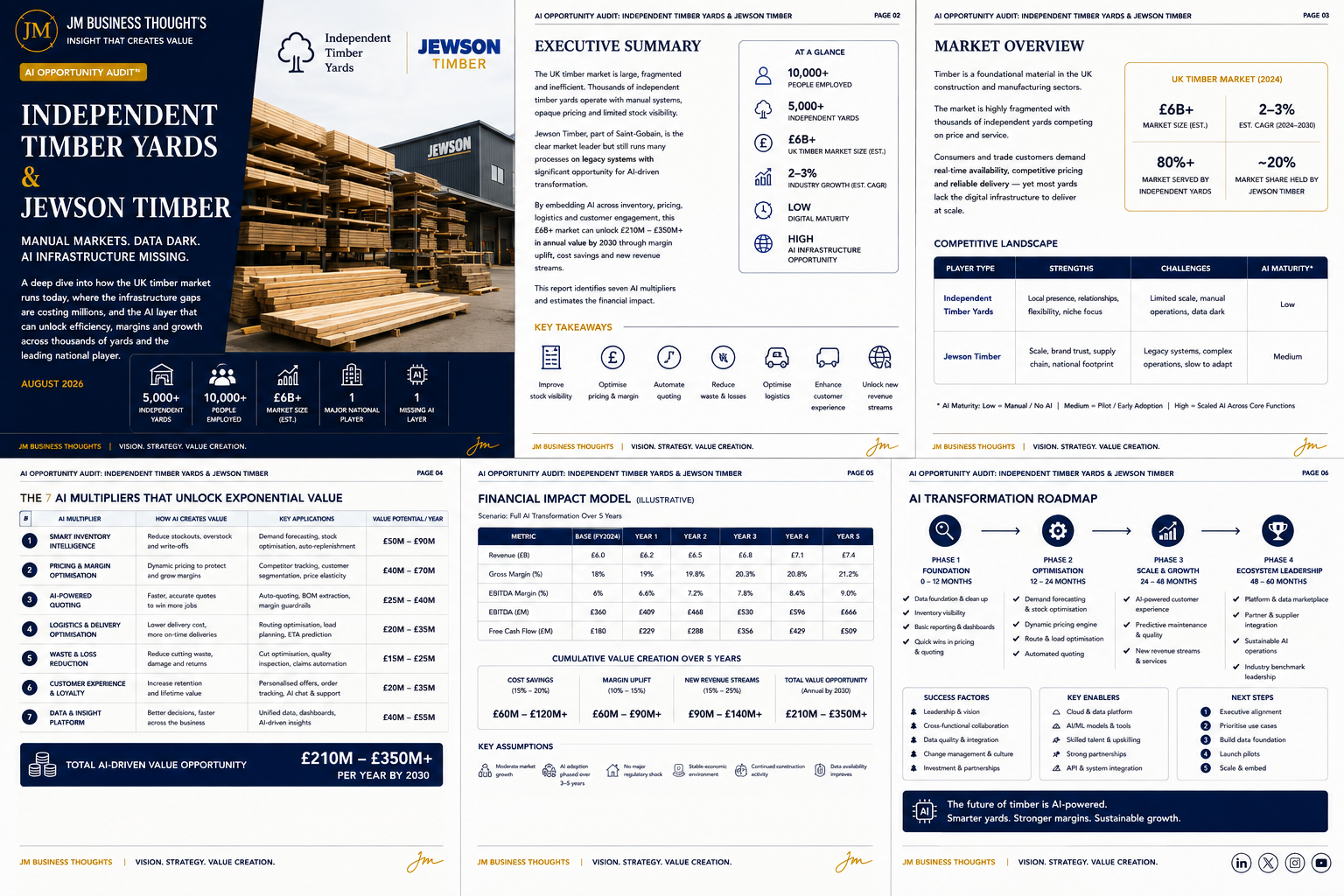
A deep dive into how the UK timber market runs today, where the infrastructure gaps are costing millions, and the AI layer that can unlock £210M – £350M+ of annual value by 2030 across thousands of yards and the leading national player.
UK Timber Market (Est.)
£6B+
Independent Yards
5,000+
People Employed
10,000+
Industry CAGR (2024–30)
2–3%
Digital Maturity
Low
Market Served By Independents
80%+
Jewson Share (Est.)
~20%
Annual AI Value By 2030
£210–350M+
The Thesis
The UK timber market is large, fragmented and structurally inefficient. Thousands of independent yards operate on manual systems, opaque pricing and near-zero stock visibility, while the clear national leader — Jewson Timber, part of Saint-Gobain — runs modern scale on legacy process. The value is not in a chatbot. It is in the missing infrastructure layer: inventory intelligence, dynamic pricing, automated quoting, routing and unified data — worth £210M – £350M+ per year by 2030 across the market.
Exhibit · Report Cover
27 · AI Opportunity Audit™

The UK timber market is worth an estimated £6B+, employs 10,000+ people and is served overwhelmingly by more than 5,000 independent yards. Growth is modest at 2–3% CAGR, which means value creation must come from margin and productivity, not volume.
The sector is data dark. Stock is counted on paper or in spreadsheets, prices are set by habit rather than elasticity, quotes are typed by hand from drawings and cut lists, and delivery is planned on local knowledge. Every one of those is now a solved problem in adjacent industries — and unsolved here.
Jewson Timber is the clear market leader with scale, brand trust and a national footprint, but many core processes still run on legacy systems. That combination — high volume, low digital maturity — is exactly where AI pays back fastest.
This audit identifies seven AI multipliers and models the financial impact of embedding them across inventory, pricing, logistics and customer engagement over a five-year horizon.

A £6bn market running on manual process. The margin is already there — it is simply not being captured.
Timber is a foundational material in UK construction and manufacturing, exposed to housebuilding starts, RMI (repair, maintenance and improvement) spend and infrastructure activity. Demand is cyclical; supply is volatile; prices move on global commodity and shipping dynamics.
The market is highly fragmented: thousands of independent yards compete primarily on price and local service, with over 80% of end demand served by independents. Trade customers now expect the same real-time availability, transparent pricing and reliable delivery they receive from national distributors in other categories — and most yards cannot deliver it at scale.
That expectation gap is the commercial opening. The yards that can answer 'do you have it, what does it cost, when can I get it' instantly will take share from those that cannot, irrespective of underlying market growth.
Independent timber yards win on local presence, relationships, flexibility and niche stock. They lose on scale, purchasing power, manual operations and the absence of usable data. AI maturity across this cohort is low — effectively manual, with no AI in core operations.
Jewson Timber wins on scale, brand trust, supply chain depth and national footprint. It loses time to legacy systems, complex operations and slower change cycles. AI maturity is medium: pilots and early adoption exist, but AI is not yet scaled across core functions.
The competitive question is therefore not 'who is biggest' but 'who digitises first'. An independent group that consolidates data across ten yards can price and serve like a national. A national that scales AI across hundreds of branches can serve like a local.
Low digital maturity is not a weakness to apologise for. It is the size of the prize, stated honestly.
Stock: yards routinely hold slow-moving lines while stocking out of fast movers, because reorder points are static and demand signals are never modelled. Working capital sits in the wrong SKUs.
Price: list prices and discount ladders are inherited, not derived. Two customers of identical value pay materially different prices for identical baskets, and margin leaks through unmanaged discretion at the counter.
Quote: bills of materials arrive as drawings, cut lists and photographs. Manual quoting is slow and error-prone, so win rates fall on jobs that would have been profitable and rise on jobs that were mispriced.
Waste and delivery: cutting patterns are optimised by eye, and delivery routes are built on habit. Both convert directly into cost of goods and cost to serve.
Modelled as a full AI transformation over five years on a £6.0B market base: revenue moves from £6.0B to £7.4B, gross margin from 18% to 21.2%, and EBITDA margin from 6% to 9%.
EBITDA grows from £360M to £666M, and free cash flow from £180M to £509M — driven as much by working capital release as by profit.
Key assumptions are deliberately conservative: moderate market growth, AI adoption phased over three to five years, no major regulatory shock, a stable economic environment, continued construction activity, and improving data availability.
£210M – £350M+ of annual value opportunity by 2030 — cost, margin and new revenue in roughly equal thirds.
Phase 1 (0–12 months) — Foundation: data foundation and clean-up, inventory visibility, basic reporting and dashboards, and quick wins in pricing and quoting.
Phase 2 (12–24 months) — Optimisation: demand forecasting and stock optimisation, a dynamic pricing engine, route and load optimisation, and automated quoting.
Phase 3 (24–48 months) — Scale and growth: AI-powered customer experience, predictive maintenance and quality, and new revenue streams and services.
Phase 4 (48–60 months) — Ecosystem leadership: a platform and data marketplace, partner and supplier integration, sustainable AI operations, and industry benchmark leadership.
Timber sits upstream of housing delivery, retrofit and net-zero construction. Efficiency here does not stay here — it flows into build cost, build speed and embodied carbon.
A market of this size with this level of digital maturity is rare in 2026. The infrastructure layer will be built by someone. The only open question is whether it is built by the incumbents, by a consolidating independent group, or by an outside platform that takes the margin with it.
The future of timber is AI-powered. Smarter yards. Stronger margins. Sustainable growth.
The Multiplier Framework
The seven AI multipliers that unlock exponential value across the UK timber market — together worth £210M – £350M+ per year by 2030.
£50M – £90M / year
Outcome · Right stock, right yard, less capital trapped in the wrong SKUs
£40M – £70M / year
Outcome · Ends unmanaged counter discretion and recovers structural margin
£25M – £40M / year
Outcome · Quote turnaround in minutes, with win rates aligned to profitability
£20M – £35M / year
Outcome · Cost to serve falls while reliability becomes a selling point
£15M – £25M / year
Outcome · Direct cost of goods reduction and a measurable carbon saving
£20M – £35M / year
Outcome · Trade customers consolidate spend with the yard that answers fastest
£40M – £55M / year
Outcome · The infrastructure layer everything else compounds on top of

The Verdict
The UK timber market does not need another chatbot. It needs an infrastructure layer — inventory intelligence, pricing discipline, automated quoting and unified data. Build it and £210M – £350M+ of annual value moves from theory to the P&L by 2030.