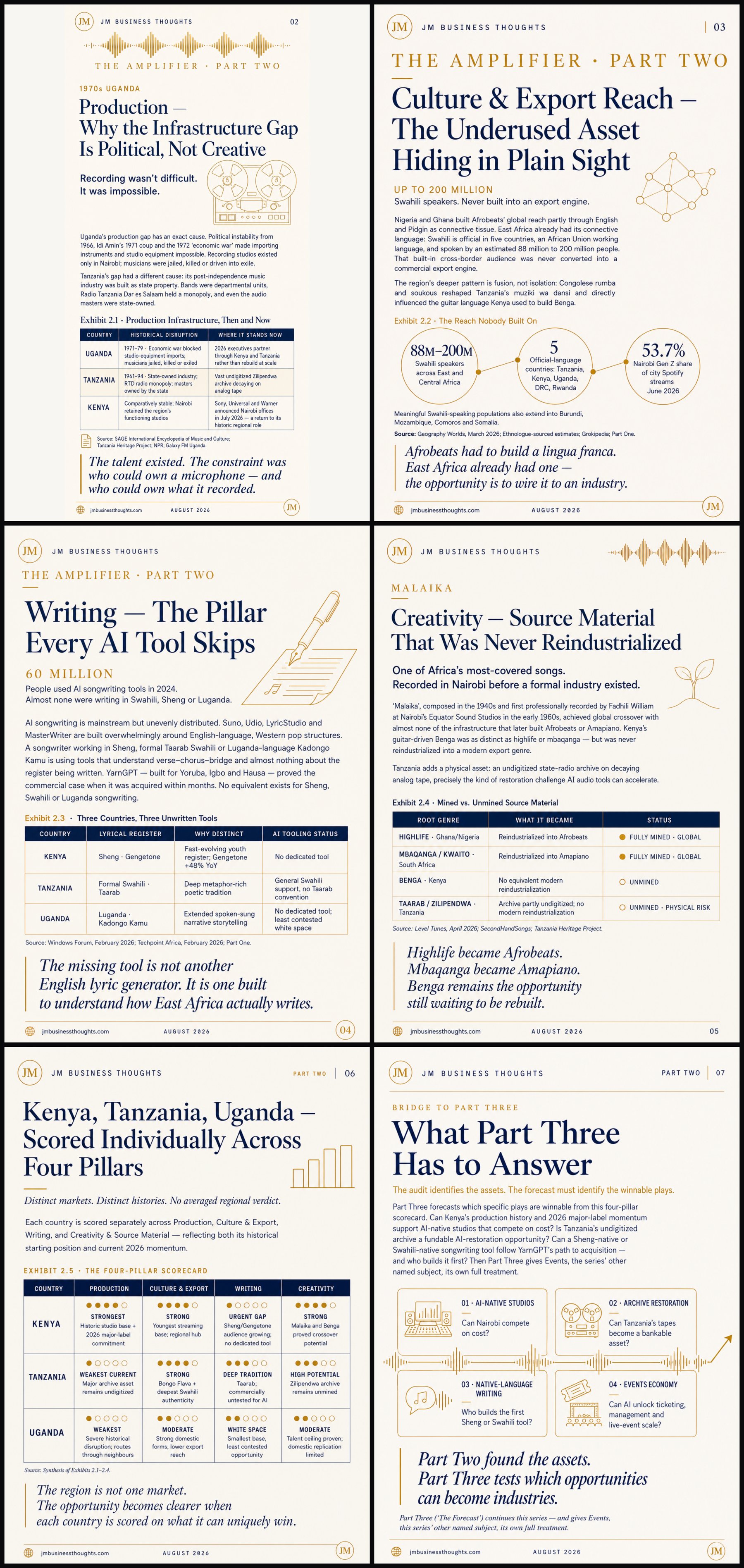
AI songwriting is now mainstream and unevenly distributed. Roughly 60 million people used AI songwriting tools in 2024. Suno, Udio, LyricStudio and MasterWriter are built overwhelmingly around English-language, Western pop structures.
A songwriter working in Sheng, formal Taarab Swahili or Luganda-language Kadongo Kamu is therefore using a tool that understands verse–chorus–bridge and almost nothing about the register being written — not the idiom, not the metaphor conventions, not the narrative form.
The commercial case is not hypothetical. YarnGPT, built for Yoruba, Igbo and Hausa, was acquired within months of launch. It demonstrated that native-language creative tooling in African markets has a buyer. No equivalent exists for Sheng, Swahili or Luganda songwriting.
Ranked by contestedness, Uganda is the cleanest white space: the smallest base, the least competition, and a narrative-sung form (Kadongo Kamu) that no general-purpose model handles. Kenya is the most urgent: Gengetone is growing +48% year on year into a fast-evolving youth register with no dedicated tool at all.