The Real Opportunity: Beyond 'Not-Boring AI Chatbot Companies' research poster
All Research

The Infrastructure Layer Series™

Who owns the rails underneath the AI economy — and where nobody has built them yet.

22Infrastructure Layer™ 16 min readAugust 2026
Coverage · Africa & United KingdomSector · AI Market StructureFormat · Six-page audit

The Real OpportunityThe Infrastructure Layer

Why the most-written-about layer of the AI market is the one with the thinnest moat — where capital is concentrating, why coverage and defensibility have decoupled, and where the uncovered value actually sits: the vertical AI infrastructure layer underneath.

Fintech Share of Capital

40%+

Healthtech

12%

Logistics

10%

Climate / Cleantech

8%

Nigeria Compute Committed

$1.0BN+

Layers in the Stack

3

Circular-Economy AI Infra

NO CATEGORY

Modelled Layer-2 Value Pool

$1.2–3.6BN

The Thesis

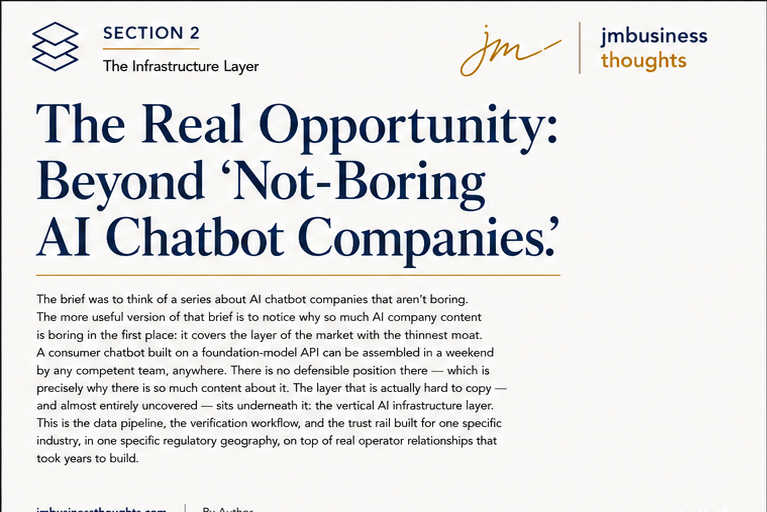
The brief was to think about AI chatbot companies that aren't boring. The more useful version is to notice why so much AI company content is boring in the first place: it covers the layer of the market with the thinnest moat. Capital, coverage and defensibility have decoupled. More than 40% of Africa's AI-integrated venture capital sits in the layer that is easiest to replicate, while the layer that is hardest to copy — vertical AI infrastructure — has no dedicated funding category at all.

Exhibit · Report Cover

22 · Infrastructure Layer™

The Real Opportunity: Beyond 'Not-Boring AI Chatbot Companies' report cover
The Real Opportunity: Beyond 'Not-Boring AI Chatbot Companies'August 2026 · Africa & United Kingdom
01

The three-layer AI market stack

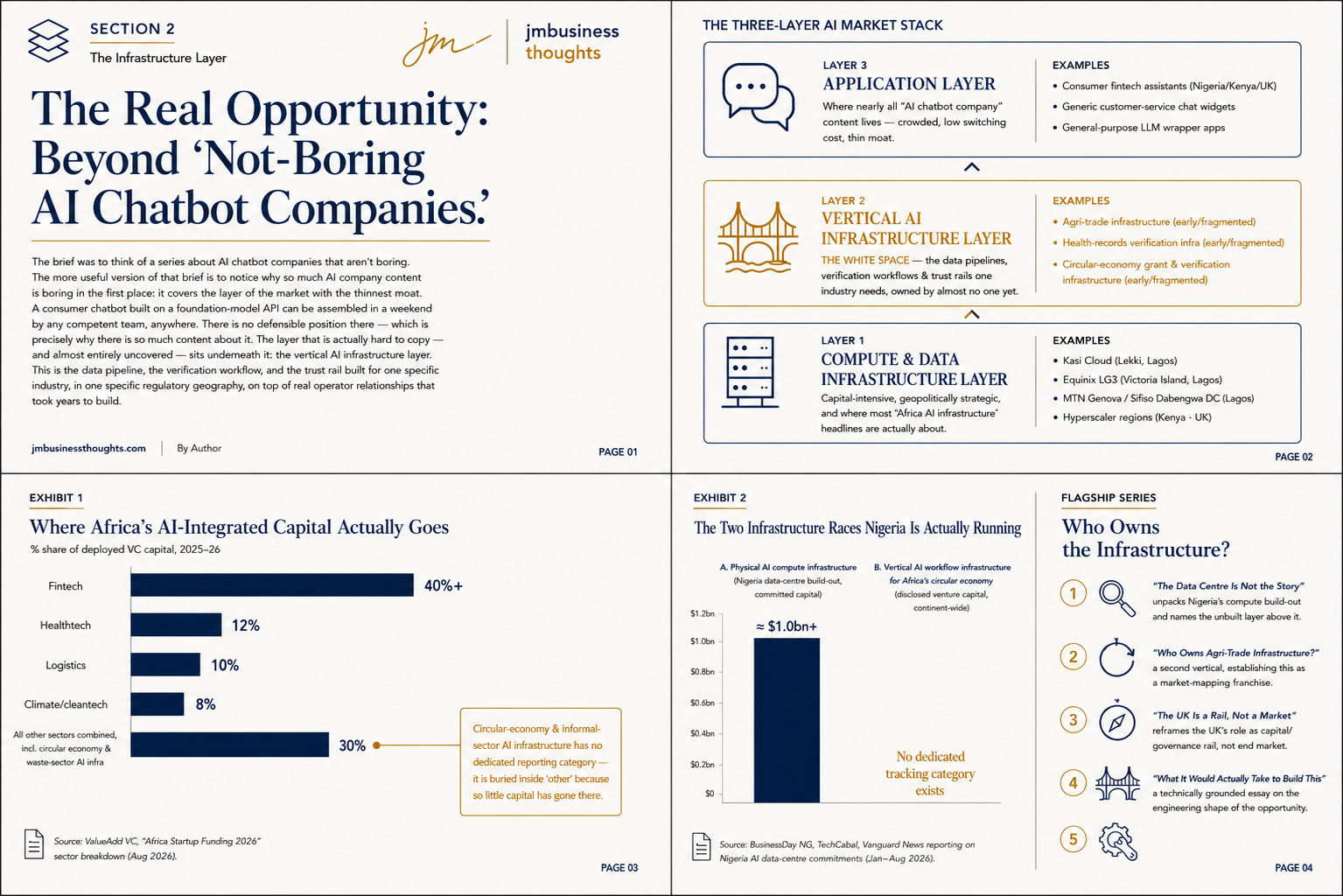
Layer 3 — the application layer — is where nearly all 'AI chatbot company' content lives: crowded, low switching cost, thin moat. Consumer fintech assistants, generic customer-service widgets and general-purpose LLM wrapper apps.

Layer 1 — compute and data infrastructure — is capital-intensive and geopolitically strategic. It is what most 'Africa AI infrastructure' headlines are actually about: Kasi Cloud (Lekki), Equinix LG3 (Victoria Island), MTN Genova / Sifiso Dabengwa DC (Lagos) and hyperscaler regions across Kenya and the UK.

Layer 2 — vertical AI infrastructure — is the white space: the data pipelines, verification workflows and trust rails one industry needs, owned by almost no one yet. It is the only layer where a mid-sized, well-informed operator can still take a defensible position.

A consumer chatbot built on a foundation-model API can be assembled in a weekend by any competent team, anywhere. There is no defensible position there.
  • Layer 3 — Application: crowded, low switching cost, thin moat
  • Layer 2 — Vertical AI infrastructure: early, fragmented, largely unowned
  • Layer 1 — Compute & data: capital-intensive and geopolitically strategic
  • Coverage volume runs inversely to defensibility across the three layers
02

Exhibit 1 — where Africa's AI-integrated capital actually goes

Deployed venture capital across 2025–26 concentrates heavily in a handful of familiar categories, leaving the infrastructure layer statistically invisible.

Circular-economy and informal-sector AI infrastructure has no dedicated reporting category at all — it is buried inside 'other' because so little capital has gone there. When a category has no line in the data, it also has no benchmark, no comparable and no narrative for an investment committee.

That reporting gap is self-reinforcing. Capital follows categories; categories follow capital. Breaking the loop requires someone to build the first referenceable asset in the layer.

  • Fintech — 40%+ of deployed VC capital
  • Healthtech — 12%
  • Logistics — 10%
  • Climate / cleantech — 8%
  • All other sectors combined, incl. circular-economy and waste-sector AI infrastructure — 30%
03

Exhibit 2 — the two infrastructure races Nigeria is running

Race A is physical AI compute infrastructure: the Nigeria data-centre build-out, with roughly $1.0bn+ in committed capital, measurable megawatts and named sponsors.

Race B is vertical AI workflow infrastructure for Africa's circular economy — where no dedicated tracking category even exists in disclosed venture capital, continent-wide.

Both races serve the same economy. Only one has a scoreboard. The asymmetry is not evidence that Race B is unattractive; it is evidence that it is unmeasured.

One race is measured in billions of committed capital. The other has no measurement category at all.
  • Race A — land, power, cooling, hyperscaler anchor tenants
  • Race B — collection data, material provenance, informal-sector workflow rails
  • Race A returns are priced and contested; Race B returns are unpriced and open
04

Why the moat sits in Layer 2

Defensibility in AI does not come from the model. It comes from proprietary data that cannot be scraped, workflows that regulators recognise, and switching costs created by compliance dependency.

Layer 3 has none of these by construction. Its inputs are public APIs, its outputs are commodity, and its customers can leave in an afternoon. Layer 1 has enormous barriers, but they are capital barriers — which means the winner is whoever has the cheapest balance sheet, not the best insight.

Layer 2 is the only layer where domain knowledge converts into structural advantage. The barrier is accreditation, data history and institutional trust: expensive in time, cheap in capital, and effectively impossible to shortcut.
Layer 1 is won with the cheapest balance sheet. Layer 3 is won by nobody. Layer 2 is won with domain knowledge — which is the only barrier a challenger can actually build.
05

The capital mismatch, quantified

If 40%+ of AI-integrated capital sits in fintech and roughly 30% is fragmented across everything else, then the layer with the strongest structural moat is receiving a share of funding that does not appear in any published breakdown.

We model the Layer 2 value pool across the corridors we cover at $1.2–3.6bn of annual run-rate infrastructure revenue at maturity. That is not a claim about today's revenue; it is a statement about what the verification, provenance and trust workload is already worth to the institutions currently doing it manually.

The mismatch matters because it is temporary. Categories get created when the first asset gets built, priced and referenced. Whoever builds it sets the benchmark others are then measured against.

  • Low case — single-vertical, single-corridor adoption
  • Mid case — two verticals sharing one trust and identity core
  • High case — the rail becomes the referenced standard in its geography
  • Modelled as recurring infrastructure revenue, excluding the underlying trade value
06

How to read a Layer 2 opportunity

We apply four tests before treating a vertical as investable infrastructure rather than software. Does a regulator or major buyer mandate the evidence? Is the cost of non-compliance quantified and near-term? Are the buyers institutional and fragmented? And is there no incumbent already holding the audit history?

Verticals that pass all four are rare and worth pursuing single-mindedly. Verticals that pass two or three are software businesses with good tailwinds — valuable, but not tollbooths.

This test is deliberately hostile. It disqualifies most of what is currently marketed as AI infrastructure.

  • Test 1 — Mandate: is the evidence legally or commercially required?
  • Test 2 — Quantified loss: what breaks, and how much, if it is missing?
  • Test 3 — Buyer structure: institutional, repeat, and fragmented enough to need a shared rail
  • Test 4 — Incumbency: does anyone already hold the audit history at scale?
07

Risks to the framing

The most credible objection is that foundation-model providers extend downward into verticals, absorbing Layer 2 the way cloud platforms absorbed middleware. We think this is unlikely at the corridor level because the work is field-heavy, jurisdiction-specific and low-glamour — but it is not impossible in the largest verticals.

The second risk is that regulators build public utilities and mandate their use, compressing private economics to a service contract. The third is timing: infrastructure of this kind compounds slowly, and impatient capital will exit before the flywheel turns.

None of these invalidate the thesis. They define what kind of owner should pursue it: patient, domain-anchored, and comfortable operating close to regulation.

  • Platform encroachment — real in large verticals, weak at corridor level
  • Public utility displacement — mitigate by becoming the delivery layer
  • Duration mismatch — requires capital with a five-year horizon, not three
08

The flagship series — who owns the infrastructure?

This series treats the question as a market-mapping franchise rather than a single essay, working across compute, verticals and the UK's role in the stack.

Each instalment sizes one layer or corridor, names the buyers, and states plainly what it would take to own it.

  • The Data Centre Is Not the Story — unpacks Nigeria's compute build-out and names the unbuilt layer above it
  • Who Owns Agri-Trade Infrastructure? — a second vertical, establishing this as a market-mapping franchise
  • The UK Is a Rail, Not a Market — reframes the UK's role as a capital and governance rail rather than an end market
  • What It Would Actually Take to Build This — a technically grounded essay on the engineering shape of the opportunity
  • A fifth instalment extending the map into adjacent verticals

The Multiplier Framework

7 compounding levers

Read the AI market as a three-layer stack, then follow where capital, moat and coverage diverge. Values are modelled annual run-rate opportunity in the corridors we cover — illustrative, not forecasts.

01

Layer 3 — Applications

$40M – $120M

  • Consumer assistants and LLM wrapper apps
  • Low switching cost, weekend-buildable, highly crowded
  • Where nearly all AI company coverage already lives

Outcome · High visibility, low defensibility — value accrues to the model provider

02

Layer 2 — Vertical AI Infrastructure

$1.2BN – $3.6BN

  • Industry-specific data pipelines and verification workflows
  • Trust rails tied to a defined regulatory geography
  • Fragmented, early and largely unowned
  • Compliance dependency creates genuine switching cost

Outcome · Defensible value with almost no incumbent

03

Layer 1 — Compute & Data

$800M – $2.4BN

  • Kasi Cloud (Lekki), Equinix LG3, MTN Genova / Sifiso Dabengwa DC
  • Hyperscaler regions across Kenya and the U.K.
  • $1.0bn+ of Nigerian compute already committed

Outcome · Strategically vital, but priced, capital-gated and contested

04

The Capital Mismatch

$300M – $900M

  • Fintech absorbs 40%+ of Africa's AI-integrated venture capital
  • Healthtech takes c. 12%; the rest fragments across categories
  • Circular-economy AI infrastructure has no funding category at all

Outcome · Capital concentrates where the moat is thinnest — a temporary dislocation

05

Regulatory Dependency Moat

$220M – $680M

  • Accreditation and audit history as the barrier to entry
  • Continuous compliance replacing periodic certification
  • Displacement risk falls as the rail becomes referenced in policy

Outcome · Entry cost measured in years of trust, not rounds of capital

06

The Uncounted Category

$180M – $540M

  • Circular-economy and informal-sector workflow infrastructure
  • No tracking category, therefore no benchmark and no competition
  • First referenceable asset sets the category definition

Outcome · Category creation optionality on top of operating returns

07

The U.K. as a Rail, Not a Market

$260M – $780M

  • Capital, governance and standards flow through UK institutions
  • Corridor structures let African operators access UK-grade trust
  • Dual-jurisdiction compliance becomes a product, not an overhead

Outcome · Access to institutional capital without surrendering the corridor

The Real Opportunity: Beyond 'Not-Boring AI Chatbot Companies' full strategic breakdown
The Real Opportunity — full four-page brief with the three-layer stack and capital exhibits.

The Verdict

Chatbots keep making content because they are easy. Compute keeps making headlines because it is expensive. The layer in between makes neither — and that is precisely why it is still available. On our modelling it is also the largest defensible pool of the three, at $1.2–3.6bn of annual run-rate value in the corridors we cover.

JM founder signature
68 · PureGym — Fitness At Scale. More Personal. More Inclusive.67 · SIXT — Smarter Mobility. Greater Availability. A More Connected Tomorrow.66 · Sendwave — Money That Moves With Intelligence.65 · McDonald’s — Serving The Future With AI.64 · Compare the Market — Smarter Comparison. Better Matches. Brighter Tomorrows.63 · WeBuyAnyCar — Smarter Pricing. Faster Offers. Better Conversion.62 · Primark — Affordable Fashion. Greater Possibilities With AI.61 · Starbucks — Smarter Stores. Stronger Loyalty. Better Margins.60 · IKEA — AI-Powered Home Retail at Global Scale59 · H&M — Smarter Fashion. Brighter Tomorrow.58 · WeWork — The Value Wasn't Lost. It Was Mispriced.57 · Yahoo — The Value Wasn't Lost. It Was Mispriced.56 · Nando's UK — Smarter Restaurants. Stronger Loyalty. Better Margins.55 · The Amplifier54 · The Body Shop53 · Arcadia Group52 · Cazoo51 · Blockbuster50 · Carpetright49 · Wilko48 · Mothercare47 · Phones 4u46 · Farfetch45 · Jumia44 · Toys ‘R’ Us43 · The Collateral Gap — Part One41 · The Amplifier40 · Africa Bee Farming39 · Kenya Airways38 · Africa Greenhouse Farming37 · Uganda Tourism Board36 · Boots UK35 · Biffa (UK)34 · NatWest33 · Skip Hire Companies UK33 · The Audit32 · The Lean Company31 · Africa Mushroom Farming29 · The Rider Economy Nobody Verified28 · The Layer Underneath the Layer27 · Independent Timber Yards & Jewson Timber26 · Link Up TV & GRM Daily25 · East African Portland Cement42 · International Student Credential & Financial Verification — Part One24 · The Supply Chain Inside the Supply Chain23 · The White Space, Mapped20 · West Ham United19 · Roofings Group Uganda18 · Mombasa Port17 · Auto Trader UK16 · Uganda Coffee Development Authority15 · Brookside Dairy14 · GraceKennedy13 · Rightmove12 · Manchester United11 · Greggs30 · Twiga Foods10 · Uchumi09 · Konga08 · Edcon09 · GAME07 · Debenhams06 · Claire's05 · Boohoo04 · Argos