The Layer Underneath the Layer: NHS Mental Health Workforce as the Root Infrastructure Gap research poster
All Research

The Infrastructure Layer Series™

Who owns the rails underneath the AI economy — and where nobody has built them yet.

28Infrastructure Layer™ 18 min readAugust 2026
Coverage · United Kingdom (England & Scotland)Sector · Health Workforce Infrastructure · Vertical AIFormat · Six-page audit

The Layer Underneath the LayerDeep Dive, Chapter 4

Chapter 3 mapped three broken stages in the mental health supply chain. All three run on the same missing layer: a workforce system that verifies each person’s credentials once, then does it all again, from scratch, every time they show up somewhere new. Referral triage, bed capacity and medication review all fail for the same reason — not enough verified staff, in the right place, at the right time.

MH Nursing Vacancy Rate

18%

Unfilled MH Nursing Posts

13,000+

Workforce Growth, 2016–22

+22%

Referral Growth, Same Period

+44%

Manual Onboarding

75 DAYS

Digitised Onboarding

10 DAYS

Cost, One 400-Bed Trust

≈£383K/YR

Agency Spend Targeted

£3BN

The Thesis

Every attempted fix in NHS mental health staffing has targeted which column the spend sits in — agency versus bank — rather than the absence underneath both: a portable, real-time, verified staffing layer that lets a cleared clinician move between trusts without starting their paperwork from zero. A workforce growing at 22% cannot absorb demand growing at 44%; no amount of triage redesign fixes a structural shortfall. Meanwhile the same credentials are re-verified from scratch on every re-engagement, costing a single 400-bed trust roughly £383,000 a year in delay and premium cover alone — and a 30% agency cap is pushing spend toward bank shifts that FOI data shows frequently cost more for identical cover. This is the credential-verification white space of Chapter 2, viewed from inside the system that most needs it.

Exhibit · Report Cover

28 · Infrastructure Layer™

The Layer Underneath the Layer: NHS Mental Health Workforce as the Root Infrastructure Gap report cover
The Layer Underneath the Layer: NHS Mental Health Workforce as the Root Infrastructure GapAugust 2026 · United Kingdom (England & Scotland)
01

The root layer: three broken stages, one shared dependency

Chapter 3 treated English mental health care as a supply chain with three failing stages — referral triage, bed placement matching and medication availability. Read individually, each looks like a distinct policy problem with a distinct owner. Read together, they share a single dependency that none of them controls: enough verified staff, in the right place, at the right time.

Triage cannot compress waits without assessors. Bed placement cannot avoid an out-of-area transfer without a safely staffed ward. Medication review cannot happen without a prescriber. Every downstream matching layer we mapped assumes a supply of cleared clinicians that the system has no mechanism to mobilise dynamically. That is the layer underneath the layer.

The commercial consequence is that workforce verification is not a sub-feature of the opportunities in Chapter 3 — it is the prerequisite. Whoever builds the portable clearance rail sits upstream of triage routing, bed exchanges and prescription routing simultaneously, because all three consume the same scarce, repeatedly re-verified resource.

Three separate problems. One shared root cause: nobody has built a system where clearance travels with the clinician.
  • Stage 1 triage is constrained by assessor availability, not process design
  • Stage 2 placement is constrained by safely staffed beds, not physical beds
  • Stage 3 medication review is constrained by prescriber capacity
  • Shared dependency: verified, mobile, real-time-matched staff
02

Exhibit A — The vacancy-to-demand gap

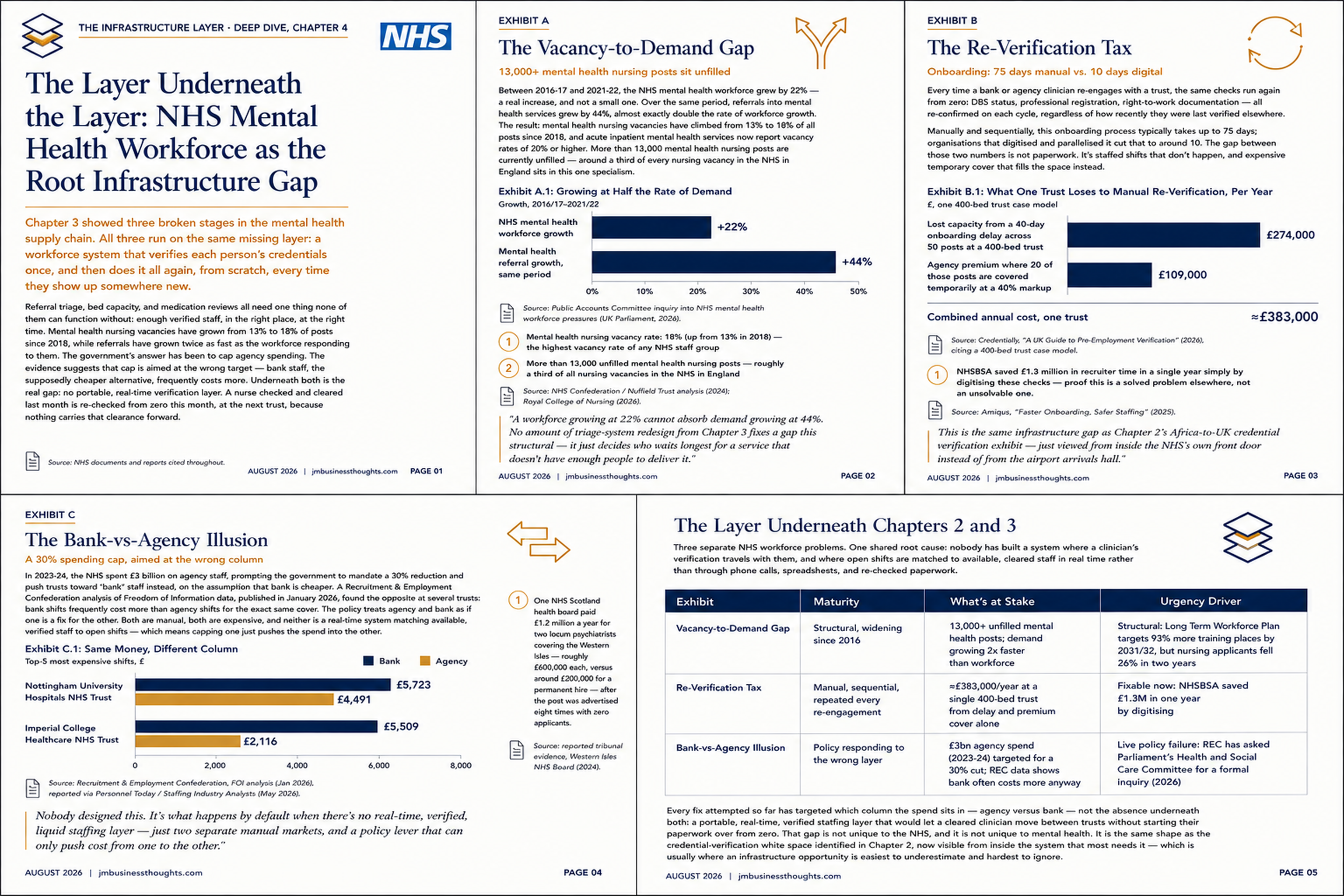
Between 2016–17 and 2021–22, the NHS mental health workforce grew by 22% — a real increase, and not a small one. Over the same period, referrals into mental health services grew by 44%, almost exactly double the rate of workforce growth. Growth was never the problem; the ratio was.

The result is visible in vacancy data. Mental health nursing vacancies have climbed from 13% to 18% of all posts since 2018, and acute inpatient mental health services now report vacancy rates of 20% or higher. More than 13,000 mental health nursing posts are currently unfilled — around a third of every nursing vacancy in the NHS in England sits in this one specialism.

The Long Term Workforce Plan targets 93% more training places by 2031/32, but nursing applicants fell 26% in two years. The pipeline fix is real, slow, and currently moving in the wrong direction — which makes utilisation of the existing cleared workforce the only lever available inside this parliament.

A workforce growing at 22% cannot absorb demand growing at 44%. No triage redesign fixes that.
  • MH workforce growth 2016/17–2021/22: +22%
  • MH referral growth, same period: +44%
  • Nursing vacancy rate: 13% (2018) → 18% today — highest of any NHS staff group
  • 13,000+ unfilled MH nursing posts; ~a third of all NHS nursing vacancies
  • Sources: Public Accounts Committee inquiry into NHS mental health workforce pressures (UK Parliament, 2026); NHS Confederation / Nuffield Trust analysis (2024); Royal College of Nursing (2026)
03

Exhibit B — The re-verification tax

Every time a bank or agency clinician re-engages with a trust, the same checks run again from zero: DBS status, professional registration, right-to-work documentation — all re-confirmed on each cycle, regardless of how recently they were last verified elsewhere.

Run manually and sequentially, this onboarding process typically takes up to 75 days. Organisations that digitised and parallelised it cut that to around 10. The gap between those two numbers is not paperwork. It is staffed shifts that do not happen, and expensive temporary cover that fills the space instead.

Modelled on a single 400-bed trust, a 40-day onboarding delay across 50 posts costs roughly £274,000 in lost capacity, with a further £109,000 where 20 of those posts are covered temporarily at a 40% agency premium — approximately £383,000 a year, at one trust, from one avoidable delay. NHSBSA saved £1.3 million in recruiter time in a single year simply by digitising these checks: proof this is a solved problem elsewhere, not an unsolvable one.

75 days manual, 10 days digital. The difference is not paperwork — it is shifts that never happen.
  • Manual onboarding: up to 75 days; digitised and parallelised: ~10 days
  • £274,000 lost capacity from a 40-day delay across 50 posts, 400-bed trust model
  • £109,000 agency premium where 20 posts are covered at a 40% markup
  • Combined ≈£383,000 per year, per trust
  • NHSBSA: £1.3M recruiter time saved in one year by digitising checks
  • Sources: Credentially, “A UK Guide to Pre-Employment Verification” (2026); Amiqus, “Faster Onboarding, Safer Staffing” (2025)
04

Exhibit C — The bank-vs-agency illusion

In 2023–24 the NHS spent £3 billion on agency staff, prompting the government to mandate a 30% reduction and push trusts toward ‘bank’ staff instead, on the assumption that bank is cheaper. Recruitment & Employment Confederation analysis of Freedom of Information data, published in January 2026, found the opposite at several trusts: bank shifts frequently cost more than agency shifts for the exact same cover.

At Nottingham University Hospitals NHS Trust, the top-five most expensive shifts cost £5,723 on bank against £4,491 on agency. At Imperial College Healthcare NHS Trust the split was £5,509 bank against £2,116 agency. One NHS Scotland health board paid £1.2 million a year for two locum psychiatrists covering the Western Isles — roughly £600,000 each, versus around £200,000 for a permanent hire, after the post was advertised eight times with zero applicants.

The policy treats agency and bank as if one is a fix for the other. Both are manual, both are expensive, and neither is a real-time matching layer connecting available, verified staff to open shifts — which means capping one simply pushes the spend into the other. Nobody designed this: it is what happens by default when there is no liquid staffing layer, just two separate manual markets and a policy lever that can only move cost between them.

£3bn targeted for a 30% cut — aimed at the column, not the layer underneath both columns.
  • £3BN NHS agency spend, 2023–24; 30% mandated reduction
  • Nottingham University Hospitals: £5,723 bank vs £4,491 agency (top-5 shifts)
  • Imperial College Healthcare: £5,509 bank vs £2,116 agency
  • Western Isles: £1.2M/yr for two locums vs ≈£200K per permanent hire
  • REC has asked Parliament’s Health and Social Care Committee for a formal inquiry (2026)
  • Sources: REC FOI analysis (Jan 2026), reported via Personnel Today / Staffing Industry Analysts (May 2026); Western Isles NHS Board tribunal evidence (2024)
05

Synthesis — maturity, stakes and urgency

Read as a matrix, the three exhibits differ in maturity but converge on the same remedy. The vacancy-to-demand gap is structural and widening since 2016; the stakes are 13,000+ unfilled posts against demand growing twice as fast as workforce; the urgency driver is a Long Term Workforce Plan targeting 93% more training places by 2031/32 while applicants fall 26% in two years.

The re-verification tax is manual, sequential and repeated on every re-engagement; the stakes are roughly £383,000 a year at a single 400-bed trust from delay and premium cover alone; the urgency driver is that it is fixable now — NHSBSA already saved £1.3 million in one year by digitising.

The bank-vs-agency illusion is a policy responding to the wrong layer; the stakes are £3 billion of 2023–24 spend targeted for a 30% cut while REC data shows bank often costs more; the urgency driver is a live policy failure with a formal parliamentary inquiry requested. Three different maturities, one procurement thesis.

Every fix so far has moved cost between columns. None has built the layer underneath both.
  • Structural gap → fix is utilisation, not pipeline, inside this parliament
  • Verification tax → fix is proven, funded and already demonstrated at NHSBSA
  • Policy failure → forcing function via Health and Social Care Committee scrutiny
  • Buyer sits at trust, ICB and national bank-collaborative level simultaneously
06

Where the value accrues — and what would break the thesis

Value accrues to whoever holds the canonical, portable record of who is cleared to work, where, and until when. That record is the scarce asset: once a clinician’s clearance travels with them, every shift-matching, triage-routing and placement system downstream becomes materially more liquid, and the holder of the record is upstream of all of them.

The commercial model that fits is avoided cost, not per-seat licensing. Trusts already measure and publish agency spend, vacancy rates, time-to-hire and temporary cover premiums. A contract written against a £383,000-per-trust baseline is a procurement case in the buyer’s own reported numbers — the same structure that made the Chapter 3 bed-exchange thesis fundable.

Three things break the thesis. First, NHS England mandates a single central passport, collapsing the market to integration services — possible, and partially signalled by existing staff-passport pilots. Second, professional-body and information-governance friction slows cross-trust portability below the pace of the procurement cycle. Third, the 30% agency cap succeeds numerically while cost migrates invisibly into bank, removing political pressure without removing the underlying spend. The third is the most dangerous: it hides the problem rather than solving it.

  • Watch: trust-level bank vs agency unit cost disclosures following REC FOI work
  • Watch: NHS staff passport pilots and any move to mandate a national standard
  • Watch: time-to-hire and onboarding cycle time as published trust KPIs
  • Watch: MH nursing vacancy rate against the 18% baseline
  • Watch: Health and Social Care Committee inquiry status into agency spend policy

The Multiplier Framework

5 compounding levers

Five positions sit inside the workforce layer. Each is separately fundable, each has an identified buyer with an existing budget line, and each compounds the Chapter 3 matching layers — because triage, placement and medication all consume the same verified staff supply.

01

Portable Credential Passport

Verify once, carry it everywhere

  • Hold DBS, registration and right-to-work status as a continuously refreshed record
  • Make clearance portable across trust boundaries without re-running checks
  • Cut onboarding from 75 days toward the demonstrated 10-day benchmark
  • Publish an auditable chain of evidence for regulators and boards

Outcome · Removes the ≈£383,000 annual re-verification tax at a single 400-bed trust

02

Real-Time Shift Liquidity Layer

Match open shifts to cleared staff, not to phone lists

  • Expose open shifts and available cleared clinicians in one live market
  • Price bank and agency options side by side at the point of decision
  • Fill from the cheapest safe source rather than the fastest known contact
  • Instrument fill rate, time-to-fill and unit cost per shift

Outcome · Ends the bank-vs-agency illusion by pricing both against one supply pool

03

Vacancy-to-Demand Forecasting Engine

Staff against next quarter’s referrals, not last quarter’s roster

  • Model referral growth by pathway against cleared workforce supply
  • Flag services heading toward the 20%+ acute inpatient vacancy threshold
  • Convert the 22% vs 44% gap into service-level staffing plans
  • Feed the Long Term Workforce Plan with bottom-up evidence

Outcome · Turns a national aggregate into an actionable ward-level rota position

04

Premium & Avoided-Cost Ledger

Bill against numbers the buyer already publishes

  • Attribute every premium-cover pound to a specific onboarding delay
  • Benchmark trust unit costs against REC FOI comparators
  • Produce board-grade evidence packs against the 30% agency reduction target
  • Anchor commercial terms in avoided cost, not per-seat licensing

Outcome · A procurement case written in the trust’s own reported metrics

05

Hard-to-Fill Geography Rail

Make remote and island posts fillable at a defensible price

  • Pool cleared clinicians across boards for rotational remote cover
  • Blend in-person and remote assessment capacity against the same rota
  • Track posts advertised repeatedly with zero applicants as a live signal
  • Replace £600,000 locum cover with structured multi-board arrangements

Outcome · Attacks the extreme tail where cost per post runs 3x a permanent hire

The Layer Underneath the Layer: NHS Mental Health Workforce as the Root Infrastructure Gap full strategic breakdown
The Infrastructure Layer · Deep Dive, Chapter 4 — full five-page audit: the vacancy-to-demand gap, the re-verification tax, the bank-vs-agency illusion and the Chapters 2–3 synthesis matrix.

The Verdict

Every fix attempted so far has targeted which column the spend sits in — agency versus bank — not the absence underneath both: a portable, real-time, verified staffing layer that would let a cleared clinician move between trusts without starting their paperwork from zero. That gap is not unique to the NHS, and it is not unique to mental health. It is the same shape as the credential-verification white space identified in Chapter 2, now visible from inside the system that most needs it — which is usually where an infrastructure opportunity is easiest to underestimate and hardest to ignore.

JM founder signature
68 · PureGym — Fitness At Scale. More Personal. More Inclusive.67 · SIXT — Smarter Mobility. Greater Availability. A More Connected Tomorrow.66 · Sendwave — Money That Moves With Intelligence.65 · McDonald’s — Serving The Future With AI.64 · Compare the Market — Smarter Comparison. Better Matches. Brighter Tomorrows.63 · WeBuyAnyCar — Smarter Pricing. Faster Offers. Better Conversion.62 · Primark — Affordable Fashion. Greater Possibilities With AI.61 · Starbucks — Smarter Stores. Stronger Loyalty. Better Margins.60 · IKEA — AI-Powered Home Retail at Global Scale59 · H&M — Smarter Fashion. Brighter Tomorrow.58 · WeWork — The Value Wasn't Lost. It Was Mispriced.57 · Yahoo — The Value Wasn't Lost. It Was Mispriced.56 · Nando's UK — Smarter Restaurants. Stronger Loyalty. Better Margins.55 · The Amplifier54 · The Body Shop53 · Arcadia Group52 · Cazoo51 · Blockbuster50 · Carpetright49 · Wilko48 · Mothercare47 · Phones 4u46 · Farfetch45 · Jumia44 · Toys ‘R’ Us43 · The Collateral Gap — Part One41 · The Amplifier40 · Africa Bee Farming39 · Kenya Airways38 · Africa Greenhouse Farming37 · Uganda Tourism Board36 · Boots UK35 · Biffa (UK)34 · NatWest33 · Skip Hire Companies UK33 · The Audit32 · The Lean Company31 · Africa Mushroom Farming29 · The Rider Economy Nobody Verified26 · Link Up TV & GRM Daily25 · East African Portland Cement42 · International Student Credential & Financial Verification — Part One24 · The Supply Chain Inside the Supply Chain23 · The White Space, Mapped22 · The Real Opportunity21 · Greencore20 · West Ham United19 · Roofings Group Uganda18 · Mombasa Port17 · Auto Trader UK16 · Uganda Coffee Development Authority15 · Brookside Dairy14 · GraceKennedy13 · Rightmove12 · Manchester United11 · Greggs30 · Twiga Foods10 · Uchumi09 · Konga08 · Edcon09 · GAME07 · Debenhams06 · Claire's05 · Boohoo04 · Argos