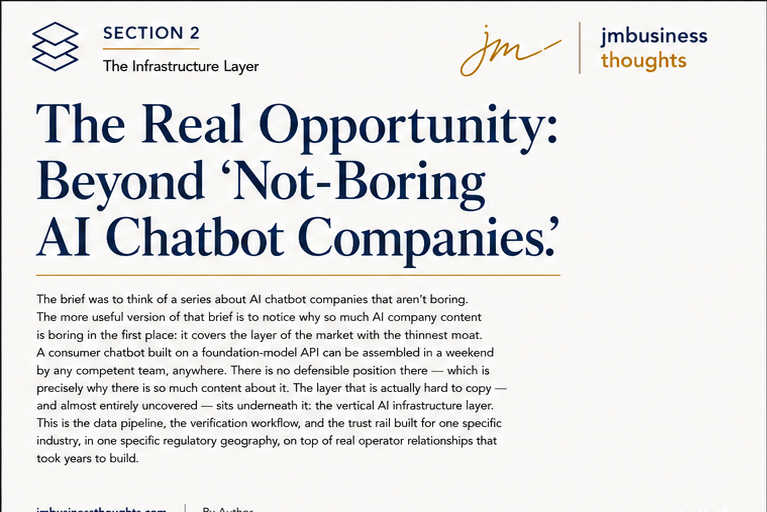
The White Space, Mapped: Three Untapped AI Infrastructure Verticals research poster
All Research

The Infrastructure Layer Series™

Who owns the rails underneath the AI economy — and where nobody has built them yet.

23Infrastructure Layer™ 18 min readAugust 2026
Coverage · Africa & United KingdomSector · Vertical AI InfrastructureFormat · Six-page audit

The White Space, MappedAfrica & U.K.

A deep dive into Layer 2 of the AI stack — agri-export compliance, critical minerals traceability and skilled-labour credential verification: three verticals that are quantifiable, urgent, regulator-forced and have no dominant infrastructure owner yet.

Verticals Mapped

3

Export Revenue at Risk

$11BN

EUDR Deadline

30 AUG 2026

Africa's Critical Minerals

~30%

EU Share of Africa Cocoa

59%

Farmers Geo-Mapped, Uganda

1.5M

Clinical Hiring Cycle

9–14 MTHS

Modelled Layer-2 Value Pool

$0.9–3.0BN

The Thesis

Layer 2 of the AI stack isn't empty because nobody needs it. It's empty because almost nobody has built it yet — and in one case, the clock is now measured in months, not years. Agricultural export compliance, critical minerals traceability and skilled-labour credential verification are each already regulated, already quantified, and each has a named buyer with a budget line. None of them has a dominant infrastructure owner. On our modelling, the three verticals together represent a $0.9–3.0bn annual value pool by maturity, and the entry cost is regulatory alignment rather than capital.

Exhibit · Report Cover

23 · Infrastructure Layer™

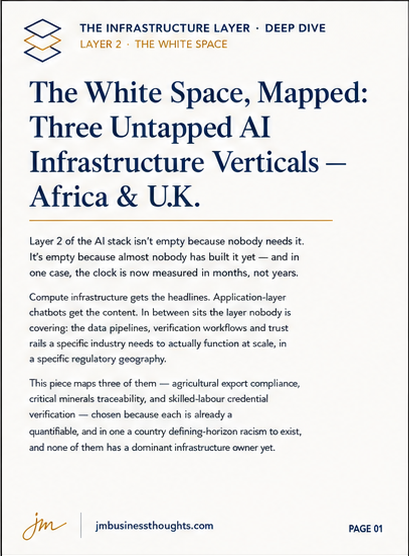
The White Space, Mapped: Three Untapped AI Infrastructure Verticals report cover
The White Space, Mapped: Three Untapped AI Infrastructure VerticalsAugust 2026 · Africa & United Kingdom
01

Why the middle layer is empty

Compute infrastructure gets the headlines because it is capital-intensive and photogenic: land, power, cooling, and a ribbon-cutting. Application-layer chatbots get the content because they are easy to build, easy to demo and easy to write about. Both are heavily covered, and both are heavily contested.

In between sits the layer nobody is covering: the data pipelines, verification workflows and trust rails a specific industry needs in order to function at scale, inside a specific regulatory geography. It cannot be built by a generalist because it requires domain law, domain data and domain relationships. It cannot be bought off the shelf because no vendor has assembled it.

That combination — hard to build, boring to describe, mandatory to comply — is the classic signature of durable infrastructure. Payments rails, credit bureaux and clearing houses all began the same way: as unglamorous obligations that quietly became tollbooths.
The infrastructure underneath a specific industry, in a specific regulatory geography, is neither easy nor photogenic — which is exactly why almost nobody has built it yet.
  • Regulatory mandate creates demand that does not need to be marketed into existence
  • Domain data compounds: every verified record makes the next verification cheaper
  • Buyers are institutions with compliance budgets, not consumers with churn
  • Incumbency is won on trust and audit history, which cannot be cloned quickly
02

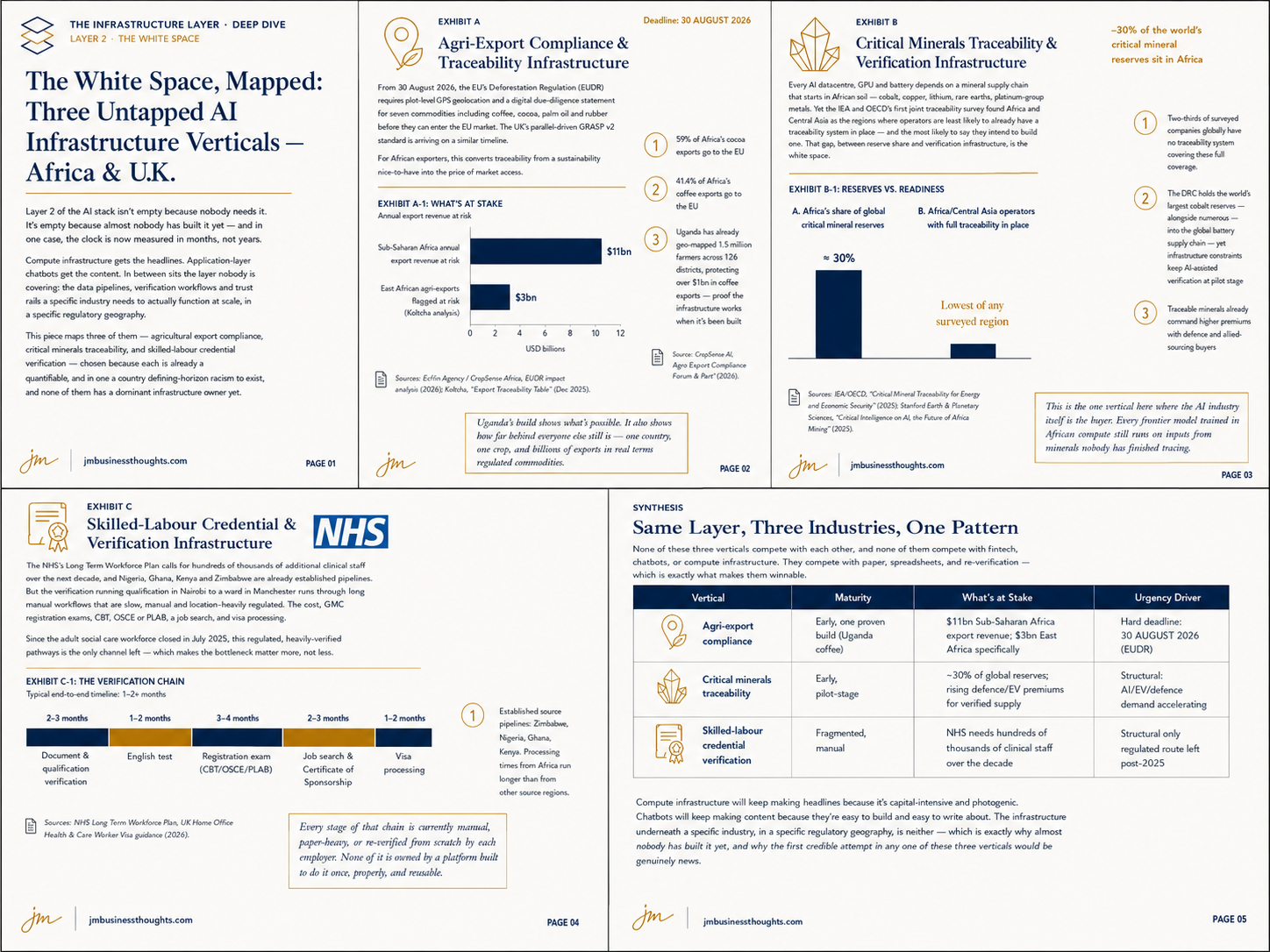
Exhibit A — Agri-export compliance & traceability

From 30 August 2026, the EU's Deforestation Regulation (EUDR) requires plot-level GPS geolocation and a digital due-diligence statement for seven commodities — including coffee, cocoa, palm oil and rubber — before they can enter the EU market. The UK's parallel-driven GRASP v2 standard is arriving on a similar timeline, which means the same exporter faces two overlapping evidence regimes.

For African exporters this converts traceability from a sustainability nice-to-have into the price of market access. A consignment without a compliant due-diligence statement is not a discounted consignment; it is a rejected one.

The economics are asymmetric in the operator's favour. The cost of building the rail is measured in per-farmer onboarding; the cost of failure is measured in the loss of an entire export corridor. That is why Uganda's national geo-mapping programme — 1.5 million farmers across 126 districts — became a state priority rather than a private experiment.

A consignment without a compliant due-diligence statement is not a discounted consignment. It is a rejected one.
  • 59% of Africa's cocoa exports go to the EU
  • 41.4% of Africa's coffee exports go to the EU
  • $11bn Sub-Saharan Africa annual export revenue directly at risk
  • $3bn East African agri-exports flagged at risk
  • Uganda has geo-mapped 1.5 million farmers across 126 districts, protecting over $1bn in coffee exports
  • Buyers: exporters, cooperatives, commodity boards, EU importers and their auditors
03

Exhibit B — Critical minerals traceability & verification

Every AI datacentre, GPU and battery depends on a mineral supply chain that starts in African soil — cobalt, copper, lithium, rare earths and platinum-group metals. Roughly 30% of the world's critical mineral reserves sit on the continent.

The IEA and OECD's first joint traceability survey found Africa and Central Asia to be the regions where operators are least likely to already have a traceability system in place — and the most likely to say they intend to build one. The gap between reserve share and verification infrastructure is the white space.

Demand here is being pulled by three unrelated buyers at once: allied-sourcing defence procurement, EV and battery supply chains subject to origin rules, and hyperscalers under pressure to evidence responsible hardware inputs. When three uncorrelated buyer groups need the same evidence, the rail becomes a shared utility rather than a vendor product.

This is the one vertical where the AI industry itself is the buyer. Every frontier model trained on new compute still runs on minerals nobody has finished tracing.
  • ~30% of the world's critical mineral reserves sit in Africa
  • Two-thirds of surveyed companies globally lack full-coverage traceability
  • The DRC holds the world's largest cobalt reserves — yet verification stays at pilot stage
  • Traceable material already commands premiums from defence and allied-sourcing buyers
  • Buyers: miners, smelters, traders, OEM procurement teams, export credit agencies
04

Exhibit C — Skilled-labour credential verification

The NHS Long Term Workforce Plan calls for hundreds of thousands of additional clinical staff over the next decade, and Nigeria, Ghana, Kenya and Zimbabwe are established pipelines. But the path from a qualification issued in Nairobi to a ward in Manchester runs through a sequence of manual, paper-heavy, separately-regulated checks.

Since the adult social care recruitment route closed in July 2025, the regulated clinical pathway is effectively the only channel left — which makes the bottleneck matter more, not less. Every month of delay is a month of unfilled rota, agency premium and candidate attrition.

Critically, almost every stage is re-verified from scratch by each employer, regulator and visa caseworker. The same document is checked repeatedly by parties who do not trust each other's checks. That is the definition of a missing trust rail.

The same document is checked again and again by parties who do not trust each other's checks. That is the definition of a missing trust rail.
  • Document & qualification verification — 2–3 months
  • English language testing — 1–2 months
  • Registration exam (CBT / OSCE / PLAB) — 3–4 months
  • Job search & Certificate of Sponsorship — 2–3 months
  • Visa processing — 1–2 months
  • Total elapsed cycle — 9 to 14 months, largely serial rather than parallel
05

Sizing the opportunity — how we model the value pool

We size each vertical bottom-up: addressable transaction volume, a defensible take rate or per-record fee, and a realistic penetration band at maturity. We deliberately exclude the value of the underlying trade itself — an infrastructure owner monetises verification events, not the commodity.

Agri-export compliance: assessed against protected export value, priced per consignment and per farmer record. Critical minerals: priced per verified tonne and per audit statement, with a premium-share component. Credential verification: priced per candidate file plus recurring employer and regulator access.

On this basis the blended value pool across the three verticals lands in a $0.9–3.0bn annual band at maturity. The low case assumes single-country adoption in each vertical; the high case assumes a regional standard emerges and the operator is inside it.

  • Low case — single-country adoption, per-record pricing only
  • Mid case — multi-country corridor adoption with employer and buyer subscriptions
  • High case — the rail becomes the referenced standard within its regulatory geography
  • Value is modelled as run-rate infrastructure revenue, not one-off implementation fees
06

Build economics — what it actually costs to own a rail

The dominant cost in all three verticals is not model training; it is field data acquisition and regulator engagement. Geo-mapping farmers, instrumenting weighbridges and verifying source documents are logistics problems with software attached, not the reverse.

That is good news for the operator. Costs are front-loaded and largely one-time per record, while revenue recurs on every subsequent verification, renewal and audit. Gross margin therefore improves structurally with age of cohort — the opposite shape to an application-layer business paying to acquire each new user.

It also explains why capital has stayed away. The first two years look like an operations company; only in year three does the ledger start to look like infrastructure.

  • Year 1–2 — field onboarding, regulator accreditation, reference customers
  • Year 3 — recurring verification revenue exceeds onboarding cost
  • Year 4–5 — second vertical or second geography reuses the same trust core
  • Capex-light: the moat is accreditation and data history, not physical plant
07

Competitive landscape — who could take this

Four candidate owners exist in each vertical: incumbent certification bodies, commodity boards or regulators themselves, global software vendors extending downward, and specialist operators built for the corridor.

Certification bodies have trust but weak software. Regulators have mandate but no commercial motion. Global vendors have engineering but no field presence and no appetite for per-farmer logistics. The specialist operator is the only profile with all three ingredients — and is the profile that barely exists today.

This is why we treat the white space as genuinely open rather than merely under-served. Absence here is structural, not accidental.

  • Certification bodies — trusted, slow, weak digital estate
  • Regulators — mandate without commercial delivery capacity
  • Global software vendors — capable but structurally unwilling to do field work
  • Specialist corridor operators — correct profile, currently absent at scale
08

Risks — what would break this thesis

Three risks are material. First, deadline slippage: if EUDR enforcement is deferred again, urgency softens and procurement decisions drift. Second, state capture of the rail: a government may build a national utility and mandate its use, converting a private opportunity into a contract-only market.

Third, fragmentation: if each buyer insists on a bespoke evidence format, the network effect never forms and the operator becomes a services business with infrastructure economics only on paper.

Each risk is mitigable but must be priced. Our base case assumes partial slippage in one vertical, state partnership rather than state exclusion, and convergence on at least one dominant evidence schema per corridor.

  • Regulatory deferral — softens urgency, does not remove the requirement
  • State-owned utility — mitigate by partnering as the delivery layer, not competing
  • Format fragmentation — mitigate by anchoring to the importer's schema first
  • Data integrity failure — a single fraud event resets trust; audit design is existential
09

Synthesis — same layer, three industries, one pattern

None of these three verticals competes with the others, and none competes with fintech, chatbots or compute infrastructure. They compete with paper, spreadsheets and re-verification — which is precisely what makes them winnable.

Agri-export compliance is early but proven (Uganda), with a hard 30 August 2026 deadline. Critical minerals traceability is early and pilot-stage, structurally pulled by AI, EV and defence demand. Skilled-labour credential verification is fragmented and manual, and structurally the only regulated route left post-2025.

The pattern repeats: a regulated obligation, a quantified loss if unmet, a fragmented set of buyers, and no owner. Where those four conditions co-exist, infrastructure eventually gets built. The only open question is by whom.

  • Watch — EUDR enforcement posture in the first two quarters after 30 Aug 2026
  • Watch — first commercial mine-to-smelter traceability contract at scale in the DRC or Zambia
  • Watch — any NHS trust accepting a reusable verified credential file
  • Watch — whether any single operator crosses two verticals on one trust core

The Multiplier Framework

7 compounding levers

Seven levers across three verticals, each modelled as annual run-rate infrastructure value at maturity. Illustrative modelling under stated assumptions, not a forecast.

01

Agri-Export Compliance Rails

$180M – $520M

  • Plot-level GPS geolocation for seven EUDR commodities
  • Digital due-diligence statements issued at consignment level
  • Cooperative-to-exporter chain of custody in a single ledger
  • Importer-side audit portal priced as recurring access

Outcome · Protects $11bn of Sub-Saharan export revenue from 30 Aug 2026

02

Critical Minerals Traceability

$240M – $760M

  • Mine-to-smelter provenance capture for cobalt, copper and lithium
  • Automated OECD due-diligence reporting for allied-sourcing buyers
  • Verification premiums monetised at point of export
  • Assay, weighbridge and custody events written to one immutable record

Outcome · Verified supply into the datacentre, defence and EV value chain

03

Credential Verification Infrastructure

$90M – $310M

  • Once-verified, reusable qualification and identity records
  • Regulator, employer and visa workflows on shared rails
  • Automated document integrity and fraud screening
  • Parallelised stages replacing today's serial 9–14 month cycle

Outcome · Compresses the only regulated UK clinical hiring pathway left

04

Data Network Effects Flywheel

$120M – $380M

  • Marginal cost of each verification falls as the record base grows
  • Cross-checking between records raises detection quality
  • Historic audit trail becomes the product buyers actually pay for

Outcome · Unit economics improve structurally with cohort age

05

Regulator-Grade Audit Rail

$75M – $260M

  • Evidence packs formatted to the importing regulator's schema
  • Immutable event history with third-party attestation
  • Continuous compliance replacing annual certification cycles

Outcome · Positions the operator inside the regulation, not beside it

06

Premium Capture at Point of Export

$110M – $340M

  • Verified-origin premiums shared with the rail that proves them
  • Faster clearance converts working-capital savings into pricing power
  • Rejection risk repriced into buyer contracts

Outcome · Turns compliance cost into a margin line for the corridor

07

Cross-Vertical Platform Leverage

$150M – $480M

  • One identity, custody and attestation core reused across verticals
  • Second vertical launched at a fraction of first-vertical cost
  • Corridor expansion into a second regulatory geography

Outcome · A single trust core compounding across three industries

The White Space, Mapped: Three Untapped AI Infrastructure Verticals full strategic breakdown
The White Space, Mapped — full five-page deep dive with exhibits and synthesis.

The Verdict

The first credible attempt in any one of these three verticals would be genuinely news. The layer is hard to copy, already regulated, already quantified — and still unowned. On our modelling it carries a $0.9–3.0bn annual value pool, and the binding constraint is execution appetite rather than capital.

JM founder signature
68 · PureGym — Fitness At Scale. More Personal. More Inclusive.67 · SIXT — Smarter Mobility. Greater Availability. A More Connected Tomorrow.66 · Sendwave — Money That Moves With Intelligence.65 · McDonald’s — Serving The Future With AI.64 · Compare the Market — Smarter Comparison. Better Matches. Brighter Tomorrows.63 · WeBuyAnyCar — Smarter Pricing. Faster Offers. Better Conversion.62 · Primark — Affordable Fashion. Greater Possibilities With AI.61 · Starbucks — Smarter Stores. Stronger Loyalty. Better Margins.60 · IKEA — AI-Powered Home Retail at Global Scale59 · H&M — Smarter Fashion. Brighter Tomorrow.58 · WeWork — The Value Wasn't Lost. It Was Mispriced.57 · Yahoo — The Value Wasn't Lost. It Was Mispriced.56 · Nando's UK — Smarter Restaurants. Stronger Loyalty. Better Margins.55 · The Amplifier54 · The Body Shop53 · Arcadia Group52 · Cazoo51 · Blockbuster50 · Carpetright49 · Wilko48 · Mothercare47 · Phones 4u46 · Farfetch45 · Jumia44 · Toys ‘R’ Us43 · The Collateral Gap — Part One41 · The Amplifier40 · Africa Bee Farming39 · Kenya Airways38 · Africa Greenhouse Farming37 · Uganda Tourism Board36 · Boots UK35 · Biffa (UK)34 · NatWest33 · Skip Hire Companies UK33 · The Audit32 · The Lean Company31 · Africa Mushroom Farming29 · The Rider Economy Nobody Verified28 · The Layer Underneath the Layer27 · Independent Timber Yards & Jewson Timber26 · Link Up TV & GRM Daily25 · East African Portland Cement42 · International Student Credential & Financial Verification — Part One24 · The Supply Chain Inside the Supply Chain21 · Greencore20 · West Ham United19 · Roofings Group Uganda18 · Mombasa Port17 · Auto Trader UK16 · Uganda Coffee Development Authority15 · Brookside Dairy14 · GraceKennedy13 · Rightmove12 · Manchester United11 · Greggs30 · Twiga Foods10 · Uchumi09 · Konga08 · Edcon09 · GAME07 · Debenhams06 · Claire's05 · Boohoo04 · Argos