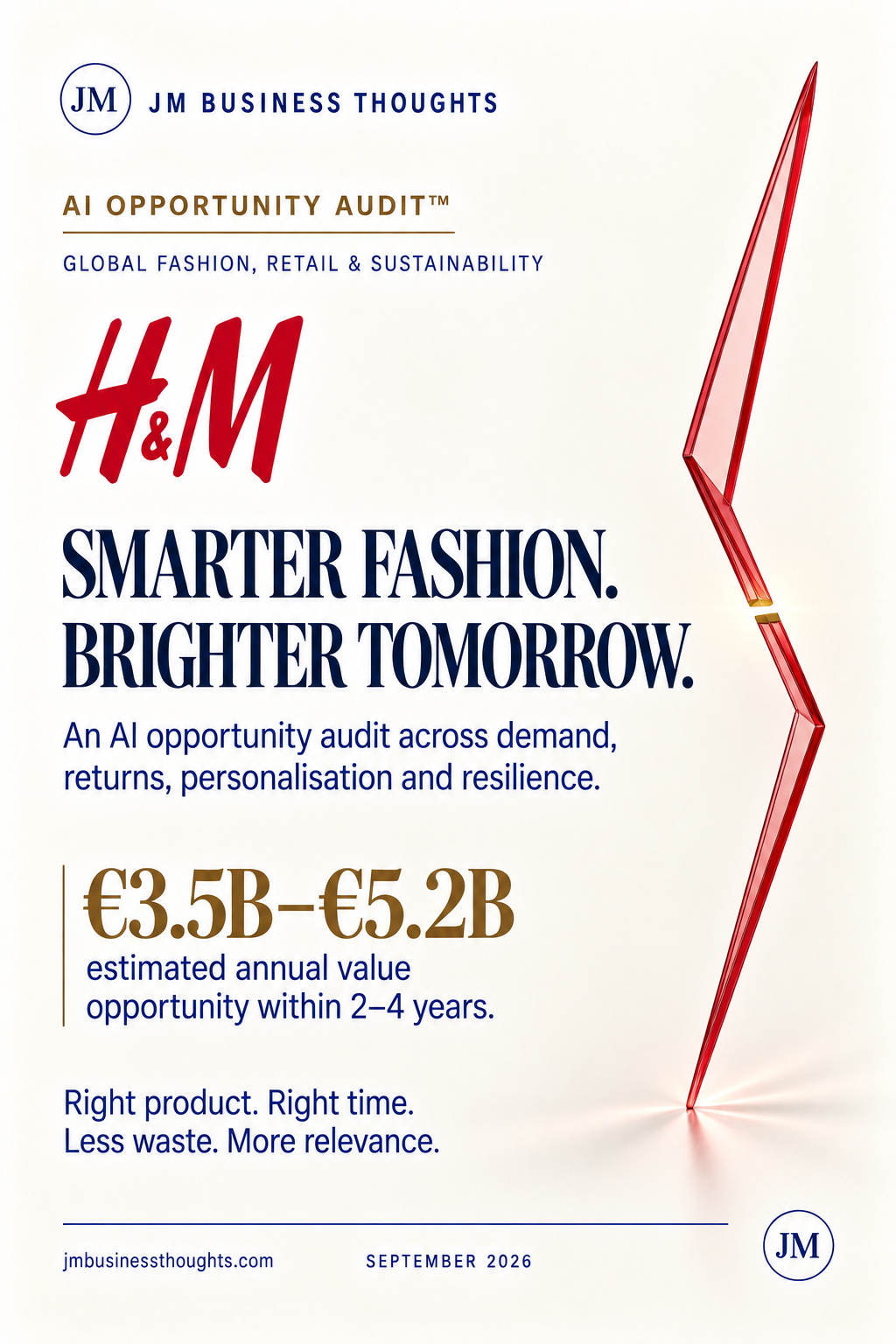
H&M — Smarter Fashion. Brighter Tomorrow. research poster
All Research

The Hidden AI Operating System Audit Series™

Where AI creates new profit pools—not just productivity.

59AI Opportunity Audit™ 18 min readSeptember 2026
Coverage · Global · Fashion, Retail & Sustainability · Institutional CoverageSector · Global Fashion Retail, Supply Chain & CircularityFormat · Six-page audit

H&M — Smarter Fashion. Brighter Tomorrow.An AI opportunity audit across demand, returns, personalisation and resilience.

H&M sits inside a $1.8TN global apparel market growing at a projected 5.6% CAGR to 2030, with online share reaching 60%. Its structural challenge is not design or reach — it is the cost of being wrong: wrong quantity, wrong size, wrong market, wrong moment. This audit sizes €3.5BN–€5.2BN of annual value opportunity within two to four years across demand forecasting, returns reduction, assortment optimisation, personalisation at scale, supply chain intelligence, sustainability acceleration and creative and trend intelligence — with 20–30% fewer returns, +10–15% conversion uplift and 15–25% lower inventory and waste as the operating consequences.

Annual Value Opportunity

€3.5BN – €5.2BN

Global Apparel Market (2026)

$1.8TN

Projected CAGR to 2030

5.6%

Online Share by 2030

60%

Returns Reduction

20–30%

Conversion Uplift

+10–15%

Inventory & Waste Reduction

15–25%

Estimated ROI on AI Spend

3–6x

The Thesis

Fast fashion's economics are decided long before a garment reaches a customer. The margin is set at the buying decision, eroded by the markdown, and destroyed by the return. H&M's scale gives it the largest possible exposure to all three — and therefore the largest possible upside from removing error. The company already holds what an AI operating system requires: enormous transactional history, global assortment data, digital-first customer journeys, product and fit data, and a supply chain with real lead-time constraints. What it has not yet done is treat those as a single intelligence layer rather than a set of departmental systems. The audit's position is that AI at H&M is not a productivity story and not an efficiency story — it is a relevance story. Predict what customers actually want, in the right size, in the right market, at the right time, and the returns rate falls, the markdown falls, the inventory falls and the sustainability position strengthens simultaneously. Same great fashion. A smarter tomorrow.

Exhibit · Report Cover

59 · AI Opportunity Audit™

H&M — Smarter Fashion. Brighter Tomorrow. report cover
H&M — Smarter Fashion. Brighter Tomorrow.September 2026 · Global · Fashion, Retail & Sustainability · Institutional Coverage
01

Executive summary — AI creates a smarter, more resilient H&M

The audit isolates €3.5BN–€5.2BN of estimated annual value opportunity from AI across key use cases on a two-to-four-year horizon, with a strong estimated return on AI investment of three to six times.

Four operating outcomes carry that value: 20–30% fewer returns through better fit, sizing and product data; +10–15% higher conversion via AI personalisation, recommendations and content; 15–25% lower inventory and waste through smarter forecasting; and a faster, more resilient and more sustainable supply chain.

The framing is deliberate. Right product, right time, right customer. Happier customers through more relevant and inspiring experiences. Leaner operations with less waste, more agility and greater resilience. A more sustainable future measured in people, planet and progress.

In H&M's own framing, AI is the opportunity to be more relevant to customers and more efficient in operations — and more responsible for the planet — while keeping great fashion accessible to everyone. The audit tests that framing against the numbers rather than restating it.

The margin is set at the buying decision, eroded by the markdown, and destroyed by the return.
  • €3.5BN–€5.2BN estimated annual value from AI within 2–4 years
  • 20–30% fewer returns · +10–15% conversion · 15–25% lower inventory and waste
  • 3–6x estimated ROI on AI investment over the horizon
  • Value is created by relevance, not by cost-cutting alone
02

Market overview — large, evolving and highly competitive

The global apparel market stands at approximately $1.8TN in 2026, with a projected 5.6% CAGR to 2030 and online penetration reaching 60% by the end of the decade. Growth is available; undifferentiated growth is not.

Five market trends define the competitive environment: growing e-commerce and mobile shopping; higher customer expectations for personalisation; an increased focus on sustainability and circular fashion; faster-changing trends and shorter product lifecycles; and rising competition from digital-native brands.

The shortening lifecycle is the critical variable. As trend windows compress, the penalty for forecasting error compounds — both in unsold stock and in missed demand. Traditional seasonal buying cycles were designed for a slower market than the one H&M now trades in.

The next era of fashion retail will be won by those who use AI to understand people better, move faster and waste less. That is a competitive statement, not a technology statement: the advantage accrues to whoever closes the loop between customer signal and supply decision first.

As trend windows compress, the penalty for forecasting error compounds on both sides — unsold stock and missed demand.
  • $1.8TN global apparel market in 2026
  • 5.6% projected CAGR to 2030 · 60% online share by 2030
  • Shorter lifecycles raise the cost of every buying error
  • Digital-native competitors compete on speed of signal, not scale of estate
03

The demand layer — forecasting, returns and assortment

Demand forecasting is the first multiplier because every downstream cost inherits its error. Predicting what customers will want, when and where, converts buying from a seasonal judgment into a continuously updated position — reducing both stockouts and terminal markdown.

Returns reduction is the highest-conviction lever in the model. Better fit and sizing guidance, richer product data and improved imagery cut the 20–30% of value that disappears in reverse logistics, restocking, refurbishment and write-off. Returns are the single largest silent margin leak in online fashion.

Assortment optimisation applies AI-driven range planning to local markets and customer segments. A globally uniform assortment is a structural mismatch in a business trading across dozens of climates, body-size distributions and cultural contexts; local optimisation is where scale converts into relevance instead of dilution.

These three levers are mutually reinforcing. A better forecast improves assortment; a better assortment reduces returns; fewer returns produce cleaner demand data. The loop compounds — which is precisely why partial implementation underperforms.

Returns are the single largest silent margin leak in online fashion.
  • 01 Demand forecasting — predict what customers will want, when and where
  • 02 Returns reduction — better fit, sizing and product information
  • 03 Assortment optimisation — AI-driven ranges for local markets and segments
  • The three levers compound; partial implementation underperforms
04

The customer and operations layer — personalisation, supply chain and sustainability

Personalisation at scale delivers more relevant outfits, content and offers across all channels, driving the +10–15% conversion uplift. At H&M's traffic volumes, a single percentage point of conversion is material; ten to fifteen is a strategic reposition.

Supply chain intelligence provides end-to-end visibility and smarter demand planning — shortening the distance between a signal in one market and a production decision in another, and improving resilience against disruption rather than merely reacting to it.

Sustainability acceleration optimises materials, reduces waste and extends product life. This is not a reporting exercise: 15–25% lower inventory and waste is simultaneously an environmental outcome and a working-capital outcome, which is why it survives a CFO review.

Creative and trend intelligence turns data into insight for design, trends and marketing — shortening the distance from signal to shelf. Used well, it augments design judgment with earlier evidence; used badly, it homogenises. The governance framing matters as much as the model.

At H&M's traffic volumes, a single point of conversion is material. Ten to fifteen is a strategic reposition.
  • 04 Personalisation at scale · +10–15% conversion across all channels
  • 05 Supply chain intelligence · end-to-end visibility and smarter planning
  • 06 Sustainability acceleration · materials, waste and product life
  • 07 Creative & trend intelligence · from data to design, trend and marketing insight
05

Financial impact model (illustrative) — material value, measurable impact

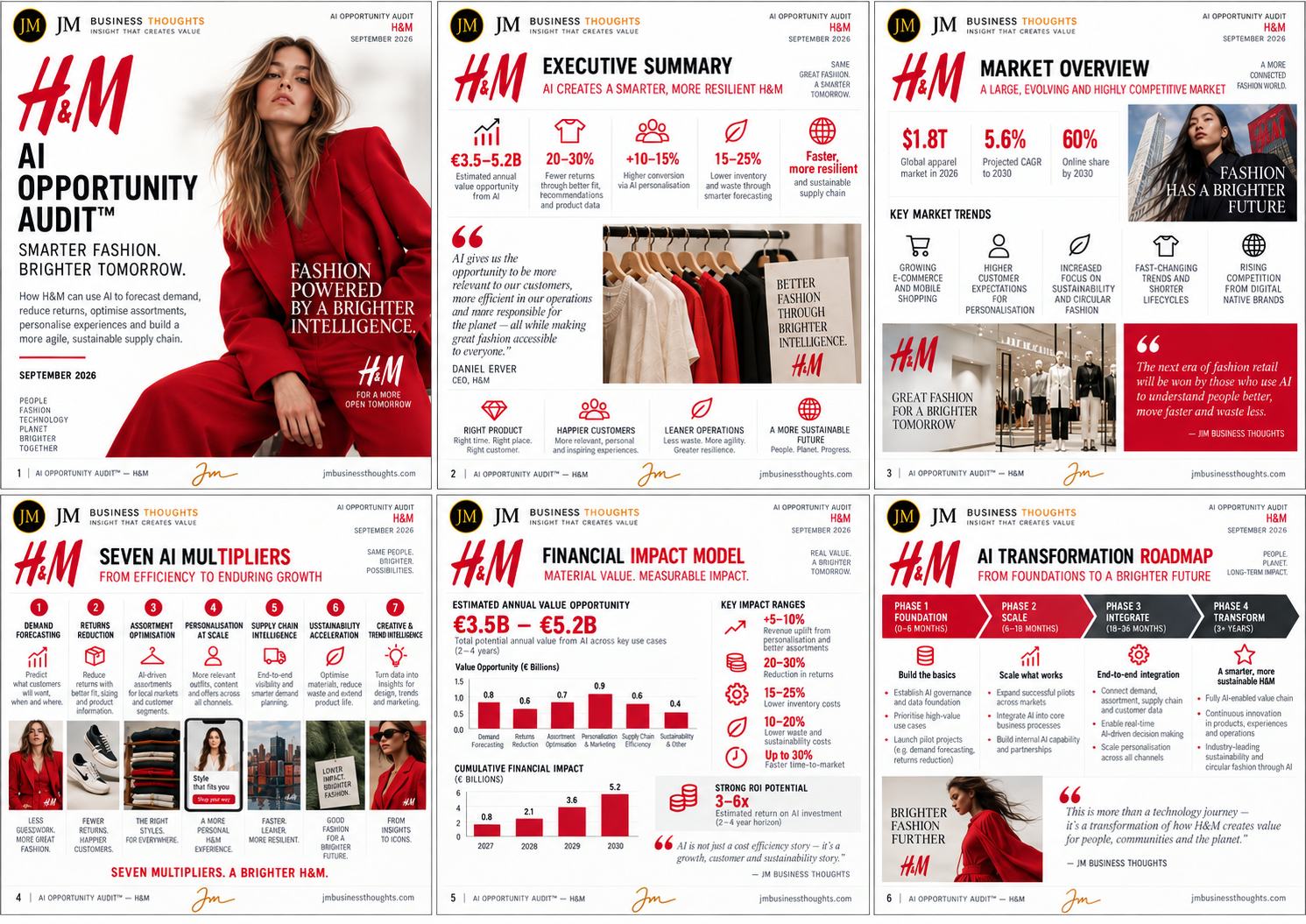
Total potential annual value from AI across key use cases is estimated at €3.5BN–€5.2BN on a two-to-four-year horizon. Distributed by lever, the illustrative annual value opportunity runs: demand forecasting €0.8BN, returns reduction €0.6BN, assortment optimisation €0.7BN, personalisation and marketing €0.9BN, supply chain efficiency €0.6BN and sustainability and other €0.4BN.

Cumulative financial impact builds through the period: €0.8BN (2027), €2.1BN (2028), €3.6BN (2029) and €5.2BN (2030) — a compounding curve rather than a step change, consistent with phased capability build.

Key impact ranges: +5–10% revenue uplift from personalisation and better assortments; 20–30% reduction in returns; 15–25% lower inventory costs; 10–20% lower waste and sustainability costs; and up to 30% faster time-to-market.

Estimated return on AI investment is three to six times over the two-to-four-year horizon. This is an illustrative JM Business Thoughts scenario based on public data and market benchmarks; it is not company guidance.

AI is not just a cost efficiency story — it's a growth, customer and sustainability story.
  • Personalisation & marketing is the largest single lever at €0.9BN
  • Cumulative impact €0.8BN → €5.2BN across 2027–2030
  • Up to 30% faster time-to-market
  • 3–6x estimated ROI on AI investment
06

AI transformation roadmap — four phases to a brighter future

Phase 1, Foundation (0–6 months): establish AI governance and the data foundation, prioritise high-value use cases, and launch pilot projects such as demand forecasting and returns reduction.

Phase 2, Scale (6–18 months): expand successful pilots across markets, integrate AI into core business processes, and build internal AI capability and partnerships — the phase where most transformations stall for want of operating ownership rather than technology.

Phase 3, Integrate (18–36 months): connect demand, assortment, supply chain and customer data; enable real-time AI-driven decision making; and scale personalisation across all channels.

Phase 4, Transform (3+ years): a fully AI-enabled value chain, continuous innovation in products, experiences and operations, and industry-leading sustainability and circular fashion through AI.

This is more than a technology journey — it is a transformation of how H&M creates value for people, communities and the planet.
Most transformations stall in Phase 2 — for want of operating ownership, not technology.
  • Phase 1 Foundation · 0–6 months — governance, data, pilots
  • Phase 2 Scale · 6–18 months — markets, processes, capability
  • Phase 3 Integrate · 18–36 months — real-time decisions, full personalisation
  • Phase 4 Transform · 3+ years — AI-enabled value chain and circularity
07

Sources and method

Market sizing and growth: global apparel market estimates for 2026 with projected CAGR to 2030 and online penetration forecasts; JM Business Thoughts analysis.

Company positioning and strategic framing: H&M public statements and reporting, including CEO commentary on AI, relevance, efficiency and responsibility.

Value ranges are modelled per lever against disclosed scale and industry benchmarks for returns rates, markdown, inventory turns and personalisation conversion uplift, then netted for overlap before the total range is stated.

Method note: figures are illustrative JM Business Thoughts scenarios based on public data and market benchmarks. They are not company guidance and JM Business Thoughts does not provide company guidance.

The Multiplier Framework

7 compounding levers

Seven AI multipliers — from efficiency to enduring growth. Same people. Brighter possibilities.

01

Demand Forecasting

Predict what customers will want, when and where.

  • Forecast at style, size, market and channel level rather than by season
  • Update buying positions continuously against live signal
  • Make forecast error a board-level operating metric

Outcome · Less guesswork. More great fashion — and fewer garments bought into the wrong market.

02

Returns Reduction

Reduce returns with better fit, sizing and product information · 20–30%.

  • Deploy AI fit and size guidance against real garment and body data
  • Enrich product data, imagery and description accuracy at scale
  • Diagnose return reasons per style and feed them back into design

Outcome · Fewer returns. Happier customers — and the largest silent margin leak closed.

03

Assortment Optimisation

AI-driven assortments for local markets and customer segments.

  • Localise ranges by climate, size distribution and cultural context
  • Rebalance stock between markets before markdown becomes inevitable
  • Protect the core range while flexing the trend layer

Outcome · The right styles. For everywhere — scale converted into relevance rather than dilution.

04

Personalisation at Scale

More relevant outfits, content and offers across all channels · +10–15% conversion.

  • Personalise recommendations, content and offers on a single customer profile
  • Run outfit-level rather than item-level recommendation
  • Tie personalisation to available inventory, not to catalogue breadth

Outcome · A more personal H&M experience — and the model's largest single value lever at €0.9BN.

05

Supply Chain Intelligence

End-to-end visibility and smarter demand planning.

  • Connect market signal directly to production and allocation decisions
  • Model disruption scenarios ahead of them rather than after
  • Compress lead times to shorten the exposure window

Outcome · Faster. Leaner. More resilient — up to 30% faster time-to-market.

06

Sustainability Acceleration

Optimise materials, reduce waste and extend product life · 10–20% lower cost.

  • Optimise material selection and specification with AI
  • Predict and design out waste across production and end-of-life
  • Build circular and resale flows on real product-level data

Outcome · Good fashion for a brighter future — an environmental and a working-capital outcome at once.

07

Creative & Trend Intelligence

Turn data into insight for design, trends and marketing.

  • Surface emerging trend signal earlier than the buying calendar allows
  • Augment — not replace — design judgment with evidence
  • Govern for distinctiveness so AI does not homogenise the range

Outcome · From insights to icons — with the distance from signal to shelf materially shortened.

H&M — Smarter Fashion. Brighter Tomorrow. full strategic breakdown
H&M · AI Opportunity Audit™ — full six-page brief: 01 Cover, 02 Executive Summary, 03 Market Overview and key trends, 04 The Seven AI Multipliers, 05 Financial Impact Model (illustrative), 06 AI Transformation Roadmap.

The Verdict

H&M does not have a demand problem; it has a precision problem. At $1.8TN of addressable market and 60% online penetration by 2030, the businesses that win will not be the ones with the widest range but the ones whose range is most often right. The audit's finding is that €3.5BN–€5.2BN of annual value sits inside decisions H&M already makes — what to buy, how much, for which market, at what price, and how to describe it well enough that it does not come back. Returns reduction alone justifies the programme; personalisation at €0.9BN is the largest single lever; and sustainability stops being a cost centre the moment it is delivered through inventory and waste reduction. The risk is sequencing, not ambition: partial implementation breaks the compounding loop between forecast, assortment and returns. Smarter fashion. Brighter tomorrow.

JM founder signature
68 · PureGym — Fitness At Scale. More Personal. More Inclusive.67 · SIXT — Smarter Mobility. Greater Availability. A More Connected Tomorrow.66 · Sendwave — Money That Moves With Intelligence.65 · McDonald’s — Serving The Future With AI.64 · Compare the Market — Smarter Comparison. Better Matches. Brighter Tomorrows.63 · WeBuyAnyCar — Smarter Pricing. Faster Offers. Better Conversion.62 · Primark — Affordable Fashion. Greater Possibilities With AI.61 · Starbucks — Smarter Stores. Stronger Loyalty. Better Margins.60 · IKEA — AI-Powered Home Retail at Global Scale57 · Yahoo — The Value Wasn't Lost. It Was Mispriced.56 · Nando's UK — Smarter Restaurants. Stronger Loyalty. Better Margins.55 · The Amplifier54 · The Body Shop53 · Arcadia Group52 · Cazoo51 · Blockbuster50 · Carpetright49 · Wilko48 · Mothercare47 · Phones 4u46 · Farfetch45 · Jumia44 · Toys ‘R’ Us43 · The Collateral Gap — Part One41 · The Amplifier40 · Africa Bee Farming39 · Kenya Airways38 · Africa Greenhouse Farming37 · Uganda Tourism Board36 · Boots UK35 · Biffa (UK)34 · NatWest33 · Skip Hire Companies UK33 · The Audit32 · The Lean Company31 · Africa Mushroom Farming29 · The Rider Economy Nobody Verified28 · The Layer Underneath the Layer27 · Independent Timber Yards & Jewson Timber26 · Link Up TV & GRM Daily25 · East African Portland Cement42 · International Student Credential & Financial Verification — Part One24 · The Supply Chain Inside the Supply Chain23 · The White Space, Mapped22 · The Real Opportunity21 · Greencore20 · West Ham United19 · Roofings Group Uganda18 · Mombasa Port17 · Auto Trader UK16 · Uganda Coffee Development Authority15 · Brookside Dairy14 · GraceKennedy13 · Rightmove12 · Manchester United11 · Greggs30 · Twiga Foods10 · Uchumi09 · Konga08 · Edcon09 · GAME07 · Debenhams06 · Claire's05 · Boohoo04 · Argos