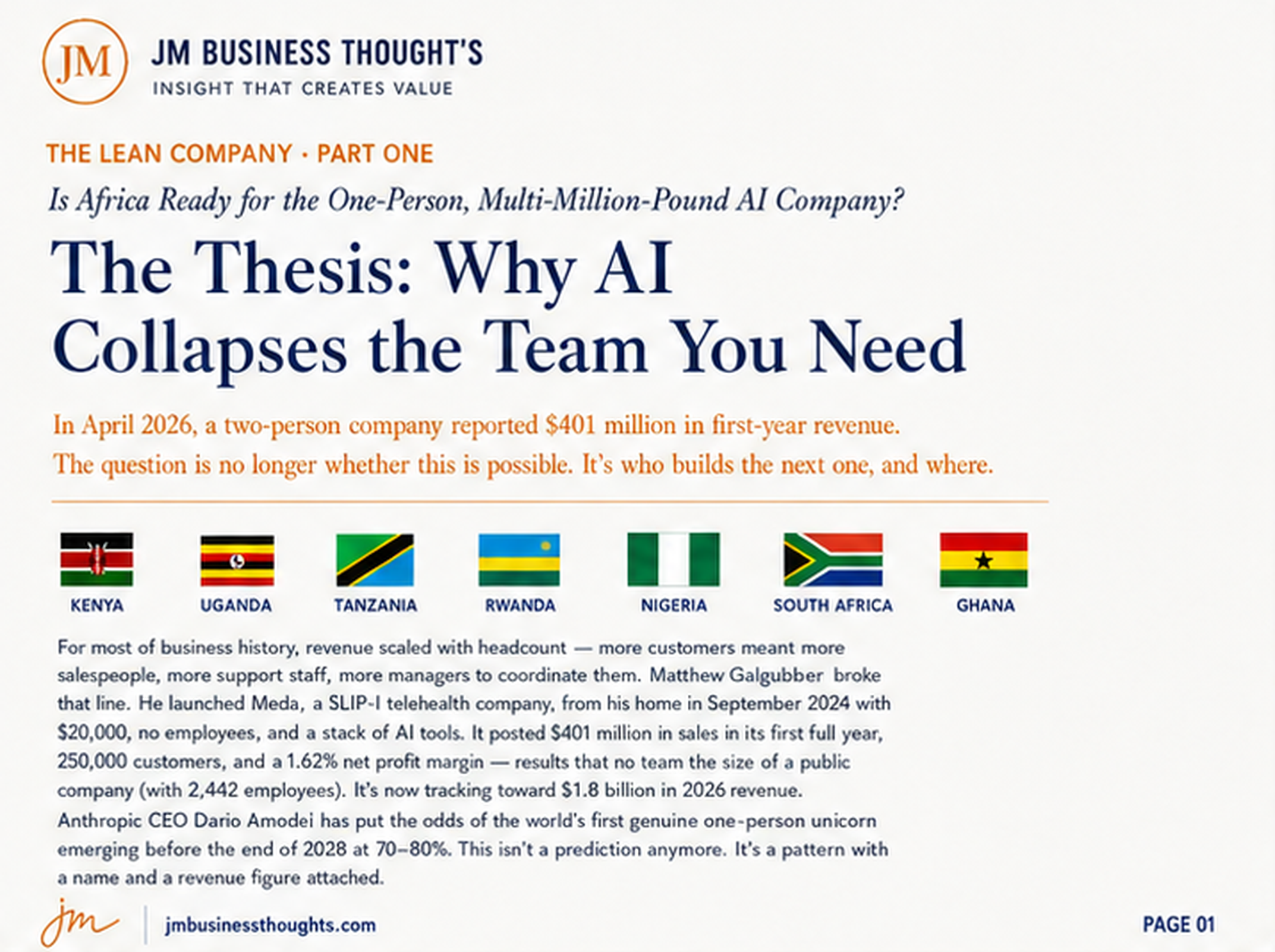
The Audit: Testing Africa's Readiness, Country by Country research poster
All Research

The Lean Company Series™

Part Two · The Audit. Testing Africa's five largest tech economies against the four preconditions a lean AI company actually needs.

33The Lean Company™ 17 min readAugust 2026
Coverage · Africa · Nigeria, Kenya, Ghana, South Africa, EgyptSector · Applied AI · Policy, Tax & Company FormationFormat · Six-page audit

The AuditIs Africa Ready for the One-Person, Multi-Million-Pound AI Company?

Part Two of The Lean Company Series™. Africa is not one readiness score — it is five countries moving in five different directions on the same four preconditions, and at least two of them just made the calculus harder overnight. This audit scores model access, payment rails, distribution talent and growth capital market by market, then makes the comparative case against Manila and Warsaw with real numbers.

Markets Audited

05

Preconditions Tested

04

Workable Preconditions

3 of 4

African Freelance Workforce

15–20M

Nigeria / Kenya / Ghana Cross-Border Exports

$4.7BN

African Dev Rates

$20–$40/hr

Southeast Asia Dev Rates

$18–$40/hr

Compute Cost Premium vs US

25–40%

The Thesis

A lean AI company needs four things: affordable model access, working payment rails, proven distribution talent, and enough capital to survive the first year. Treating "Africa" as a single answer to whether those four things exist is the first mistake most coverage makes. Nigeria, Kenya, Ghana, South Africa and Egypt are running five different policy experiments right now, several of them contradicting each other inside the same country. Scored individually, three of the four preconditions are workable today. One — growth capital — is a genuine, structural cost problem.

Exhibit · Report Cover

33 · The Lean Company™

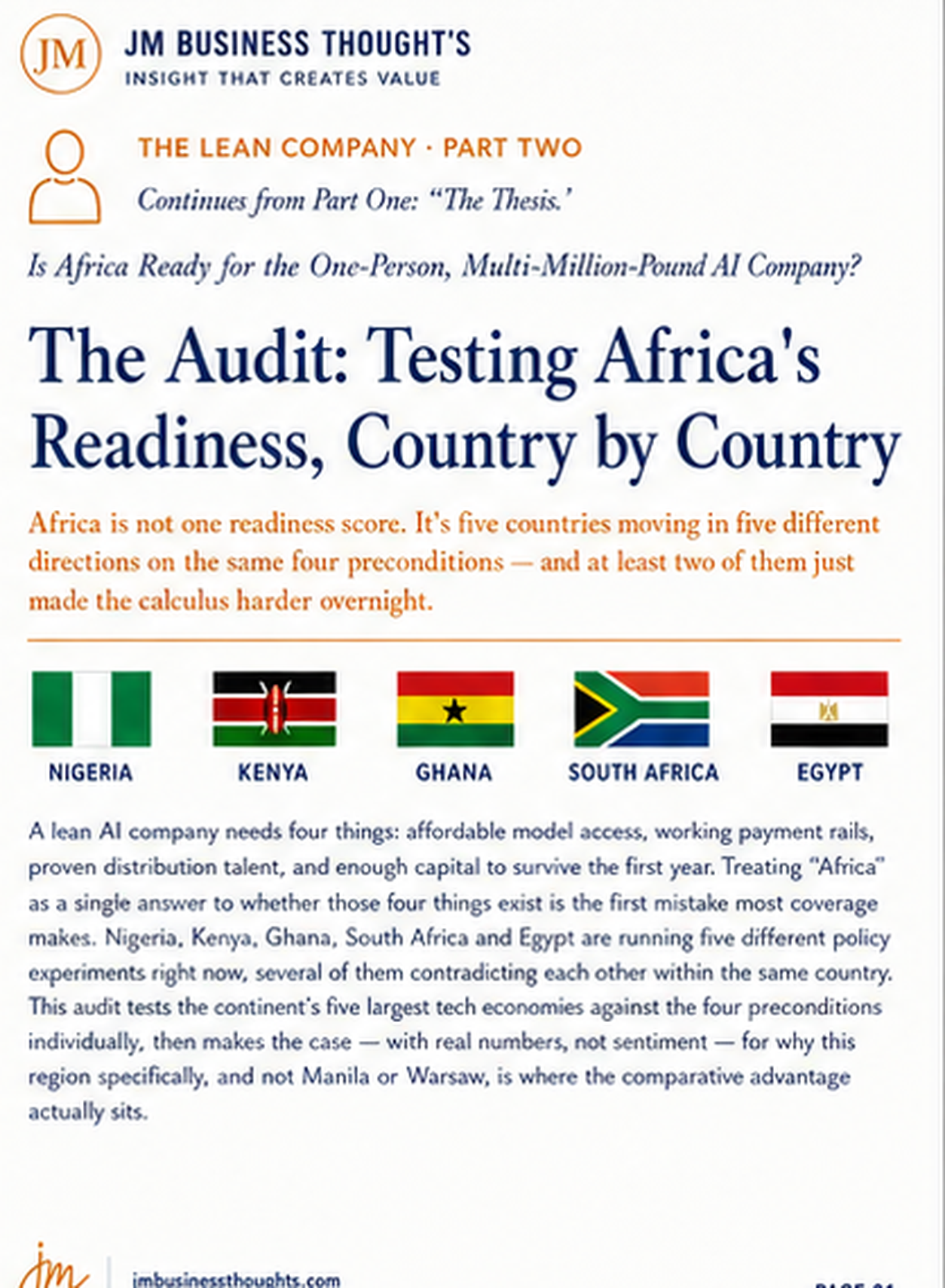
The Audit: Testing Africa's Readiness, Country by Country report cover
The Audit: Testing Africa's Readiness, Country by CountryAugust 2026 · Africa · Nigeria, Kenya, Ghana, South Africa, Egypt
01

Executive summary

Part One established that the relationship between headcount and revenue has broken, and that the enabling conditions for a lean, AI-native company are unusually favourable in Africa. Part Two tests that claim properly — country by country, precondition by precondition — because the aggregate view hides the only variable that matters to a founder deciding where to incorporate.

The audit covers the continent's five largest technology economies. Each is scored against four preconditions: model and compute access, payment and monetisation rails, talent and distribution proof, and growth capital. Three of the four are workable in 2026. Compute is workable but not ownable; payment rails are largely ready and improving fast; talent is already proven at commercial scale. Growth capital is structurally lighter for this model than for a conventional startup, but the friction is real and, in at least two markets, rising.

The headline finding is that the tax and capital-mobility story almost nobody covers is where the binding friction actually sits — not the compute story everyone covers. Ghana made it easier to own 100% of a company in the month that Kenya made it harder to keep what that company earns. Both are true simultaneously, in neighbouring markets, and both moved in 2026.

Africa is not one readiness score. It's five countries moving in five different directions on the same four preconditions — and at least two of them just made the calculus harder overnight.
02

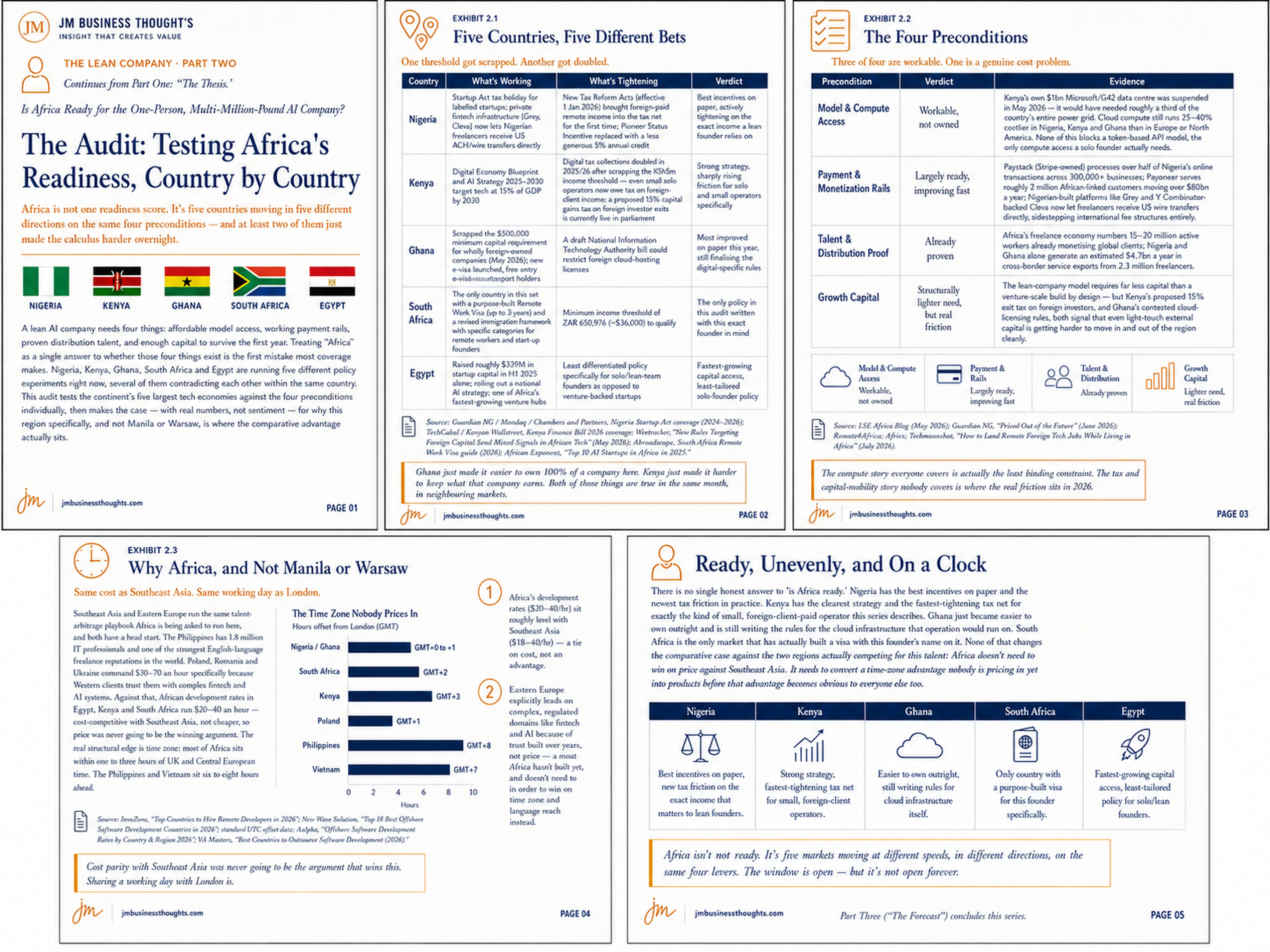
Exhibit 2.1 — Five countries, five different bets

Nigeria has the best incentives on paper. The Startup Act tax holiday for labelled startups, a private fintech infrastructure layer (Grey, Cleva) that now lets freelancers receive US ACH and wire transfers directly, and the Pioneer Status Incentive replaced with a less generous 5% annual credit. Against that, the New Tax Reform Acts effective 1 January 2026 bring foreign-paid remote income into the tax net for the first time. Best incentives on paper, sharply tightening on the exact income a lean founder relies on.

Kenya runs the clearest strategy and the fastest-tightening net. The Digital Economy Blueprint and AI Strategy 2025–2030 target technology at 15% of GDP by 2030. In the same period digital tax collections doubled in 2025/26 after scrapping the KSh5m threshold, small solo operators now owe tax on foreign-client income, and a proposed 15% capital gains tax on foreign investor exits is currently live in parliament. Strong strategy, sharply rising friction for solo and small operators.

Ghana is the most improved on paper this year. It scrapped the $500,000 minimum capital requirement for wholly foreign-owned companies in May 2026 and launched a new e-visa with lower entry friction. A draft National Information Technology Authority bill could restrict foreign cloud-hosting licences — the digital-specific rules are still being finalised.

South Africa is the only country in this set with a purpose-built Remote Work Visa (up to three years) and a revised immigration framework carrying specific categories for remote workers and start-up founders, subject to a minimum income threshold of ZAR 650,976 (roughly $36,000). It is the only policy in this audit written with this exact founder in mind.

Egypt raised roughly $339M in startup capital in H1 2025 alone, is rolling out a national AI strategy, and hosts one of Africa's fastest-growing venture hubs. It is the least differentiated on policy specifically for solo and lean-team founders — the capital is there, the tailored rules are not.
Ghana just made it easier to own 100% of a company here. Kenya just made it harder to keep what that company earns. Both of those things are true in the same month, in neighbouring markets.
  • Nigeria — best incentives on paper; 2026 tax reform brings foreign-paid remote income into scope
  • Kenya — clearest national AI strategy; fastest-tightening tax net for small foreign-client operators
  • Ghana — $500,000 foreign-ownership capital floor scrapped May 2026; cloud-hosting rules unresolved
  • South Africa — the only purpose-built Remote Work Visa, ZAR 650,976 income threshold
  • Egypt — ~$339M raised in H1 2025; strongest capital access, least tailored policy
03

Exhibit 2.2 — The four preconditions: three workable, one real cost problem

Model and compute access: workable, not ownable. Kenya's own $1BN Microsoft/G42 data centre was suspended in May 2026 — it would have needed roughly a third of the country's entire power grid. Cloud compute still runs 25–40% costlier than in the United States or North America. None of this blocks a token-based API model, because a solo founder buys inference, not infrastructure. It does block sovereign, at-scale model ownership for the rest of this decade.

Payment and monetisation rails: largely ready, improving fast. Paystack (Stripe-owned) processes over half of Nigeria's online transactions across 300,000+ businesses. Payoneer serves roughly 2 million Africa-linked customers moving over $60BN a year. Nigerian-built platforms including Grey and Y Combinator-backed Cleva now let freelancers receive US wire transfers directly, sidestepping international fee structures entirely.

Talent and distribution proof: already proven. Africa's freelance economy numbers 15–20 million active workers already monetising global clients. Nigeria and Ghana alone generate an estimated $4.7BN a year in cross-border service exports from 2.3 million freelancers. This is not a pipeline argument — it is an existing, transacting market.

Growth capital: structurally lighter need, but real friction. The lean-company model requires far less capital than a conventional startup by design — that is the entire point of Part One. But Kenya's proposed 15% exit tax on foreign investors, and Ghana's contested cloud-licensing rules, mean that even light-touch external capital is getting harder to move in and out of the region cleanly.

The compute story everyone covers is actually the least binding constraint. The tax and capital-mobility story nobody covers is where the real friction sits in 2026.
  • Model & compute access — workable, not ownable (25–40% cost premium; $1BN Kenya data centre suspended)
  • Payment & rails — largely ready, improving fast (Paystack 300,000+ businesses; Payoneer $60BN/yr)
  • Talent & distribution — already proven (15–20M freelancers; $4.7BN Nigeria + Ghana exports)
  • Growth capital — lighter need, real friction (Kenya 15% proposed exit tax; Ghana cloud licensing)
04

Exhibit 2.3 — Why Africa, and not Manila or Warsaw

Southeast Asia and Eastern Europe run the same talent-arbitrage playbook Africa is being asked to run here, and both have a head start. The Philippines has 1.8 million IT professionals and one of the strongest English-language freelance reputations in the world. Poland, Romania and Ukraine command $30–$70 an hour specifically because Western clients trust them with complex fintech and AI systems.

Against that, African development rates in Egypt, Kenya and South Africa run $20–$40 an hour — cost-competitive with Southeast Asia's $18–$40, not cheaper. So price was never going to be the winning argument. Cost parity with Southeast Asia was never going to be the argument that wins this.

The real structural edge is time zone. Most of Africa sits within one to three hours of UK and Central European time. The Philippines and Vietnam sit six to eight hours ahead — GMT+8 and GMT+7 against Nigeria and Ghana at GMT+0 to +1, South Africa at GMT+2, Kenya at GMT+3 and Poland at GMT+1. Sharing a working day with London is the asset, not the hourly rate.

Eastern Europe explicitly leads on complex, regulated domains in fintech and AI because of trust built over years, not price — a moat Africa has not built yet, and does not need to in order to win on time zone and language reach instead.

Cost parity with Southeast Asia was never going to be the argument that wins this. Sharing a working day with London is.
  • Philippines — 1.8M IT professionals, GMT+8, six to eight hours ahead of London
  • Poland / Romania / Ukraine — $30–$70/hr on trust in complex regulated domains, not price
  • Africa — $20–$40/hr, cost parity with Southeast Asia's $18–$40, not a cost advantage
  • Time zone — Nigeria/Ghana GMT+0 to +1, South Africa GMT+2, Kenya GMT+3: same working day as London
05

The verdict by market: ready, unevenly, and on a clock

There is no single honest answer to "is Africa ready". Nigeria has the best incentives on paper and the newest tax friction in practice. Kenya has the clearest strategy and the fastest-tightening tax net for exactly the kind of small, foreign-client-paid operator this series describes. Ghana just became easier to own outright and is still writing the rules for the cloud infrastructure that operation would run on. South Africa is the only market that has actually built a visa with this founder's name on it. Egypt has the capital access, least-tailored policy for solo and lean founders.

None of that changes the comparative case against the two regions actually competing for this talent: Africa does not need to win on price against Southeast Asia. It needs to convert a time-zone advantage nobody is pricing in yet into products before that advantage becomes obvious to everyone else too.

The window is open. It is not open forever — and the direction of travel on tax in two of the five markets is the clock that closes it.

  • Nigeria — best incentives on paper, new tax friction on the exact income that matters to lean founders
  • Kenya — strong strategy, fastest-tightening tax net for small foreign-client operators
  • Ghana — easier to own outright, still writing rules for cloud infrastructure itself
  • South Africa — only country with a purpose-built visa for this founder specifically
  • Egypt — fastest-growing capital access, least-tailored policy for solo and lean founders
06

What this means for founders, investors and policymakers

For founders: incorporate where the money can leave cleanly, operate where the working day overlaps your buyer, and do not confuse a tax holiday on paper with an income treatment in practice. On this audit, South Africa is the cleanest residency answer, Ghana the cleanest ownership answer, and Nigeria and Kenya the strongest operating markets with the highest fiscal watch level.

For investors: the diligence question in this cohort is no longer burn or headcount — it is capital mobility. A 15% exit tax on foreign investors changes the return profile of a lean company more than any operational variable in the model, precisely because there is so little cost base left to optimise.

For policymakers: the four preconditions are not equally in your control. Compute cost is set globally; payment rails are already solved by the private sector; talent is already proven. The only lever left that materially moves the outcome is the tax and capital-mobility treatment of small, foreign-client-paid operators — and that is exactly the lever two of these five markets tightened in 2026.

Part Three ("The Forecast") concludes this series by sizing the addressable value across these five markets through 2030.

  • Founders — incorporate for capital exit, operate for time-zone overlap
  • Investors — capital mobility is now the dominant diligence variable in lean companies
  • Policymakers — tax treatment of foreign-paid solo operators is the only high-leverage lever left

The Multiplier Framework

7 compounding levers

Seven levers convert this readiness audit into a decision framework. Each is stated with the advantage it releases, the moves that release it and the outcome a disciplined founder or allocator should expect.

01

The Time-Zone Arbitrage Nobody Prices

Same working day as London · 6–8 hours better than Manila

  • Target UK and Central European buyers where synchronous overlap is the product
  • Sell same-day responsiveness explicitly rather than hourly rate
  • Structure delivery around a shared working day, not an overnight handoff

Outcome · A structural advantage over Southeast Asia that price competition cannot erase

02

Incorporate For Capital Exit, Not Headline Rate

Neutralises the 15% proposed exit-tax drag

  • Score jurisdictions on how cleanly capital and earnings leave, not on tax holidays
  • Model the post-2026 treatment of foreign-paid income before choosing a domicile
  • Separate the operating market from the holding jurisdiction where the rules diverge

Outcome · Return profile protected against the fastest-moving policy variable in the set

03

Buy Inference, Never Infrastructure

Sidesteps the 25–40% compute cost premium

  • Run entirely on token-priced API access rather than owned or reserved compute
  • Contract redundancy across two or more providers to cap supplier concentration
  • Treat sovereign compute timelines as irrelevant to the operating plan this decade

Outcome · The least binding constraint is removed from the cost base entirely

04

Direct-Rail Monetisation

Paystack 300,000+ businesses · Payoneer $60BN annual flow

  • Receive in USD directly through Grey, Cleva or Payoneer rather than correspondent banking
  • Integrate Paystack-class rails instead of building a payments function
  • Document the money trail for acquisition and tax diligence from day one

Outcome · International fee structures bypassed without adding a finance hire

05

Distribution Talent Already Proven

15–20M freelancers · $4.7BN Nigeria + Ghana service exports

  • Recruit from the transacting freelance market, not the training pipeline
  • Contract capability rather than employ it until the function cannot be constrained into software
  • Use existing client relationships as the first distribution channel

Outcome · Go-to-market capacity acquired without converting variable cost into payroll

06

Ownership Reform Arbitrage

Ghana's $500,000 foreign-capital floor scrapped, May 2026

  • Track ownership and visa reform as a live variable, reviewed quarterly
  • Move on reform windows early, before the enabling rules are finalised against you
  • Pair a reformed ownership jurisdiction with a purpose-built residency route

Outcome · 100% ownership secured at the moment the entry cost is lowest

07

Policy Clock Discipline

Two of five markets tightened in a single year

  • Maintain a live readiness scorecard across the four preconditions per market
  • Re-run the domicile decision annually rather than treating it as fixed at formation
  • Build the compliance evidence trail before the rules require it, not after

Outcome · The window is used while it is open, not defended after it closes

The Audit: Testing Africa's Readiness, Country by Country full strategic breakdown
The Lean Company · Part Two — the full five-page audit: the thesis page, Exhibit 2.1 (five countries, five different bets), Exhibit 2.2 (the four preconditions), Exhibit 2.3 (why Africa, and not Manila or Warsaw) and the country-by-country verdict.

The Verdict

Africa isn't not ready. It's five markets moving at different speeds, in different directions, on the same four levers. Three of the four preconditions are workable today; growth capital and its tax treatment are the genuine friction. The comparative case is not price — it is a working day shared with London that nobody is pricing in yet. The window is open, but it is not open forever.

JM founder signature
68 · PureGym — Fitness At Scale. More Personal. More Inclusive.67 · SIXT — Smarter Mobility. Greater Availability. A More Connected Tomorrow.66 · Sendwave — Money That Moves With Intelligence.65 · McDonald’s — Serving The Future With AI.64 · Compare the Market — Smarter Comparison. Better Matches. Brighter Tomorrows.63 · WeBuyAnyCar — Smarter Pricing. Faster Offers. Better Conversion.62 · Primark — Affordable Fashion. Greater Possibilities With AI.61 · Starbucks — Smarter Stores. Stronger Loyalty. Better Margins.60 · IKEA — AI-Powered Home Retail at Global Scale59 · H&M — Smarter Fashion. Brighter Tomorrow.58 · WeWork — The Value Wasn't Lost. It Was Mispriced.57 · Yahoo — The Value Wasn't Lost. It Was Mispriced.56 · Nando's UK — Smarter Restaurants. Stronger Loyalty. Better Margins.55 · The Amplifier54 · The Body Shop53 · Arcadia Group52 · Cazoo51 · Blockbuster50 · Carpetright49 · Wilko48 · Mothercare47 · Phones 4u46 · Farfetch45 · Jumia44 · Toys ‘R’ Us43 · The Collateral Gap — Part One41 · The Amplifier40 · Africa Bee Farming39 · Kenya Airways38 · Africa Greenhouse Farming37 · Uganda Tourism Board36 · Boots UK35 · Biffa (UK)34 · NatWest33 · Skip Hire Companies UK31 · Africa Mushroom Farming29 · The Rider Economy Nobody Verified28 · The Layer Underneath the Layer27 · Independent Timber Yards & Jewson Timber26 · Link Up TV & GRM Daily25 · East African Portland Cement42 · International Student Credential & Financial Verification — Part One24 · The Supply Chain Inside the Supply Chain23 · The White Space, Mapped22 · The Real Opportunity21 · Greencore20 · West Ham United19 · Roofings Group Uganda18 · Mombasa Port17 · Auto Trader UK16 · Uganda Coffee Development Authority15 · Brookside Dairy14 · GraceKennedy13 · Rightmove12 · Manchester United11 · Greggs30 · Twiga Foods10 · Uchumi09 · Konga08 · Edcon09 · GAME07 · Debenhams06 · Claire's05 · Boohoo04 · Argos