01
Route Optimisation
£35M – £60M / year
- Dynamic routing and traffic AI across 5,000+ vehicles
- Collection window optimisation by round and material
- Reduce miles, fuel, emissions and overtime
Outcome · Fuel savings, fewer miles, lower CO₂
The Hidden AI Operating System Audit Series™
Where AI creates new profit pools—not just productivity.
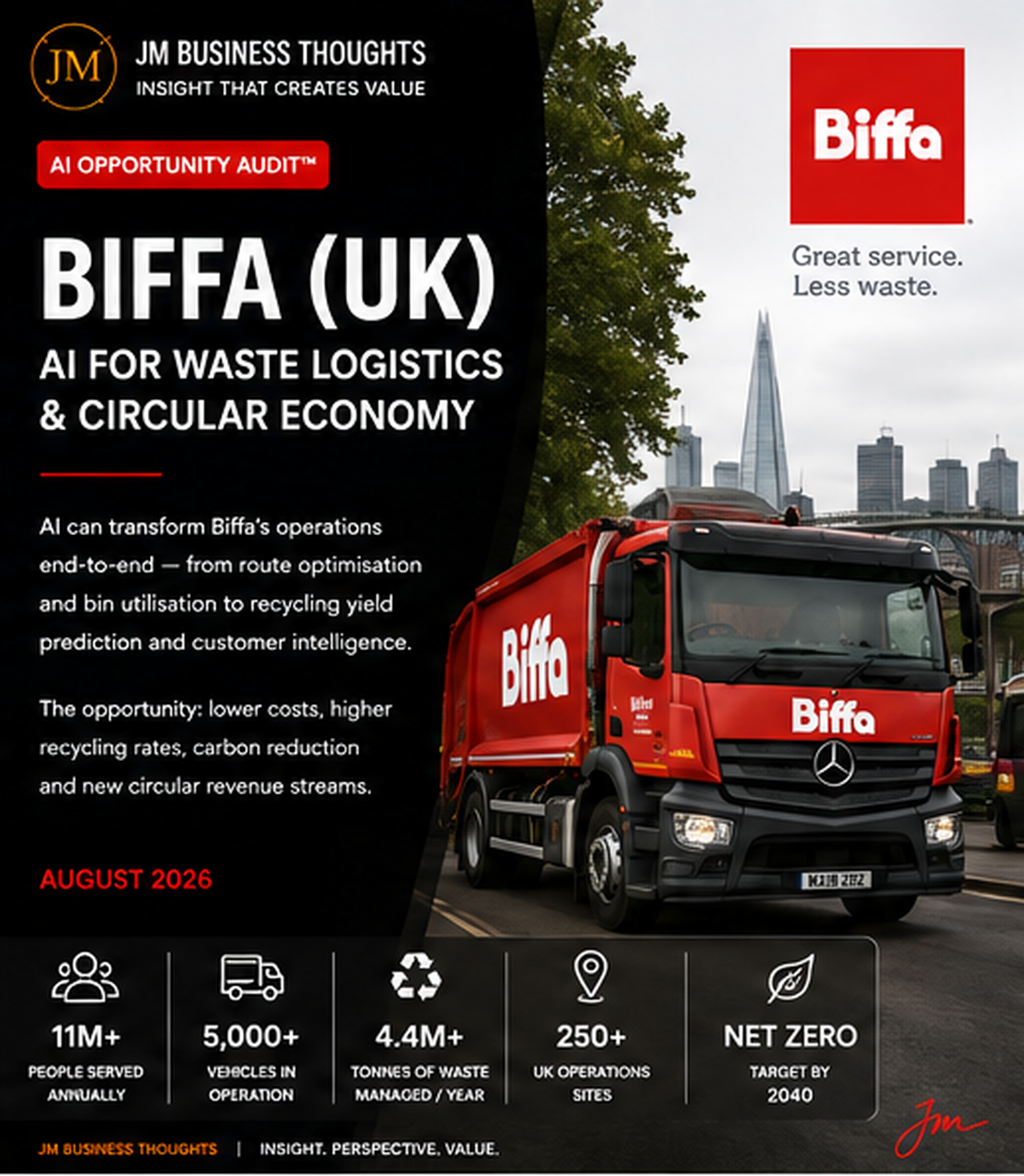
An AI Opportunity Audit™ across Biffa's UK collection, treatment and resource-recovery estate — route optimisation, container utilisation, waste and recycling forecasting, predictive maintenance, customer intelligence and carbon compliance — identifying £120M – £200M+ of annual value potential by 2030, equivalent to 8–12% EBIT uplift.
People Served Annually
11M+
Vehicles In Operation
5,000+
Waste Managed / Year
4.4M+ Tonnes
UK Operations Sites
250+
FY2024 Revenue
£1.3BN+
FY2024 Adjusted EBIT
£205M
Net Zero Target
2040
Annual AI Value By 2030
£120M – £200M+
The Thesis
Biffa is the UK's leading integrated waste management company — 11M+ people served, 5,000+ vehicles, 4.4M+ tonnes handled a year across 250+ sites. It is, functionally, one of the largest logistics networks in Britain that has never been priced as one. Its economics are decided by three variables: miles per lift, fill rate per container, and tonnes recovered as saleable material rather than disposed as cost. Each is a prediction problem. AI moves all three at once — and simultaneously converts regulatory pressure (55%+ landfill diversion achieved, 2042 zero avoidable waste target) from a compliance cost into a revenue line via commodity yield and carbon reporting. Our analysis identifies £120M – £200M+ in annual AI-driven value by 2030 against a £205M adjusted EBIT base — an 8–12% EBIT uplift achieved without a single acquisition.
Exhibit · Report Cover
35 · AI Opportunity Audit™
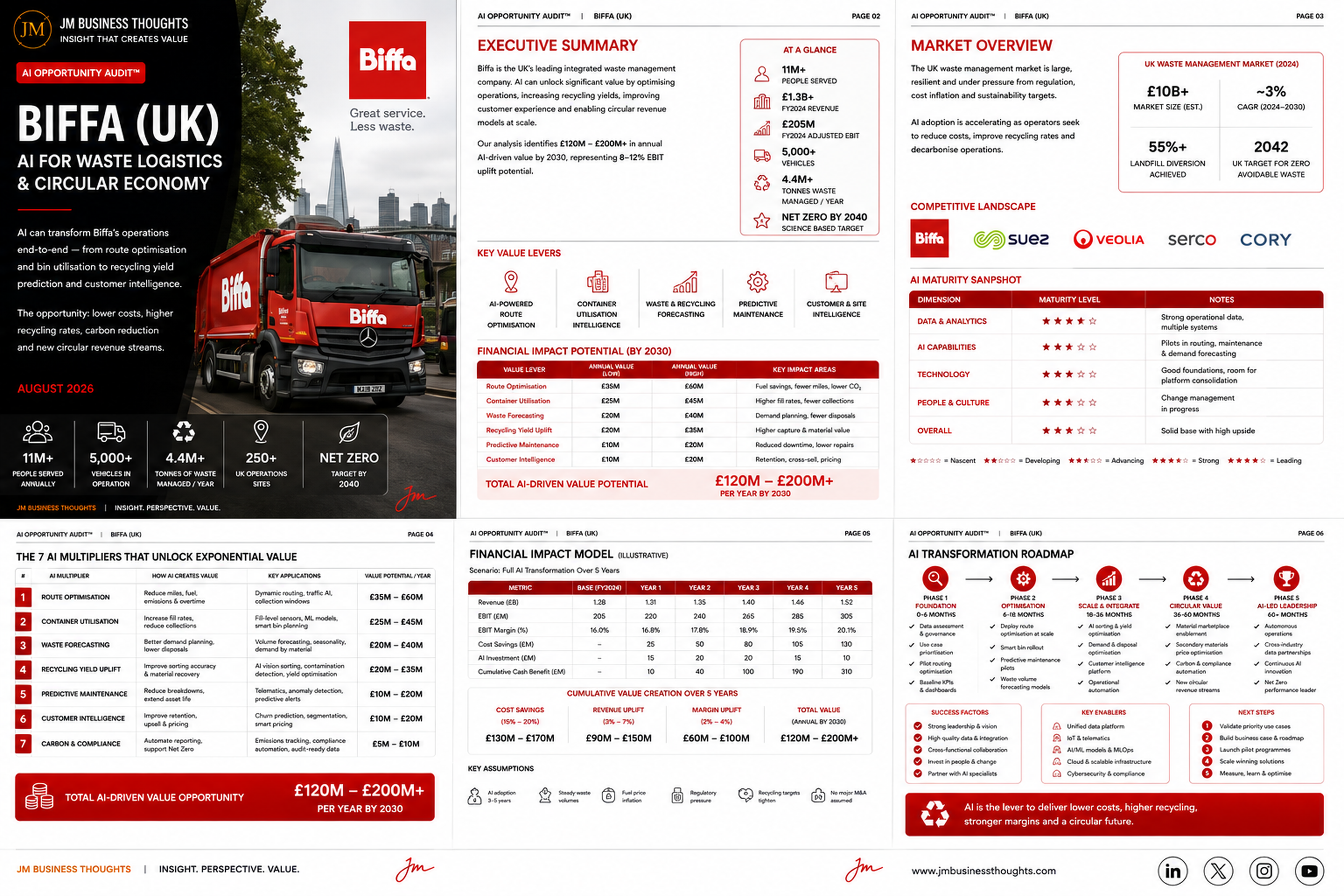
Biffa is the UK's leading integrated waste management company. AI can unlock significant value by optimising operations, increasing recycling yields, improving customer experience and enabling circular revenue models at scale.
The at-a-glance position is strong: 11M+ people served, £1.3BN+ FY2024 revenue, £205M FY2024 adjusted EBIT, 5,000+ vehicles, 4.4M+ tonnes of waste managed per year and a science-based Net Zero 2040 target.
Our analysis identifies £120M – £200M+ in annual AI-driven value by 2030, representing 8–12% EBIT uplift potential. That value is not a productivity narrative — it is six discrete P&L lines: route optimisation, container utilisation, waste forecasting, recycling yield uplift, predictive maintenance and customer intelligence, with carbon and compliance automation underneath all of them.
£120M – £200M+ per year by 2030 — 8–12% EBIT uplift on a £205M base.
The UK waste management market is large, resilient and under pressure from regulation, cost inflation and sustainability targets. Market size is estimated at £10B+ in 2024, growing at roughly 3% CAGR through 2030 — a low-growth pool in which share and margin, not market expansion, decide outcomes.
Regulation is the demand driver. 55%+ landfill diversion has already been achieved nationally, and the UK's zero avoidable waste target lands in 2042. Extended producer responsibility, Simpler Recycling and carbon disclosure are all pushing accountability down the chain to operators who can evidence what they collected, sorted and recovered.
AI adoption is accelerating as operators seek to reduce costs, improve recycling rates and decarbonise operations. The competitive set — Suez, Veolia, Serco and Cory — is running the same arithmetic. The differentiator will not be who deploys AI, but who industrialises it across a national fleet first.
£10B+ market, ~3% CAGR, 2042 zero avoidable waste target — regulation is the growth engine.
The audit scores Biffa as advancing rather than leading. Data and analytics is the strongest dimension — strong operational data across multiple systems, generated continuously by telematics, weighbridges and route execution.
AI capabilities sit mid-maturity: pilots in routing, maintenance and demand forecasting exist but have not been industrialised. Technology shows good foundations with room for platform consolidation — the single most common blocker in multi-site waste estates is that operational data is captured but never joined.
People and culture is scored as change management in progress. Overall: a solid base with high upside. The value is not blocked by model availability; it is blocked by data unification and depot-level adoption.
Waste collection economics are decided by miles per lift, fill rate per container and tonnes recovered as saleable material. Everything else — depot overhead, admin, sales cost — is second order.
Manual and semi-static route planning across a 5,000-vehicle fleet routinely produces 10–20% more miles than optimised plans for identical demand. Every excess mile carries fuel, driver hours, vehicle wear and a CO₂ charge that is now contractually relevant on municipal and corporate contracts.
Under-filled containers are the most expensive invisible cost in the industry: a lift performed on a half-full bin consumes the entire cost of the lift and earns the same revenue. Sensor-informed, demand-predicted collection windows attack this directly — and it is where operators find margin fastest.
The third leak is downstream. Material that could have been recovered but was contaminated, mis-sorted or mis-forecast moves from a revenue line to a disposal cost line. AI vision sorting and contamination detection reverse that flow.
The illustrative model runs a full AI transformation over five years from an FY2024 base. Revenue moves from £1.28BN to £1.52BN by Year 5. EBIT moves from £205M to £305M, with EBIT margin expanding from 16.0% to 20.1%.
Cost savings ramp from £25M in Year 1 to £130M in Year 5, against AI investment of £15M, £20M, £20M, £15M and £10M respectively — £80M of cumulative investment. Cumulative cash benefit reaches £310M by Year 5, with a positive net position from Year 2 onward.
Cumulative value creation over five years splits into cost savings of £130M – £170M (15–20%), revenue uplift of £90M – £150M (3–7%) and margin uplift of £60M – £100M (2–4%) — a total annual value of £120M – £200M+ by 2030.
EBIT margin 16.0% → 20.1%. Cumulative cash benefit £310M on £80M of AI investment.
The model assumes AI adoption phased over three to five years, steady waste volumes, fuel price inflation, tightening regulatory pressure and recycling targets, and no major M&A activity.
Downside risk is concentrated in three places: commodity price volatility, which moves recycling yield economics independently of operational performance; depot-level adoption, the difference between a deployed routing engine and a used one; and data unification slippage, which delays every downstream use case simultaneously.
Upside risk is distributional. In a ~3% growth market, an operator that compresses cost per lift and raises recovery yield takes contracts from peers who cannot evidence either — and wins them on carbon reporting as much as on price.
Phase 1 (0–6 months) is foundation: data assessment and governance, use case prioritisation, pilot routing optimisation, and baseline KPIs and dashboards.
Phase 2 (6–18 months) is optimisation: deploy route optimisation at scale, smart bin rollout, predictive maintenance pilots and waste volume forecasting models. Phase 3 (18–36 months) is scale and integrate: AI sorting and yield optimisation, demand and disposal optimisation, a customer intelligence platform and operational automation.
Phase 4 (36–60 months) is circular value: material marketplace enablement, secondary materials price optimisation, carbon and compliance automation and new circular revenue streams. Phase 5 (60+ months) is AI-led leadership: autonomous operations, cross-industry data partnerships, continuous AI innovation and Net Zero performance leadership.
The Multiplier Framework
Seven multipliers convert Biffa's fleet, sites and material flows into a compounding operating advantage. Each is scoped with its value potential per year and the impact areas it moves.
£35M – £60M / year
Outcome · Fuel savings, fewer miles, lower CO₂
£25M – £45M / year
Outcome · Higher fill rates, fewer collections
£20M – £40M / year
Outcome · Demand planning, fewer disposals
£20M – £35M / year
Outcome · Higher capture and material value
£10M – £20M / year
Outcome · Reduced downtime, lower repairs
£10M – £20M / year
Outcome · Retention, cross-sell, pricing
£5M – £10M / year
Outcome · Audit-ready carbon and compliance reporting
The Verdict
AI is the lever to deliver lower costs, higher recycling, stronger margins and a circular future. For Biffa that is £120M – £200M+ of annual value by 2030, four points of EBIT margin, and the option to define UK waste economics rather than absorb them.