Boots UK: AI-Powered Health, Beauty & Wellbeing At Scale. research poster
All Research

The Hidden AI Operating System Audit Series™

Where AI creates new profit pools—not just productivity.

36AI Opportunity Audit™ 18 min readAugust 2026
Coverage · United Kingdom · Institutional CoverageSector · Health & Beauty Retail · Pharmacy & WellbeingFormat · Six-page audit

Boots UKStronger Loyalty, Better Health Outcomes — And Sustainable Growth.

An AI Opportunity Audit™ across Boots' UK retail, pharmacy, healthcare services and supply chain estate — personalisation, clinical services intelligence, inventory optimisation, store automation, retail media, fraud control and ESG — identifying £250M – £450M+ of annual AI-driven value by 2030 against a £2.1BN adjusted operating profit base.

Active Advantage Card Members

11M+

Stores Across The UK

2,200+

App Downloads

20M+

FY2024 Revenue

£10.8BN+

FY2024 Adjusted Operating Profit

£2.1BN

UK Health & Beauty Market

£27BN+

Online Market Size (2024)

~£3.5BN

Annual AI Value By 2030

£250M – £450M+

The Thesis

Boots is the UK's leading health and beauty retailer — 2,200+ stores, 11M+ active Advantage Card members, 20M+ app downloads and £10.8BN+ of FY2024 revenue. That combination is rare: a national physical footprint, a clinical services licence, and one of the deepest first-party consumer datasets in Britain. Almost none of it is currently priced as a data business. Boots' economics turn on three variables — basket relevance per member, clinical throughput per pharmacy hour, and availability per square foot. All three are prediction problems, and all three compound against the same customer record. Our analysis identifies £250M – £450M+ in annual AI-driven value by 2030, delivered through seven multipliers and without a single new store.

Exhibit · Report Cover

36 · AI Opportunity Audit™

Boots UK: AI-Powered Health, Beauty & Wellbeing At Scale. report cover
Boots UK: AI-Powered Health, Beauty & Wellbeing At Scale.August 2026 · United Kingdom · Institutional Coverage
01

Executive summary: the data asset hiding inside a retailer

Boots is the UK's leading health and beauty retailer with a trusted heritage and unmatched reach. By embedding AI across customer experience, health services, operations and supply chain, Boots can unlock £250M – £450M+ in annual AI-driven value by 2030.

The at-a-glance position is strong: 11M+ active Advantage Card members, 2,200+ stores across the UK, 20M+ app downloads, £10.8BN+ FY2024 revenue and £2.1BN adjusted operating profit, underpinned by the strongest brand trust position in UK health and beauty.

This report identifies seven AI value multipliers and estimates the financial and strategic impact. The value is not a productivity narrative — it is five distinct P&L lines: revenue growth (£80M – £150M), cost optimisation (£90M – £160M), risk and fraud reduction (£40M – £80M), customer experience (£40M – £80M) and capital and balance sheet efficiency (up to £20M).

£250M – £450M+ per year by 2030 — on an £10.8BN revenue and £2.1BN operating profit base.
  • Revenue growth: £80M – £150M / year — personalisation, cross-sell, new products
  • Cost optimisation: £90M – £160M / year — automation, shrink reduction, efficiency
  • Risk & fraud reduction: £40M – £80M / year — fraud prevention, compliance, claims
  • Customer experience: £40M – £80M / year — loyalty, retention, NPS improvement
  • Capital & balance sheet: up to £20M / year — working capital, inventory turns
02

Market overview: £27BN+, resilient, and re-shaped by convenience

The UK health and beauty market is large, resilient and growing, driven by an ageing population, wellness focus and demand for convenience. Market size is estimated at £27BN+ in 2024, growing at 4–5% CAGR through 2030 — faster than general retail and materially less discretionary.

Digital adoption, value pressures and new entrants are reshaping how customers shop and engage. 70%+ of category shoppers are now multi-channel, and the online market alone is approximately £3.5BN. The customer who researches on the app and collects in store is now the default, not the exception.

The competitive landscape spans Superdrug and Holland & Barrett on specialist positioning, LloydsPharmacy on clinical services and Amazon on convenience and price transparency. AI will be the key differentiator for Boots — not to match Amazon on logistics, but to out-personalise everyone on health.

£27BN+ market, 4–5% CAGR, 70%+ multi-channel shoppers — relevance is the battleground.
  • UK health & beauty market (2024 est.): £27BN+
  • CAGR (2024–2030): 4–5%
  • Multi-channel shoppers: 70%+
  • Online market size (2024): ~£3.5BN
  • Competitive set: Superdrug, Holland & Barrett, LloydsPharmacy, Amazon
03

AI maturity snapshot: advancing, with a strong data foundation

The audit scores Boots as advancing rather than leading. Data and analytics is the strongest dimension — a strong data foundation exists through Advantage Card, but scope remains to unify and activate it across retail, pharmacy and healthcare services.

AI capabilities show pilots in key areas and building scale. The technology and data platform is mid-modernisation, with cloud and data lake work underway. Customer experience scores well: the app and loyalty programme are strong, with more personalisation still available.

Operations and supply chain remains the weakest dimension — fragmentation persists in places, which is precisely where the largest cost pool sits. People and culture shows upskilling and change management ongoing. Overall: a good foundation with high upside.

  • Data & analytics: strong foundation, scope to unify and activate
  • AI capabilities: pilots in key areas, building scale
  • Technology & data platform: modernisation underway, cloud and data lake
  • Customer experience: app and loyalty strong, more personalisation available
  • Operations & supply chain: fragmentation remains in places
04

Where the money actually leaks

In a 2,200-store health and beauty estate, three leaks dominate. The first is relevance: an 11M-member loyalty base that receives category-level rather than individual-level offers converts a fraction of what it could. Every generic promotion is a margin transfer with no incremental basket attached.

The second is availability. Fragmented forecasting across seasonal beauty, everyday health and prescription lines produces simultaneous overstock and stockout — markdown on one shelf and lost sale on the next. Working capital is trapped in the difference.

The third is clinical throughput. Pharmacy and health services are the highest-trust, highest-margin part of the estate, and they are constrained by scheduling, triage and adherence follow-up — all of which are queue-management problems that AI resolves without additional clinical headcount.

Underneath all three sits shrink, fraud and policy compliance: in a high-footfall, high-SKU, part-regulated environment, detection quality is worth tens of millions a year on its own.

  • Relevance gap: generic offers against an 11M-member first-party dataset
  • Availability gap: overstock and stockout coexisting across 2,200+ stores
  • Throughput gap: clinical capacity constrained by scheduling, not demand
  • Integrity gap: shrink, fraud and policy compliance across high-footfall estate
05

The financial impact model: base year to Year 5

The illustrative model runs a full AI transformation over five years from an FY2024 base. Revenue moves from £10.8BN to £13.2BN by Year 5, with growth stepping from 2.5% in Year 1 to 5.0% in Years 4 and 5.

Adjusted EBIT moves from £0.7BN to £1.00BN, with adjusted EBIT margin expanding from 6.5% to 7.6%. Free cash flow rises from £0.4BN to £0.7BN and ROIC improves from 10.2% to 13.6% — the return metric matters most here, because the programme is software-weighted rather than store-weighted.

Cumulative value creation over five years splits into cost savings of £130M – £220M+ (15–25%), revenue uplift of £90M – £150M+ (10–15%) and margin uplift of £60M – £100M+ (2–4%) — aggregating to the £250M – £450M+ annual run-rate by 2030.

Revenue £10.8BN → £13.2BN. Adjusted EBIT £0.7BN → £1.00BN. ROIC 10.2% → 13.6%.
  • Revenue: £10.8BN → £11.1BN → £11.5BN → £12.0BN → £12.6BN → £13.2BN
  • Adjusted EBIT: £0.70BN → £1.00BN
  • Adjusted EBIT margin: 6.5% → 7.6%
  • Free cash flow: £0.4BN → £0.7BN
  • ROIC: 10.2% → 13.6%
06

Key assumptions and execution risk

The model assumes moderate top-line growth, AI adoption over a three-to-five-year horizon, stable funding and capex, no major regulatory shock, continued brand trust and loyalty, and disciplined execution and change management.

The binding constraint is not model capability — it is data unification and colleague adoption. A personalisation engine that pharmacy teams do not trust, or an inventory model that store managers override, delivers nothing. Success depends on strong leadership and vision, data quality and integration, cross-functional collaboration, a customer-centric culture, and a measure-learn-iterate operating rhythm.

Regulatory sensitivity is real in pharmacy and health data. Every clinical use case must be built with consent, auditability and clinical governance designed in from the first pilot, not retrofitted at scale.

  • Moderate top-line growth; AI adoption across 3–5 years
  • Stable funding and capex; no major regulatory shock
  • Continued brand trust and loyalty; disciplined execution and change
  • Key enablers: modern data platform, cloud and AI infrastructure, AI/ML tools and MLOps, talent and skills at scale, partner ecosystem
07

AI transformation roadmap: five phases to 2030

Phase 1 (0–6 months) — Foundation: data foundation and governance, AI use case prioritisation, baseline KPIs and dashboards, quick wins identification.

Phase 2 (6–12 months) — Optimisation: deploy pilots and prove value, process automation at scale, AI tools for store and pharmacy colleagues, customer experience enhancements.

Phase 3 (12–24 months) — Scale and growth: AI across core journeys, advanced demand and inventory AI, retail media monetisation, health services intelligence at scale.

Phase 4 (24–36 months) — Circular value: circular economy initiatives, sustainable supply chain, ESG and carbon optimisation, data monetisation expansion.

Phase 5 (36+ months) — Intelligent leadership: autonomous operations, predictive enterprise across all functions, industry benchmark leadership, new growth platforms.

Next steps are sequential and unglamorous: validate priority use cases, build the business case and roadmap, launch pilot programmes, scale and industrialise, then measure and embed.
AI is the lever to deliver healthier lives, delight customers and drive sustainable growth.

The Multiplier Framework

7 compounding levers

Seven AI multipliers, each with a defined mechanism, application set and annual value range — aggregating to £250M – £450M+ of AI-driven value per year by 2030.

01

Personalised Health & Beauty Experiences

Deliver hyper-personalised offers, advice and content across 11M+ Advantage Card members.

  • Next-best-action engine across app, email and till
  • AI beauty and skincare concierge
  • Personalised health and wellbeing routines

Outcome · £60M – £100M per year

02

Health Services Intelligence

Improve clinical outcomes and adherence across pharmacy and healthcare services.

  • Symptom checker and digital triage
  • Adherence nudges and repeat-prescription recall
  • Clinical capacity and appointment optimisation

Outcome · £40M – £80M per year

03

Supply Chain & Inventory Optimisation

Reduce stockouts and waste while improving availability across 2,200+ stores.

  • Demand forecasting by store and category
  • Automated replenishment and allocation
  • Seasonal beauty and health demand modelling

Outcome · £50M – £100M per year

04

Store Operations Automation

Improve colleague productivity and customer service across the estate.

  • Task automation and workforce scheduling
  • Queue management and footfall prediction
  • Colleague AI assistant for product and policy queries

Outcome · £40M – £70M per year

05

Data & Insights Monetisation

Unlock new revenue from first-party data and media inventory.

  • Retail media network build-out
  • Category insights sold to brand partners
  • Closed-loop measurement for suppliers

Outcome · £30M – £60M per year

06

Risk, Fraud & Compliance Intelligence

Reduce shrink, fraud and compliance risk across a high-footfall, part-regulated estate.

  • Real-time fraud and shrink detection
  • Age verification and restricted-product controls
  • Automated policy monitoring and audit trails

Outcome · £30M – £60M per year

07

Sustainability & ESG Optimisation

Lower carbon, energy and waste while evidencing progress to customers and regulators.

  • Route optimisation across distribution
  • Energy AI across stores and depots
  • Packaging and waste reduction modelling

Outcome · £20M – £30M per year

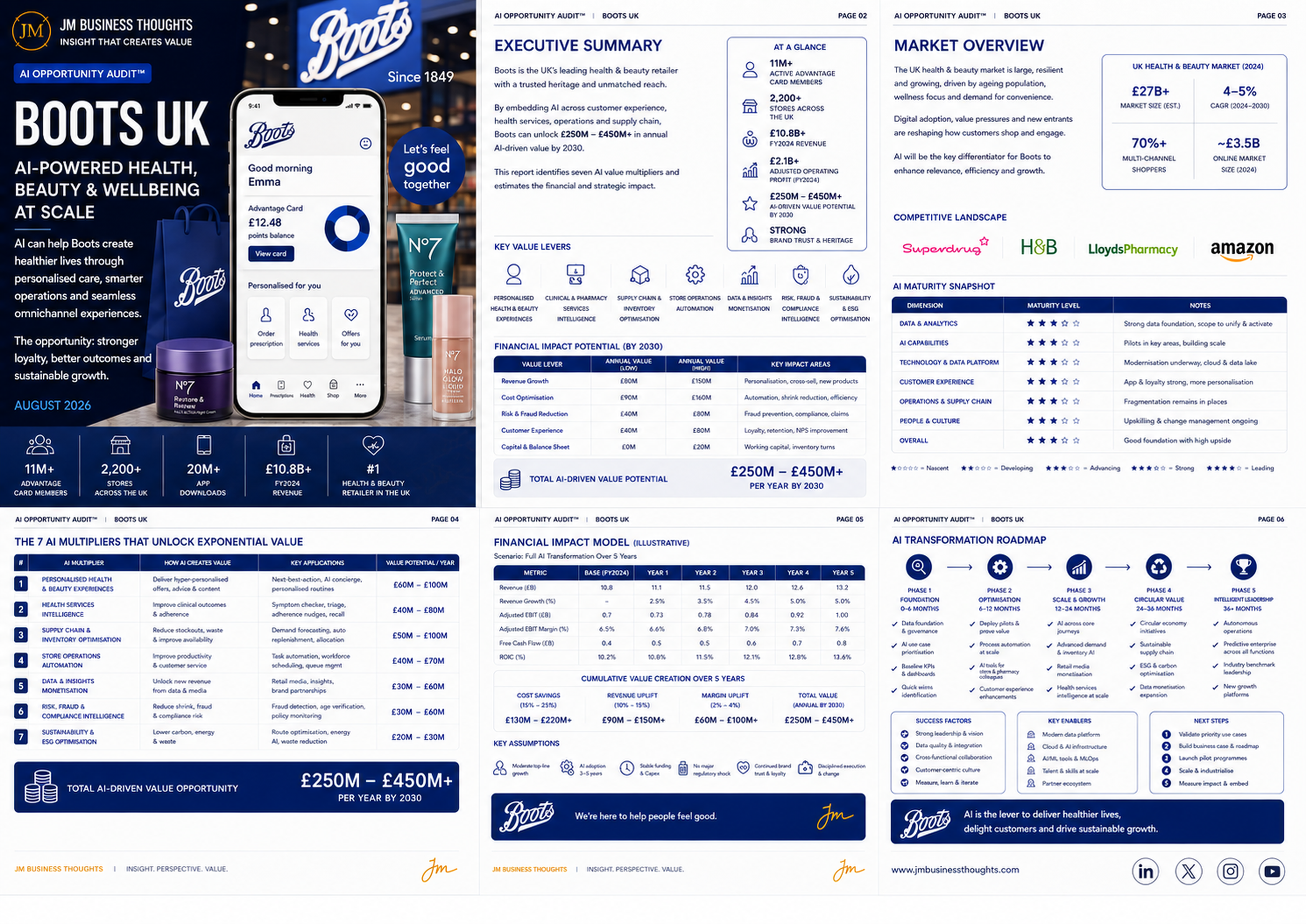
Boots UK: AI-Powered Health, Beauty & Wellbeing At Scale. full strategic breakdown
Boots UK — AI Opportunity Audit™: executive summary, market overview, AI maturity snapshot, the seven multipliers, five-year financial impact model and transformation roadmap.

The Verdict

Boots does not need a new strategy — it needs its existing assets priced correctly. A trusted national brand, 2,200+ stores, 11M+ identified customers and a clinical licence is a combination none of its competitors can assemble. AI converts that from a heritage position into a compounding one: £250M – £450M+ of annual value by 2030, a 7.6% adjusted EBIT margin and a 13.6% ROIC. The risk is not that the technology fails. It is that a retailer sitting on one of Britain's best first-party health datasets keeps running it as a coupon programme.

JM founder signature
68 · PureGym — Fitness At Scale. More Personal. More Inclusive.67 · SIXT — Smarter Mobility. Greater Availability. A More Connected Tomorrow.66 · Sendwave — Money That Moves With Intelligence.65 · McDonald’s — Serving The Future With AI.64 · Compare the Market — Smarter Comparison. Better Matches. Brighter Tomorrows.63 · WeBuyAnyCar — Smarter Pricing. Faster Offers. Better Conversion.62 · Primark — Affordable Fashion. Greater Possibilities With AI.61 · Starbucks — Smarter Stores. Stronger Loyalty. Better Margins.60 · IKEA — AI-Powered Home Retail at Global Scale59 · H&M — Smarter Fashion. Brighter Tomorrow.58 · WeWork — The Value Wasn't Lost. It Was Mispriced.57 · Yahoo — The Value Wasn't Lost. It Was Mispriced.56 · Nando's UK — Smarter Restaurants. Stronger Loyalty. Better Margins.55 · The Amplifier54 · The Body Shop53 · Arcadia Group52 · Cazoo51 · Blockbuster50 · Carpetright49 · Wilko48 · Mothercare47 · Phones 4u46 · Farfetch45 · Jumia44 · Toys ‘R’ Us43 · The Collateral Gap — Part One41 · The Amplifier40 · Africa Bee Farming39 · Kenya Airways38 · Africa Greenhouse Farming37 · Uganda Tourism Board34 · NatWest33 · Skip Hire Companies UK33 · The Audit32 · The Lean Company31 · Africa Mushroom Farming29 · The Rider Economy Nobody Verified28 · The Layer Underneath the Layer27 · Independent Timber Yards & Jewson Timber26 · Link Up TV & GRM Daily25 · East African Portland Cement42 · International Student Credential & Financial Verification — Part One24 · The Supply Chain Inside the Supply Chain23 · The White Space, Mapped22 · The Real Opportunity21 · Greencore20 · West Ham United19 · Roofings Group Uganda18 · Mombasa Port17 · Auto Trader UK16 · Uganda Coffee Development Authority15 · Brookside Dairy14 · GraceKennedy13 · Rightmove12 · Manchester United11 · Greggs30 · Twiga Foods10 · Uchumi09 · Konga08 · Edcon09 · GAME07 · Debenhams06 · Claire's05 · Boohoo04 · Argos